

The inner life
Übermensch
Direct answer
Übermensch: The Übermensch, or overman, is Friedrich Nietzsche's image of a higher kind of human being who overcomes himself and creates his own values after the old ones have lost their hold.
$0 today, then $19/month after 7 days. Cancel anytime.
At a glance
- Also called
- overman, superman nietzsche, nietzsche ubermensch, the overman
- Found in
- Consciousness & Spiritual Psychology
- Related
- Will to Power, Machiavellianism, Virtù and Fortuna, Charismatic Authority
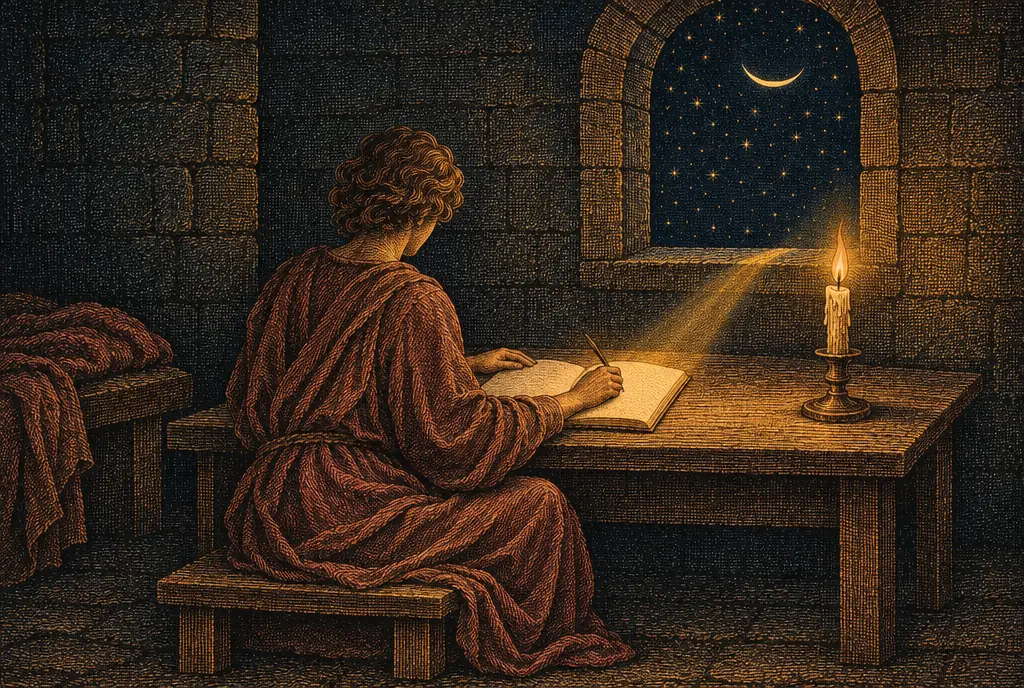
The Übermensch, or overman, is Friedrich Nietzsche's image of a higher kind of human being who overcomes himself and creates his own values after the old ones have lost their hold.
A plain educational schematic; it does not diagnose a condition or replace professional care.
Understand the chapter you are in.
Your life’s turning points, measured from your birth.
Walk through Alex’s whole example first


Prefer to explore first?
 The Road of AgesThe turning points of your whole life, from your own chart
Walk my road
What does Übermensch mean?
Nietzsche's Zarathustra comes down from his mountain to teach that man is something to be overcome: a rope stretched between animal and overman. The overman is offered as a goal for a time when belief in God and in a moral order given from outside is failing. In place of comfort and conformity, which Nietzsche personifies in the last man, he sets a being who says yes to life as it is, masters his own impulses and gives his existence a meaning of his own making.
The figure is sketched, never defined, and it is not a biological type, a race or a ruler over others. The self-overcoming it demands is directed first at oneself. Nietzsche despised German nationalism and antisemitism, yet after his death the word was bent to both; the reading that makes the overman a master race is a distortion of the text.
On the tree of the hidden arts: Power and influence.
What sets Übermensch apart
The overman is defined mostly by contrast, and the contrast is not with the weak but with the comfortable. His opposite in Zarathustra is the last man, who has invented happiness, takes no risks and blinks. The crowd in the marketplace, hearing both described, asks to be given the last man. A second defining test comes later in the book: the thought of eternal recurrence, whether one could wish one's life to return exactly as it was, endlessly. The overman is whoever could hear that thought and welcome it.
- Source: Thus Spoke Zarathustra, 1883 to 1885
- Key image: man as a rope between animal and overman, over an abyss
- Opposite figure: the last man, who seeks only comfort
- Earlier appearance: Goethe's Faust, Part One
- English renderings: superman (Shaw, 1903); overman (Kaufmann)
- Test: the thought of eternal recurrence
Often mistaken for something else: The will to power is the drive Nietzsche saw in all living things; the Übermensch is the rare outcome he hoped for when that drive is turned on oneself.
The story behind Übermensch
The word is older than Nietzsche and occurs in Goethe's Faust. Nietzsche made it his own in Thus Spoke Zarathustra, published in parts from 1883 to 1885. His sister Elisabeth Förster-Nietzsche controlled his papers after his collapse in 1889 and aligned his name with nationalist causes, and National Socialist writers later appropriated his vocabulary. George Bernard Shaw rendered the word as superman in 1903; Walter Kaufmann, writing from 1950, preferred overman.
Why Übermensch matters
Übermensch is the aim that Nietzsche's will to power serves, and it shows that his idea of power is mastery of the self first.
How to read Übermensch
Readers of philosophy take it as a measure of self-overcoming; in loose speech it is misapplied to any person imagined as superior to others.
Übermensch in practice: an example
A reader who resolves to stop blaming circumstance and to shape one hard habit is nearer Nietzsche's meaning than any picture of a conqueror.
Where readings of Übermensch go wrong
Übermensch gives no ground for ranking peoples or persons, and its adoption by the Nazis contradicted Nietzsche's own stated views.
Sources and editorial method
This entry summarizes the tradition in the Almanac's own words; where no source is listed, it is an editorial summary rather than a primary text, and symbolic readings are named as the tradition's, not as fact.
- Source
- The Great Almanac Dictionary
- Category
- Consciousness & Spiritual Psychology
- Aliases
- ubermensch meaning, overman, superman nietzsche, nietzsche ubermensch, the overman
- Last updated
- 2026-09-26
See Übermensch in your personal almanac
A definition tells you what it is; your own birth chart tells you what it means for you. The Oracle casts your real chart and answers for your love, your work, and your year ahead, in conversation. It opens with the 7-day Oracle trial.
Speak with the OracleRelated terms
More in Consciousness & Spiritual Psychology
- The Art of War
- Cold Reading
- Ego Death
- Hot Reading
- Lucid Dreaming
- Positive Thinking
- Samatha
- Spiritual Awakening
From the reference page to your own chart
Every word here
is in your own chart.
- Your life’s turning points, measured from your birth
- A practical next step to consider
- It opens with 7 days free: the AI Oracle on thirty hidden arts, and your daily horoscope
$0 today, then $19/month after 7 days. Cancel anytime.
Common questions
What does Übermensch mean?
Literally over-human. It is Nietzsche's name for a future kind of person who has overcome the ordinary human condition, affirms life fully and creates values instead of receiving them.
Is the Übermensch the same as Superman?
Superman is an early English translation, popularised by Shaw in 1903, and the comic-book hero took the name later. Many translators now prefer overman, because super suggests greater strength where Nietzsche meant going beyond.
Did Nietzsche support the Nazis?
He died in 1900, decades before the party existed, and he wrote scornfully of antisemites and of German nationalism. His sister edited his legacy in a nationalist spirit, and Nazi authors then quoted him selectively.


