
William Blake
1757 to 1827
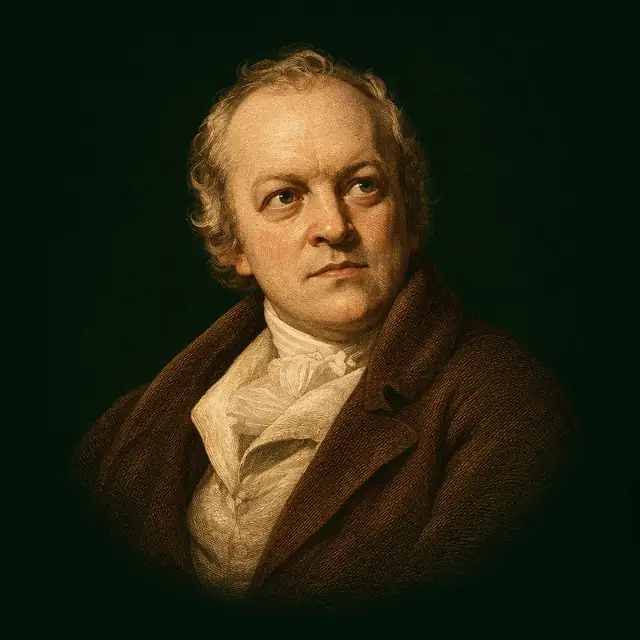
Who was William Blake, and what is truly known of them?
What is known
English poet, painter and engraver, born in London, where he spent all but three years of his life. Apprenticed to the engraver James Basire in 1772, he devised a way of etching words and pictures together in relief, and printed and coloured his own books: Songs of Innocence (1789), The Marriage of Heaven and Hell (about 1790) and Jerusalem (1804 to about 1820). He said that he saw and talked with angels and the dead from childhood. In April 1789 he and his wife Catherine signed the register of the first conference of the Swedenborgian New Church; within a year he was mocking Swedenborg in print. He named Paracelsus and Böhme among the writers who had formed him. Tried for sedition in 1804, he was acquitted. He died in 1827.
The teaching
Taught from his own illuminated books, above all The Marriage of Heaven and Hell, Milton and Jerusalem.
Contraries
Blake's teaching begins with a law of the soul: without contraries is no progression. Attraction and repulsion, reason and energy, love and hate are all necessary to human existence, and from these contraries spring what the religious call good and evil. Good, in their language, is the passive that obeys reason; evil is the active springing from energy. Blake does not ask which of the pair should win. A life, a nation and a faith grow by the strife of both, and to destroy either is to stop growing.
The errors of the Bibles
The Voice of the Devil in The Marriage of Heaven and Hell names three errors that all Bibles and sacred codes have taught: that a human being has two real principles, a body and a soul; that energy, called evil, is only from the body, and reason, called good, only from the soul; and that God will torment people in eternity for following their energies. Against them it sets three truths. A human being has no body distinct from the soul, for what is called the body is the portion of soul discerned by the five senses, the chief inlets of soul in this age. Energy is the only life and is from the body, and reason is the bound or outward circumference of energy. And energy is eternal delight.
The doors of perception
If the doors of perception were cleansed, Blake writes, everything would appear to man as it is, infinite; for man has closed himself up, till he sees all things through narrow chinks of his cavern. The work of art and of prophecy is to open them. He likens it to his own way of printing, which bites the copper with acids, melting apparent surfaces away and displaying the infinite that was hidden, and he calls it printing in the infernal method, by corrosives, which in hell are salutary and medicinal.
Proverbs of Hell
In the same book he gathers the wisdom of energy into proverbs. The road of excess leads to the palace of wisdom. The cistern contains; the fountain overflows. Exuberance is beauty. The tigers of wrath are wiser than the horses of instruction. Eternity is in love with the productions of time. What is now proved was once only imagined. Drive your cart and your plough over the bones of the dead. Prudence, the narrow kind, he mocks as a rich, ugly old maid courted by incapacity. The proverbs are not rules of conduct but blows against a timid morality, meant to wake the reader's own energy.
Innocence and experience
The Songs of Innocence and of Experience show, as their title page says, the two contrary states of the human soul. In Innocence the child asks the lamb who made it, and answers: he who calls himself a lamb. In Experience the speaker stands before the tiger burning bright in the forests of the night and asks what immortal hand or eye could frame its fearful symmetry, and whether he who made the lamb made it too. Many songs come in pairs, the chimney sweeper, the nurse, Holy Thursday: the same scene seen with trust, and seen with knowledge of the world's cruelty.
Neither state is the whole truth. Innocence without knowledge is helpless and easily used; experience without vision hardens into fear and law. Blake's hope is a third state beyond both, an innocence that has passed through experience and keeps its eyes open, for innocence, he noted, dwells with wisdom, but never with ignorance.
Imagination, the divine body
Imagination, for Blake, is not fancy but the real and eternal world, of which this vegetable world is a faint shadow. The eternal body of man, he writes, is the imagination, that is God himself, the divine body, Jesus, and we are his members. To see by it is to see a world in a grain of sand and a heaven in a wild flower, to hold infinity in the palm of your hand and eternity in an hour. He speaks of fourfold vision, the sight of the soul at its height, and prays to be kept from single vision and Newton's sleep: the eye that sees only what can be measured, and so sees a dead world.
The four mighty ones
In the long prophecies Blake gives this teaching as a myth. Albion, the eternal man, who is both England and all humankind, holds four mighty ones within him: Urizen, reason, who measures and makes laws; Luvah, love and passion; Tharmas, the body and its senses; and Urthona, the imagination, whose working form in time is Los, the smith and poet. When they quarrel and each seeks to rule, Albion falls into a deadly sleep, and the world of rigid law, war and fear is that sleep. Los labours at his furnaces through the ages, building Golgonooza, the city of art, and giving a body to falsehood so that it may be cast off for ever.
Los speaks Blake's own vow: I must create a system, or be enslaved by another man's; I will not reason and compare, my business is to create.
Mental fight and forgiveness
The war Blake calls for is mental fight. In the preface to Milton he asks for his bow of burning gold and his arrows of desire, and vows not to cease from mental fight, nor let his sword sleep in his hand, till Jerusalem is built in England's green and pleasant land. The enemy is the Selfhood, the part of a person that accuses others and justifies itself, and in Milton the poet goes down into death to annihilate his own. The heart of Christianity, as Jerusalem teaches it, is the forgiveness of sins: mutual forgiveness of each vice, he writes, such are the gates of Paradise.
Against the angels of Swedenborg
Blake had read Swedenborg closely, and his answer belongs to the teaching. Swedenborg, he writes, conversed with angels, who are all religious, and not with devils, who all hate religion, and so he wrote no new truth, only the old falsehoods. Any man of mechanical talents, he adds, could make ten thousand volumes as good from the writings of Paracelsus or Jakob Böhme. Truth, for Blake, is found by marrying heaven to hell, reason to energy, not by taking the angels' side.
Orders and memberships
None is documented beyond his signing at the New Church conference of 1789, and he did not stay. No lodge record names the poet as a Freemason.
The legend
That he was Chosen Chief of a Druid order from 1799 to 1827: the list that says so was drawn up in the twentieth century and has no record behind it. That he was mad: friends who knew him well found him sane and courteous, and he spoke of his visions as things seen with the imagination.
Their works
- Songs of Innocence and of ExperienceBook, 1789 and 1794
His short poems etched in relief with their pictures, printed and coloured by himself and his wife Catherine. The Lamb and The Tyger stand as the two contrary states of the human soul. Few copies were made in his lifetime, and it is his best known work.
Ask the Oracle about it - The Marriage of Heaven and HellBook, about 1790
A prose book of visions and proverbs, mocking Swedenborg, whose church he had briefly joined, and turning heaven and hell upside down: energy is eternal delight. He named Paracelsus and Böhme here as the writers he preferred.
Ask the Oracle about it - MiltonPoem, about 1804 to 1811
A long poem in which the poet John Milton returns from eternity and enters Blake’s foot to set right his errors. Its preface holds the verses later set to music as the hymn Jerusalem.
Ask the Oracle about it - JerusalemPoem, 1804 to about 1820
His longest illuminated book, in a hundred plates, on the fall and waking of Albion, the giant who is both England and all humankind. It sets out his private mythology of Los, the spirit of imagination, at its fullest.
Ask the Oracle about it - Illustrations of the Book of JobEngraving, 1826
Twenty-one engravings made in his last years for his friend John Linnell, following Job through his trials to his restoration. They are often counted among the finest engravings made in England.
Ask the Oracle about it - Visionary HeadsDrawings, about 1819 to 1825
Pencil portraits of the dead and of spirits drawn at night for his friend John Varley, an astrologer, who wrote the sitters’ names beside them. Among them is the Ghost of a Flea. They show his visions as he described them, things seen with the imagination.
Ask the Oracle about it
How the house tells a life
This life is told from the record, with what is documented, what is legend and what was forged kept apart. A membership in an order is stated only where documents show it. A person’s chart explains none of their deeds.
The arts it feeds
Lives near it in time
Thinkers and teachers
Thomas PaineAugustin BarruelCharles-François DupuisLouis-Claude de Saint-MartinJohann Wolfgang von GoetheWolfgang Amadeus MozartGodfrey HigginsRobert TaylorPhineas QuimbyRalph Waldo EmersonGiuseppe MazziniGerald MasseyThe whole tree

