
Augustin Barruel
1741 to 1820
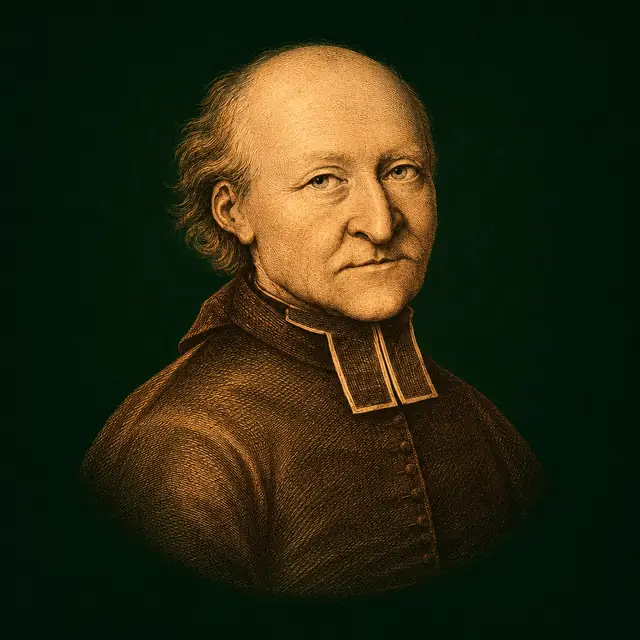
Who was Augustin Barruel, and what is truly known of them?
What is known
French Jesuit priest and writer. He entered the Society of Jesus in 1756, lived abroad after it was banned in France, and fled to England in 1792 after the September massacres. There he published the four volumes of his Memoirs Illustrating the History of Jacobinism in 1797 and 1798. It claimed that the French Revolution was no accident but the work of a long conspiracy of philosophers, Freemasons and the Bavarian Illuminati. The Scottish professor John Robison printed a like book in 1797. Historians do not accept the thesis: the Illuminati had been broken up ten years before, and no such direction has been shown. The book became the pattern for later theories of a hidden hand. He died in Paris in 1820.
The teaching
Taught from his Memoirs Illustrating the History of Jacobinism (1797 and 1798).
A plot in three parts
Barruel's claim is that nothing in the French Revolution happened by chance. Its crimes, the overthrow of altar and throne, the massacres and the killing of the king, were in his account the work of a conspiracy planned long before, and his four volumes set it out in three parts and a sequel. The first is a plot of the philosophers against Christianity; the second, a plot of the same philosophers, joined with the higher lodges of Freemasonry, against kings; the third, a plot of the Illuminati, joined with both, against every government, all property and all society. The fourth volume tells how the three came together in the Jacobin club and made the Revolution.
It is taught here as the claim it is. The thesis does not hold, for reasons given at the end.
The philosophers
The first conspirators, as Barruel tells it, are Voltaire, d'Alembert and Diderot, with their royal friend Frederick of Prussia. He builds his case on their letters, above all on Voltaire's watchword, crush the infamous thing, which he reads as a pact to destroy the Christian religion itself. The Encyclopaedia, the academies, the salons, the cheap tracts sent out among the people and the placing of friends in the chairs of learning are for him the means of a single campaign, steered by a few men who knew its aim while the many who served it did not.
The lodges
Barruel holds that most Freemasons are honest men who know nothing of the plot. The first degrees of the craft, he says, are harmless, their oaths and emblems a game. The secret lies higher, in the advanced grades, where the Mason learns at last that liberty and equality are the true meaning of the craft: that all men are equal and free, and that kings and priests have usurped their rights. In the grade of Knight Kadosh he finds a vow to avenge the murdered master, which he reads as the Templars' old vengeance on the king and pope who destroyed them, turned now against every throne and altar.
The Illuminati, as he read them
His third volume rests on the papers of Adam Weishaupt's order, seized and printed by the Bavarian government. He reads the order's furthest grades as a plan to abolish property, nations and religion, and its secrecy, its classical code names and its reports passed upward to unknown superiors as the machinery of a society able to act unseen and to outlive its own suppression. The order as its own papers show it, its aims, names and grades, is taught in the branch on the Templars and Illuminati, among the orders and mystery schools.
The plain facts
The record answers the claim at each point. The Bavarian Illuminati were banned in 1784 and 1785 and their leaders scattered, and nothing shows that they lived on or steered anything in France. Freemasons stood on every side of the Revolution, nobles and priests among them, and many were imprisoned or went to the guillotine. The philosophers' letters show a hatred of the Church's power, not a plan for a revolution that most of them did not live to see.
In 1801 Jean Joseph Mounier, who had sat in the revolutionary assembly himself, answered Barruel in a book on the influence attributed to the philosophers, the Freemasons and the Illuminati, and set out how the Revolution grew instead from the debts of the crown, the conduct of the court and the quarrels of the orders of the realm.
The shape of the claim
Against its intention, the book teaches how such a claim is built, and its pattern returns in every later theory of a hidden hand. Likeness is read as link, so that men who shared ideas are made to share a plan. Sequence is read as design, so that whatever came after was meant by what came before. The innocent majority are called dupes, so that their innocence proves nothing, and the lack of evidence is taken as proof of secrecy, so that nothing could ever show the claim false.
The answer to the whole pattern is the method of the branch on testing a claim, among Conspiracies, examined: ask who said it first, what would disprove it, and who has checked.
Orders and memberships
A Jesuit, documented, from 1756 until the Society was suppressed, and again after its restoration. He wrote that he had once been admitted to a Masonic lodge in Paris without taking its oath; that rests on his word.
The legend
That the Revolution was planned in the lodges and steered by the Illuminati. That is his own thesis and it does not hold: lodge members stood on every side of the Revolution, and many of them went to the guillotine.
What was forged, or is false
A letter of 1806 signed “Simonini”, sent to him from Florence, which added the Jews to the plot. He did not print it. It was published long after his death and fed the antisemitic lie of a hidden Jewish hand; its writer has never been identified, and what it says is false.
Their works
- Memoirs Illustrating the History of JacobinismBook, 1797 to 1798
Four volumes printed in London, in French and at once in English, arguing that the French Revolution was the work of a long plot of philosophers, Freemasons and the Bavarian Illuminati. Historians do not accept it: the Illuminati had been broken up ten years before, and lodge members stood on every side. It became the pattern for later theories of a hidden hand.
Ask the Oracle about it - Les HelviennesLetters, 1781 to 1788
A series of letters attacking the philosophers of the Enlightenment, Voltaire and the Encyclopaedists among them, as enemies of faith and order. Written while he lived in France as a former Jesuit, it shows the case he would later turn into a history of conspiracy.
Ask the Oracle about it - History of the Clergy during the French RevolutionBook, 1793
Printed in London soon after his flight, an account of the priests who refused the oath to the new constitution and of those killed in the September massacres of 1792. It was quickly put into English and read widely among the émigrés and their English hosts.
Ask the Oracle about it
How the house tells a life
This life is told from the record, with what is documented, what is legend and what was forged kept apart. A membership in an order is stated only where documents show it. A person’s chart explains none of their deeds.
The arts it feeds
Lives near it in time
Thinkers and teachers
Robert BoyleEmanuel SwedenborgThe Baal Shem TovBenjamin FranklinGeorge WashingtonThomas PaineCharles-François DupuisLouis-Claude de Saint-MartinJohann Wolfgang von GoetheWolfgang Amadeus MozartWilliam BlakeGodfrey HigginsThe whole tree

