
Charles-François Dupuis
1742 to 1809
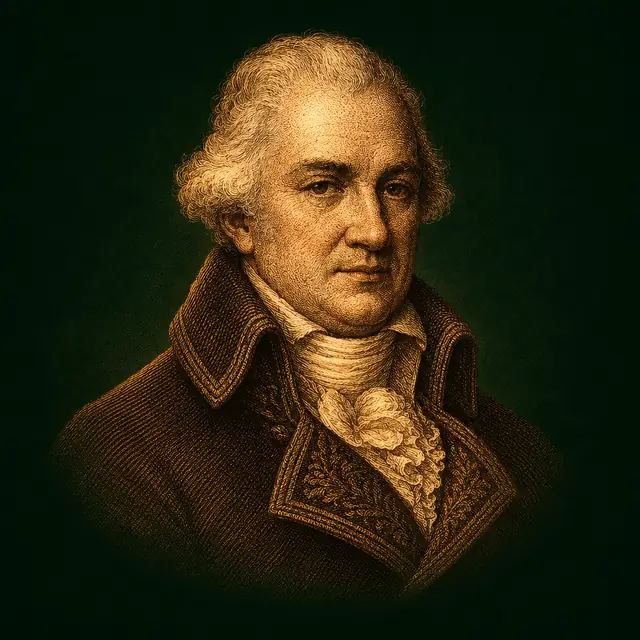
Who was Charles-François Dupuis, and what is truly known of them?
What is known
French scholar and politician, born at Trie-Château. A pupil of the astronomer Lalande, he taught rhetoric in Paris, held the chair of Latin eloquence at the Collège de France from 1787 and sat in the Convention from 1792, where he voted against the death of the king. His Origine de tous les cultes, printed in 1795 with a shorter version in 1798, argued that every religion, Christianity among them, grew from the worship of the Sun and the stars, and that the labours of Hercules and the life of Christ alike retell the Sun’s yearly course through the zodiac. He set the birth of the zodiac in Egypt many thousands of years back. He died in 1809.
The teaching
Taught from his own books, above all the Origine de tous les cultes (1795) and its abridgement of 1798.
The key, and where it is taught
Dupuis teaches that all religion is the worship of nature, above all of the Sun, and that its gods and heroes are the lights of the sky and the seasons of the year made into persons. The Sun is born at the winter solstice, triumphs at the spring equinox, weakens in autumn and dies into winter, and every hero who labours, suffers, dies and returns is the same Sun. That reading, from the virgin of the midnight sky to the Lamb of Easter, is taught in full in the branch on what astrotheology claims, among The sky in the scriptures, for it is his school. What follows is his own: how he came to the key, what he took the first god to be, and how he read the faiths of two principles, the mysteries and the last book of the Bible.
A farmer's calendar in the sky
His first discovery, as he saw it, came from the figures of the zodiac. They are not arbitrary, he argues, but pictures of what happens on earth while the Sun stands in each sign: a farmer's calendar drawn in the sky by the people who first named the stars. Read in that way they fit the year of the Nile on one condition only, that the Balance, the sign of equal day and night, stood at the spring equinox. Then the Water Bearer pours in the months of the flood, and the Virgin holds her ear of wheat at the harvest.
Since the slow turning of the sky carries the equinox back through one sign in about two thousand years, he concludes that the zodiac was invented in Egypt many thousands of years ago, and that its people were the first teachers of mankind. The plain fact is that the twelve signs as we know them took shape in Babylonia, in the centuries before Christ.
The world is God
Beneath the solar fables lies his real theology. The first god of mankind, he holds, was the universe itself, the great whole, living, eternal and moved by its own soul, and the Sun is that soul's most visible seat, the eye and heart of the world. The first peoples divided the whole into two causes: an active cause, the sky with its fire and light, which they made male and called father, and a passive cause, the earth and its waters, which they made female and called mother, from whose union every living thing is born. All later gods are those two causes and their parts, given names, faces and stories.
Light and darkness
From the same sky comes the war of good and evil. The equinoxes cut the year in two: a half of long days, when light rules and the earth bears fruit, and a half of long nights, when darkness rules and nature dies. The Persians made the two halves into two principles, Ormuzd, the god of light, and Ahriman, the god of darkness, and every faith that sets a good power against an evil one, a god against a devil or a saviour against a serpent, is telling, in Dupuis's reading, the contest of summer and winter, with the serpent and the Scorpion as the autumn signs of the dark.
The mysteries
The ancient mysteries were for him schools in which this astronomy was taught as a drama, and in which the fate of the soul was joined to the course of the stars. The soul, in the teaching he gathers from the Platonists, comes down from the sky through the spheres of the planets, taking something from each, and after death climbs back the same way to the fixed stars. The initiate who saw the god die and rise in the rites of Mithras, of Isis or of Eleusis saw at once the Sun's year and the soul's own journey, and was promised a happy return.
The book of Revelation
Dupuis gives the last book of the Christian Bible a long reading of its own. The Apocalypse, he argues, is a book of the mysteries of the Sun written in the language of the sky. Its Lamb is the Ram of the spring equinox; its four living creatures, the lion, the calf, the face of a man and the eagle, are the four signs that stood at the four corners of the year; its seven spirits and seven seals are the seven planets; its twelve gates and twelve foundations are the twelve signs; and its new Jerusalem, coming down out of heaven foursquare and full of light, is the sky itself renewed at the end of a great cycle.
His aim
Dupuis wrote to free his readers, as he saw it, from the quarrels and fears of the churches, by showing them that every creed is the same first worship of nature in different dress. His own creed is the one he found at the root: the universe itself is the god, and the reverence owed to it is reverence for its order and its laws. The reader holds his key as his reading, not as the history of any faith.
Orders and memberships
He is often named as a member of the Paris Lodge of the Nine Sisters, which his teacher Lalande founded; the claim rests on later lists, and the house has not seen a lodge record. No other order is documented.
The legend
That he proved the Gospels to be sun myth. He argued from likenesses, and historians and biblical scholars do not accept it. His great age for the zodiac fell in the 1820s, when Champollion showed the zodiac ceiling of Dendera, brought to Paris as proof, to be of Greek and Roman times. Later writers of astrotheology, Robert Taylor, Godfrey Higgins and Gerald Massey among them, built on him.
Their works
- Origine de tous les cultesBook, 1795
His great work, in several volumes with an atlas of plates, arguing that every religion, Christianity among them, grew from the worship of the Sun and the stars. He read the labours of Hercules and the life of Christ alike as the Sun’s yearly course through the zodiac. Scholars do not accept it, and later writers of astrotheology built on it.
Ask the Oracle about it - Abrégé de l’origine de tous les cultesBook, 1798
His own shortened version of the great work, in one volume. It was this abridgement that was reprinted and translated through the nineteenth century, and through it his reading of religion as star worship reached Robert Taylor, Godfrey Higgins and Gerald Massey.
Ask the Oracle about it - Mémoire sur l’origine des constellationsTreatise, 1781
His first statement of the thesis, written as a pupil of the astronomer Lalande, explaining the figures of the constellations and the old myths by the farming year of an ancient people. Here he first set the birth of the zodiac in Egypt many thousands of years back.
Ask the Oracle about it - Mémoire explicatif du zodiaque chronologique et mythologiqueTreatise, 1806
A late work on the zodiacs of Egypt, written as the carved zodiac of Dendera became known in France. He took it as proof of the great age he claimed; in the 1820s Champollion showed the Dendera zodiac to be of Greek and Roman times.
Ask the Oracle about it
How the house tells a life
This life is told from the record, with what is documented, what is legend and what was forged kept apart. A membership in an order is stated only where documents show it. A person’s chart explains none of their deeds.
The arts it feeds
Lives near it in time
Thinkers and teachers
Emanuel SwedenborgThe Baal Shem TovBenjamin FranklinGeorge WashingtonThomas PaineAugustin BarruelLouis-Claude de Saint-MartinJohann Wolfgang von GoetheWolfgang Amadeus MozartWilliam BlakeGodfrey HigginsRobert TaylorThe whole tree

