
Louis-Claude de Saint-Martin
1743 to 1803
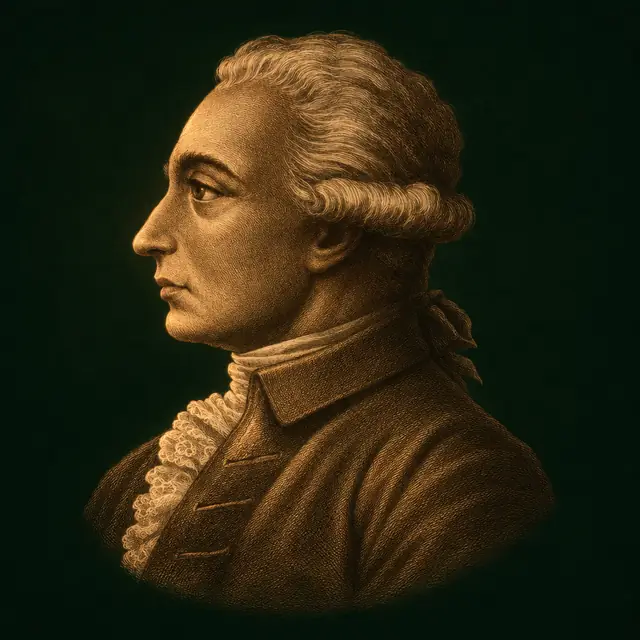
Who was Louis-Claude de Saint-Martin, and what is truly known of them?
What is known
French writer who signed his books “the Unknown Philosopher”. Born at Amboise, he was an officer of the Foix regiment at Bordeaux when, in 1768, he was received into the Elect Cohens of Martinez de Pasqually, whose secretary he became. He left the army in 1771. Of Errors and of Truth appeared in 1775 and The Man of Desire in 1790. He came to distrust his master’s ceremonies and taught an inward way of prayer and attention with no rite at all. At Strasbourg from 1788 he found the books of Jakob Böhme, learned German to read them and put several into French. He died at Aulnay, near Paris, in 1803.
The teaching
Taught from his own books, above all Of Errors and of Truth, The Man of Desire and The Ministry of the Spirit Man.
Man explains the world
Saint-Martin's first rule turns the philosophy of his century around. The philosophers of his day explained man by nature, as one thing among things, a body moved by its senses. He teaches the reverse: it is by man that nature must be explained, and not by nature that man must be explained. The human being, with his thought, his will and his longing for the infinite, is the key, and the visible world is a book written in a lesser script, which only one who has first read himself can read.
The first dignity and the fall
In Of Errors and of Truth he sets out, in veiled words, the teaching he had received from Martinez de Pasqually. Man was first a being of light and power, set over the creation as the agent of God, with the task of holding in check a spirit who had fallen before him. He fell in his turn, by turning his will from his principle towards himself, and was clothed in a body of matter, which is at once his prison and his shelter. The visible world was made after that fall, as a place of exile and of remedy, in which every being suffers and waits.
Evil, in this teaching, is no second god. There is one good principle, the source of all; evil has no being of its own and is only the corruption of a will that has turned away. So the fall can be undone: what was lost by a turning of the will is regained by a turning back, and the human being is called to reintegration, the return to the first dignity.
The Repairer
The return is not made alone. Saint-Martin speaks of an active and intelligent cause, sent between God and the fallen human being, and in his later books he names it plainly the Repairer, the Christ, who came down into the world of the fall to open the way back. To follow the Repairer is not to hold an opinion about him but to let the same work of repair be done within oneself.
From the ceremonies to the heart
Among the Elect Cohens the way back was worked by ceremonies: circles, lights and invocations at fixed seasons, meant to bring the operator into contact with good spirits. Saint-Martin learned them and came to distrust them. Such works act on the outward person, he holds, and they open a door to spirits whose nature cannot be known. The true work is inward. The only initiation he preaches and seeks with all the ardour of his soul, he writes, is the one by which a person enters the heart of God and makes the heart of God enter his own, and it needs no rite at all: only prayer, attention and a purified will.
The man of desire
The name of his best loved book comes from the angel's word to Daniel, who is called in the Latin Bible a man of desires. Desire is for him the deepest force in the soul: the human being is not first a thinking thing but a longing, a hunger that nothing finite fills. Prayer is that desire turned towards its source, the breathing of the soul, and the man of desire is the one who keeps it awake, in short and frequent turnings of the heart to God through the day, in silence as much as in words. The meditations of the book ask the reader always to begin from within: to quiet the noise of the senses, to watch over the will, and to wait.
The new man
The aim of the inward way is a birth. Within the old person, shaped by the fall and by the world, a new person can be born, as the Word was born into the world, and The New Man describes that birth as the slow forming of the divine life in the soul: first a seed received in humility, then a growing likeness to the Repairer through trial, patience and charity, until the person thinks, wills and acts from the new centre and no longer from the old.
The ministry of the spirit man
In his last large book Saint-Martin gives the renewed person a task in the world. Nature suffers and waits, as Paul says that the whole creation groans and travails, waiting for the revealing of the children of God. The human being was meant to be the minister of the spirit to nature, the one through whom the divine word comes into the world, and human speech was once a living power of that word. The spirit man is the one in whom the word has begun to live again, and his ministry is to restore it, first in himself, then in those around him, and through them in the creation that waits.
The light of Böhme
In the books of Jakob Böhme he found, late in life, the teacher he had been seeking, and he spoke of him as the greatest light to appear on earth after the one who is the light itself. From Böhme he took the teaching of an eternal nature in God, from whose working all things come, and of the divine Wisdom, the Sophia, who meets the soul that seeks her, and he joined these to his own inward way, the way his later readers called the way of the heart.
Orders and memberships
A member of the Elect Cohens from 1768, documented in his own letters. He also joined a mesmerist Society of Harmony in 1784 and the circle of Jean-Baptiste Willermoz at Lyon in 1785, and in 1790 he asked for his name to be struck from the Masonic rolls.
The legend
That he founded the Martinist Order. The order of that name was founded in Paris by Papus and Augustin Chaboseau between about 1887 and 1891, and the chain of personal initiation they traced back to him is not documented. He left books and friends, and no organisation.
Their works
- Of Errors and of TruthBook, 1775
His first book, signed as the Unknown Philosopher and printed at Lyon. It sets out, veiled and allusive, the teaching he had learned among the Elect Cohens of Martinez de Pasqually: man fallen from a first dignity and able to return. It was read and argued over in the lodges of France and Germany.
Ask the Oracle about it - Natural Table of the Relations between God, Man and the UniverseBook, 1782
A companion to his first book, tracing how the visible world, the human being and the divine answer to one another. It was written in the years when he still worked with the circle of Jean-Baptiste Willermoz at Lyon.
Ask the Oracle about it - The Man of DesireBook, 1790
A book of short meditations and prayers, written in a free and lyrical prose. It marks his turn away from ceremonies to an inward way of prayer and attention, which later readers called the way of the heart.
Ask the Oracle about it - The New ManBook, 1792
A meditation on the birth of a renewed person within the old one, written in the years of the Revolution. With Ecce Homo of the same year it carries on the inward teaching of The Man of Desire.
Ask the Oracle about it - The Dawn RisingTranslation, 1800
His French version of Aurora, the first book of the German mystic Jakob Böhme, whose writings he had found at Strasbourg and learned German to read. He put several more of Böhme’s books into French, and through them Böhme reached French readers.
Ask the Oracle about it - The Ministry of the Spirit ManBook, 1802
His last large book, printed the year before his death, on the task of the human being to restore the word and the spirit in the world. It shows how far Böhme had come to shape his thought.
Ask the Oracle about it
How the house tells a life
This life is told from the record, with what is documented, what is legend and what was forged kept apart. A membership in an order is stated only where documents show it. A person’s chart explains none of their deeds.
The arts it feeds
Lives near it in time
Thinkers and teachers
The Baal Shem TovBenjamin FranklinGeorge WashingtonThomas PaineAugustin BarruelCharles-François DupuisJohann Wolfgang von GoetheWolfgang Amadeus MozartWilliam BlakeGodfrey HigginsRobert TaylorPhineas QuimbyThe whole tree

