
Hazrat Inayat Khan
1882 to 1927
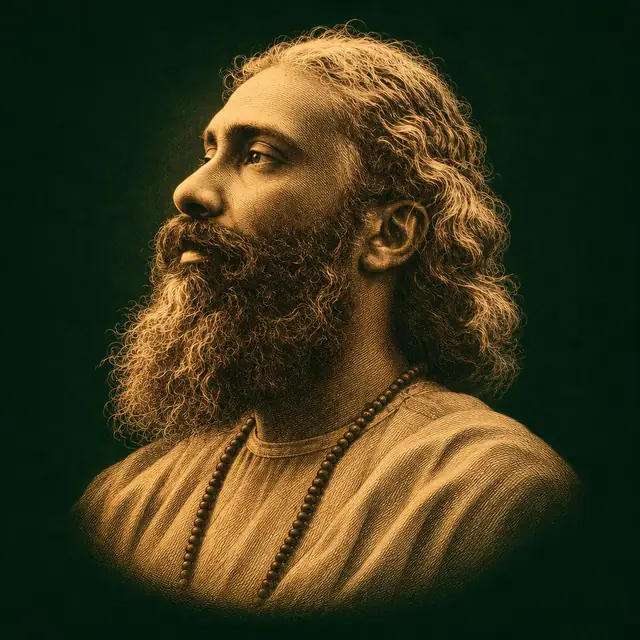
Who was Hazrat Inayat Khan, and what is truly known of them?
What is known
Indian musician and Sufi teacher, born at Baroda into a family of court musicians; his grandfather Maula Bakhsh founded a music academy there. He was initiated at Hyderabad by Abu Hashim Madani into the Chishti order, and in 1910 sailed for the United States with a brother and a cousin as a performer of Indian classical music. He taught in America, France, Russia and England, and in London in 1914 founded the Sufi Order in the West, which offered Sufism as a message open to people of every faith. He married an American, Ora Ray Baker. Their daughter Noor Inayat Khan served as a British wireless operator in occupied France and was killed at Dachau in 1944. He died in Delhi.
The teaching
Taught from his own books and talks, above all The Way of Illumination, The Mysticism of Sound and the Gayan.
The ten Sufi thoughts
Inayat Khan gathers the inner life into ten thoughts. There is one God, the Eternal, the Only Being, and none exists save He. There is one Master, the Guiding Spirit of all souls, who constantly leads his followers toward the light. There is one Holy Book, the sacred manuscript of nature, the only scripture that can enlighten the reader. There is one Religion, the unswerving progress in the right direction toward the ideal, which fulfils the life's purpose of every soul. There is one Law, the law of reciprocity, which can be kept by a selfless conscience together with a sense of awakened justice.
There is one Brotherhood, the human brotherhood, which unites the children of earth without distinction in the fatherhood of God. There is one Moral, the love that springs from self-denial and blooms in deeds of kindness. There is one Object of Praise, the beauty that uplifts the heart of its worshippers through every aspect from the seen to the unseen. There is one Truth, the true knowledge of our being within and without, which is the essence of all wisdom. And there is one Path, the annihilation of the false ego in the real, which raises the mortal to immortality, in which all perfection resides.
The God of every creed
The God of the Sufi is the God of every creed. Allah, God, Gott, Dieu, Khuda, Brahma and Bhagwan are all His names, and yet He is beyond every name; the Sufi sees Him in the sun, in fire and in the images that different sects worship, knowing Him beyond all form. The one Master has spoken through many teachers, Shiva, Buddha, Rama and Krishna, Abraham, Moses, Jesus and Muhammad, as one person wearing different coats: those who knew the person recognised Him in every guise, and those who saw only the coat went astray. So the Sufi learns from young and old, learned and unlearned, and his order's Universal Worship sets the scriptures of the great religions side by side on one altar, with a candle lit for each.
Vibration
Everything, he teaches, is made of vibrations: the inward, essential part of every being of fine ones, which we call spirit, and the outward part of gross ones, which we call matter. As activity increases, vibrations grow coarser and materialise; as it lessens, they return to spirit, passing through five phases, ether, air, fire, water and earth, each with its own savour, colour and form. The soul's original being is peace and its nature is joy; it opens its eyes on the outer life and enjoys it until it is satisfied, and then begins to close them and to seek the peace from which it came.
The abstract sound
All space is filled with a sound too fine for the outer ear, which the Sufis call Saut-i Sarmad, the sound of the abstract, and the Vedas Anahad Nada, the unlimited sound. Muhammad heard it in the cave of Hira, Moses on Sinai, Christ in the wilderness and Shiva in his samadhi, and the flute of Krishna is its symbol; it is the source of all revelation, which is why the masters teach one truth. It is always sounding within and around a person, but is not heard while the consciousness is centred in the body.
Those who seek it listen in solitude, by the sea, on a river bank or in the hills; yogis blow a horn or a conch, dervishes play the double flute, and the bells and gongs of churches and temples are meant to recall it. It is heard in ten aspects, like thunder, the roaring sea, the jingling of bells, running water, the buzzing of bees, the twittering of sparrows, the vina, a whistle and the conch, until it becomes Hu, the most sacred of all sounds. Hu, he teaches, is the name of the Nameless, belonging to no language and no religion, the spirit of every word, the Word that was in the beginning.
Music, the voice and the word
A musician before he was a teacher, he hears music in all of nature, in the wind in the trees, the sea, the thunder and the movements of the stars, which all keep one harmony; and he holds that the voice not only shows a person's character but is the expression of their spirit. The sacred word, repeated in the practice the Sufis call zikr, the remembrance of God, is given by a teacher as a physician gives a prescription, knowing for what need it is meant, and the number of repetitions matters, since each number has its own value.
The annihilation of the false ego
The path ends in fana, the passing away of the false ego into the real. He quotes the saying of one who walked it: I passed away into nothingness, I vanished, and lo, I was all living. It is not reached by thought alone but under a guide, the murshid, through concentration, contemplation and meditation into realisation, and in the meantime it is lived as the one moral, love, and the one object of praise, beauty. God is beautiful, the tradition says, and He loves beauty; and his order took for its sign a heart with wings, the heart that rises when it is set free from itself.
Orders and memberships
Initiated into the Chishti order of Sufis and, by his own account, authorised in three other orders as well. The Sufi Order he founded in 1914 divided after his death into several bodies, among them the Sufi Movement and what is now called the Inayatiyya.
The legend
That his teacher sent him west with the charge to join East and West by the harmony of his music: the words are known only from his own later account. Sufi teachers within Islam have questioned whether a Sufism set apart from the practice of Islam is Sufism at all; his followers hold that he taught its inner meaning.
Their works
- A Sufi Message of Spiritual LibertyBook, 1914
His first book, printed in London in the year he founded the Sufi Order in the West. It presents Sufism as a message open to people of every faith. It set out the universal teaching that his order carried on.
Ask the Oracle about it - GayanBook, 1923
A book of short sayings and verses, arranged under musical names such as alapas and boulas. It gathers his teaching in its most compact form. It was later joined with Vadan and Nirtan as a set.
Ask the Oracle about it - The Mysticism of SoundBook, 1923
His teaching on music, sound and vibration as a path to the divine, drawn from his life as a musician. It reflects the Indian classical music he had played before he gave it up for teaching. It is among the most read of his works.
Ask the Oracle about it - The Sufi Message of Hazrat Inayat KhanCollection, printed from 1960
The collected lectures and writings gathered by his followers into many volumes. Much of it was taken down from his talks by his pupils. It is the main body of his teaching.
Much of it is pupils’ notes of his talks, edited after his death.
Ask the Oracle about it
How the house tells a life
This life is told from the record, with what is documented, what is legend and what was forged kept apart. A membership in an order is stated only where documents show it. A person’s chart explains none of their deeds.
The arts it feeds
Lives near it in time
Thinkers and teachers
Walter RussellFlorence Scovel ShinnSri AurobindoP. D. OuspenskyRamana MaharshiAlvin Boyd KuhnNapoleon HillNiels BohrRené GuénonErwin SchrödingerErnest HolmesKrishnamacharyaThe whole tree

