
Paramahansa Yogananda
1893 to 1952
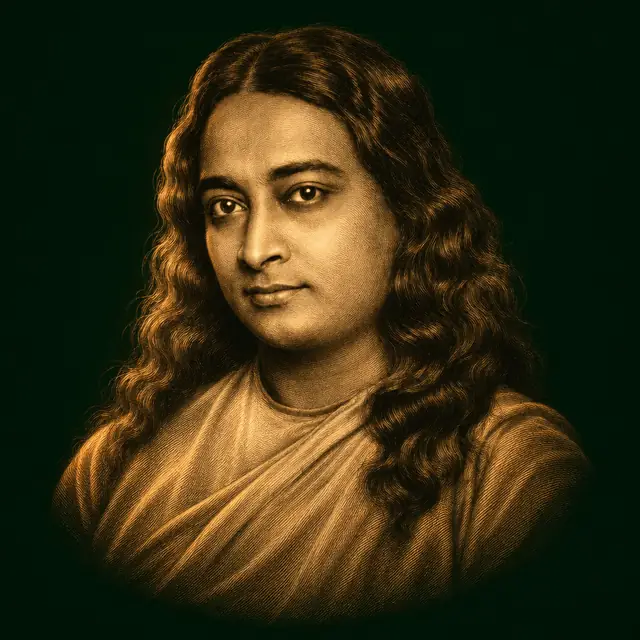
Who was Paramahansa Yogananda, and what is truly known of them?
What is known
Born Mukunda Lal Ghosh at Gorakhpur in north India, a disciple of Sri Yukteswar, who made him a monk of the Swami order in 1915. In 1917 he opened a school for boys in Bengal, soon moved to Ranchi. He sailed for Boston in 1920 as India’s delegate to a congress of religious liberals, stayed, and that year founded the Self-Realization Fellowship, which from 1925 had its seat on Mount Washington in Los Angeles. He lectured in large halls across the United States and taught Kriya Yoga by lessons sent through the post. His Autobiography of a Yogi (1946) has stayed in print in many languages. He died on 7 March 1952 at the Biltmore Hotel in Los Angeles after speaking at a dinner for the Indian ambassador.
The teaching
Taught from his own books, above all Autobiography of a Yogi (1946), with his lessons and his commentary on the Gita.
Self-realization
Yogananda names the aim of his teaching Self-realization: the knowing, in body, mind and soul, that one is one with God, by experience and not by belief alone. God, in his phrase, is ever-existing, ever-conscious, ever-new bliss, his rendering of the Sanskrit sat, chit and ananda. The soul is a spark of that bliss which has come to identify itself with a body and a personality, and has forgotten what it is; every craving and every sorrow is the soul seeking, in the wrong places, the joy that is its own nature.
He calls religion a science for this reason. Everyone seeks to escape pain and to find a happiness that lasts; that lasting happiness is God; and there are methods, as exact as those of a laboratory, by which anyone may test the claim in their own experience. Belief is the first step, but the proof he offers is the meditator's own.
Energy and the will
The body, he teaches, lives less by food than by life energy, prana, which enters chiefly through the medulla oblongata at the base of the brain, the place he called the mouth of God. The will draws that energy: the greater the will, the greater the flow. His exercises for energy, taught from 1916, train this by tensing each part of the body in turn with the will, gently and then firmly, and relaxing it, so that the student comes to feel energy as something that can be called and sent. They are done unhurried, with the breath free.
Watching the breath
Concentration comes next, and its door is the breath. The student sits upright with the spine straight, the eyes closed and lifted gently toward the point between the eyebrows, and watches the natural breath without controlling it, silently joining a sound to each breath as it comes and goes. As the breath is watched it slows of itself, and as it slows the restless mind grows still. Breath and mind, in his teaching, rise and fall together: calm one and the other follows.
The spiritual eye and Aum
The point between the eyebrows is the seat of the spiritual eye, which the meditator may come to see as a ring of golden light around a field of deep blue, with a white five-pointed star at its centre: the gold, the blue and the star stand for the three aspects of God. Beside the light there is sound. Aum, the creative vibration that upholds all things, is the Word of the Gospel of John and the Holy Ghost of the creed, and the meditator learns to hear it within as an inner sound and to be absorbed in it.
So he reads the Trinity in Indian terms. God beyond creation is Sat, the Father; the intelligence of God present in every particle of creation is Tat, which he calls the Christ consciousness; and the vibration by which creation is made and held is Aum, the Holy Ghost. Jesus and Krishna, in his teaching, were each one with that Christ consciousness, and so taught the same thing.
Kriya Yoga
Kriya Yoga is the method at the heart of his line, which he says the deathless Babaji revived and gave to Lahiri Mahasaya in 1861. By it the meditator draws the life current up and down the spine, around its six centres from the base to the medulla, and so withdraws energy from the senses and turns it toward the brain. The six centres, doubled by their two poles, answer to the twelve signs of the zodiac, and the one who circles the current through them is said to hasten the slow growth that nature gives: half a minute of Kriya, he writes, equals a year of ordinary spiritual unfolding.
He grounds it in the Bhagavad Gita, which speaks of offering the in-breath into the out-breath and the out-breath into the in-breath, and so stilling both. The technique itself is given only by initiation in his line, after a period of preparatory lessons, and he never set it out in print. The breath in it is gentle; nothing is forced or held to strain.
The battle within
His long commentary on the Gita reads the war of the poem as the war inside every seeker. The field of Kurukshetra is the body. The blind king Dhritarashtra is the blind mind, led by the senses, and his hundred sons are the restless desires and bad habits that crowd it. The five Pandava brothers are the soul's divine powers, children of pure discrimination, with Arjuna the devotee among them, and Krishna, his charioteer, is Spirit, or the guru who speaks for it. The battle is meditation: each day the devotee meets the army of the senses and habits, and wins back ground for the soul.
Prayer as a child's claim
Devotion stands beside the methods. Yogananda teaches the student to speak to God as a child to its Mother or Father, intimately and without fear, and not as a beggar: the soul, being God's child, may claim God's love and ask for it with persistence until God answers. His prayers in Whispers from Eternity are of this kind, written to be read aloud and then dwelt on in silence.
He gave affirmations the same pattern of descent. A sentence of truth is said aloud, then more softly, then in a whisper, then only in the mind, so that it sinks from the conscious mind into the subconscious and at last into what he calls the superconscious, the soul's own knowing. He used them for health, for will and for peace; the house gives them as prayer and practice, never as a cure, and never in place of a doctor's care.
The householder's yoga
The line he taught passes from guru to disciple: Babaji to Lahiri Mahasaya, Lahiri Mahasaya to Sri Yukteswar, Sri Yukteswar to Yogananda, and the guru is the channel through whom God teaches. Its model is Lahiri Mahasaya, a clerk with a family who reached the highest states without leaving the world, which shows that Kriya is for the householder as much as the monk. Its rule of life is balance: to work, to serve and to meditate, until the work itself is done for God.
Orders and memberships
A swami of the Giri branch of the Dashanami order of Hindu monks, in the Kriya Yoga line of Lahiri Mahasaya and Sri Yukteswar. He founded the Self-Realization Fellowship in America and the Yogoda Satsanga Society of India.
The legend
That his body showed no decay for twenty days after death. The claim rests on a letter from the director of the Forest Lawn mortuary, which the Fellowship prints in part; the whole letter records that the body had been embalmed. The saints and wonders of the Autobiography, from the deathless Babaji to a woman who never ate, are given on his word and on that of the people he met.
Their works
- Autobiography of a YogiBook, 1946
His life from his boyhood in Bengal to his years in America, told through the teachers and saints he met, among them Lahiri Mahasaya, Sri Yukteswar and the deathless Babaji. It introduced Kriya Yoga to a wide Western public and has stayed in print in many languages. Its wonders are given on his word and on that of the people he met.
The Fellowship revised the text after his death, and the first edition of 1946 is reprinted by others as he left it.
Ask the Oracle about it - Whispers from EternityPoem, 1929
A book of prayers and poems in prose and verse, addressed to God as Mother and Father and Friend. He meant them to be read aloud and dwelt upon in meditation. They show the devotional side of his teaching, which in his lectures stood beside the methods of breath and concentration.
Ask the Oracle about it - The Self-Realization Fellowship LessonsLessons, from the 1920s
The course of printed lessons he sent by post to students across America, teaching his methods of energy, concentration and meditation, with Kriya Yoga for those who went on. They let him teach far more people than his halls could hold. The Fellowship still issues them to its members.
They have been revised and reissued by the Fellowship more than once since his death.
Ask the Oracle about it - God Talks with ArjunaCommentary, printed 1995
His long commentary on the Bhagavad Gita, verse by verse, gathered by the Fellowship from his writings and talks. He reads the battle of the poem as the struggle within the soul, and the book is the fullest statement of his teaching on yoga. It was printed in two volumes more than forty years after his death.
It was edited by the Fellowship from work he left, and how much was finished by him is not set out.
Ask the Oracle about it - The Second Coming of ChristCommentary, printed 2004
His commentary on the words of Jesus in the four Gospels, which he read as teaching the same union with God as the yogis of India. It was compiled by the Fellowship from his writings of many years and printed in two volumes. It shows how he joined the Christian faith of his hearers with his own.
Like God Talks with Arjuna, it was edited from his papers after his death.
Ask the Oracle about it
How the house tells a life
This life is told from the record, with what is documented, what is legend and what was forged kept apart. A membership in an order is stated only where documents show it. A person’s chart explains none of their deeds.
The arts it feeds
Lives near it in time
Thinkers and teachers
Napoleon HillNiels BohrRené GuénonErwin SchrödingerErnest HolmesKrishnamacharyaAldous HuxleyJiddu KrishnamurtiJ. B. RhineWilhelm ReichGershom ScholemJoseph MurphyThe whole tree

