
J. B. Rhine
1895 to 1980
Who was J. B. Rhine, and what is truly known of them?
What is known
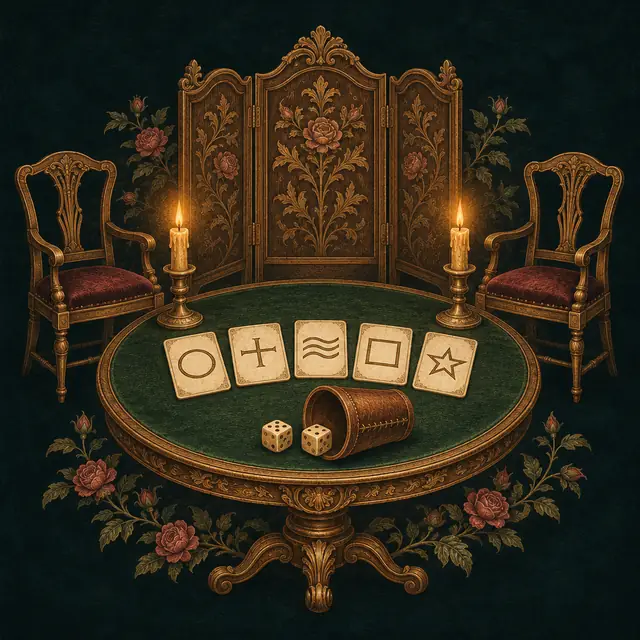
American researcher who trained as a botanist, taking his doctorate at Chicago in 1925, and turned to the study of claimed psychic powers. At Duke University from 1927, with the psychologist William McDougall and his own wife Louisa Rhine, he replaced the séance room with counted trials: a subject guessed the order of a pack of twenty-five cards bearing five plain signs, and the score was set against chance. His monograph Extra-Sensory Perception (1934) made the term ESP common, and he founded the Journal of Parapsychology in 1937. In 1974 the director of his own institute was caught by colleagues faking results and resigned, and Rhine made the case public.
The teaching
Taught from his own books, above all Extra-Sensory Perception (1934) and The Reach of the Mind (1947).
The test by counting
J. B. Rhine teaches that the claims of psychical research can be settled only by experiment: plain targets, many trials, and every score set against what chance alone would give. His tools, the pack of five symbols and the dice, and the conditions that separate one kind of claimed perception from another, are taught in full in the branches called From Rhine to the Ganzfeld and Psychokinesis. What follows is what he held the experiments to mean, and how he held that the work must be done.
The living mind first
Psychical research before him had asked chiefly whether the dead survive, and had looked for the answer in the séance room. Rhine turns the question round. Any true message a medium gives, he reasons, might come from the minds of the living by extrasensory perception rather than from the dead, so nothing can be settled about survival until it is known whether living minds have such powers at all. The first question is therefore the living mind, and it is a question for the laboratory, not the darkened parlour.
So the subject should be an ordinary person and not a famous medium; the material should be plain, cards and dice and not messages; the procedure should be the same each time, so that others can repeat it; and the result should be a number. He took the German word parapsychology for this experimental science, and meant it as a branch of psychology like any other.
A power of ordinary people
Rhine holds that extrasensory perception is not the gift of a rare few but a capacity found, in some measure, in ordinary people, many of whom scored above chance in the early tests without any training. It is, he says, a natural power of the mind and not a supernatural one: lawful, though not yet understood, and open to study as memory and learning are.
Unconscious and shy
The power, as he describes it, works below awareness. A subject cannot tell which calls were hits and which were misses, cannot summon the power at will, and cannot keep it. It is easily lost: scores fall with boredom, fatigue, distraction and a dulled mind, and rise with interest, a spirit of play, a friendly and encouraging experimenter and the sense of a challenge. In the early work, he reported, a sedative drug lowered a subject's scores and caffeine brought them back. The decline of scores across a run or a session he read as the mark of a mind tiring, not of a machine.
Beyond space and time
From the tests at a distance and the tests of the future he drew his boldest conclusion. Scores did not fall as the distance between subject and cards grew, from one room to another building and then across many miles, as they would if a physical signal carried the knowledge and weakened on the way. And in the tests of precognition the calls matched an order of cards that did not yet exist when the calls were made. A power that is not bound by space or by time, he argues, cannot be a physical energy of any known kind: the mind has a property that the physics of his day does not contain.
One psi, knowing and acting
The dice showed him the other face of the same power. If the mind can know matter without the senses, he reasons, it may also act on matter without the muscles; and the same signs appeared in both kinds of test, the same falling off with boredom and the same dependence on mood. He took the name psi for the whole from two colleagues in Britain, and taught extrasensory perception and psychokinesis as two sides of one function, the mind receiving from the world and acting on it.
The reach of the mind
Here his teaching meets the old questions of religion. If the mind can reach beyond the body in space and time, then the picture of a person as nothing but a physical machine is incomplete, and the questions that religion has long asked by faith, of the soul, of the freedom of the will, of what may outlast the body, become questions that experiment can begin to touch. He did not claim that parapsychology proves any creed, only that it opens these questions to test. Beside his conclusions stands the plain fact that his best results were not repeated under tighter controls, and that the case is not held proven.
The experimenter's duty
He held the experimenter to a strict rule: publish the method in full, keep every record, report the failures with the successes, invite the critics in, and tighten the conditions whenever a flaw is shown. A science of something so elusive, he held, lives or dies by its honesty, and any fraud found in it must be made public at once by those who find it.
Orders and memberships
No lodge or secret order is documented. He was the moving spirit of the Parapsychological Association, founded in 1957, which the American Association for the Advancement of Science accepted as an affiliate in 1969.
The legend
That his card tests proved extrasensory perception. His best subjects scored far above chance in the early 1930s, but other laboratories could not repeat the results, and critics showed that early cards could be read from the back or the edge and that scores fell as controls were tightened. Most psychologists hold the case not proven. He was no friend to mediums: in 1926 he called the Boston medium known as Margery a fraud.
Their works
- Extra-Sensory PerceptionMonograph, 1934
His report of the card guessing trials at Duke, in which subjects named the order of packs bearing five plain symbols and their scores were set against chance. It gave the term ESP to the language and made his laboratory famous. Other laboratories could not repeat its best results, and critics found flaws in the early controls.
Ask the Oracle about it - One Evening’s Observation on the Margery MediumshipPaper, 1927
A paper he and his wife Louisa wrote after a séance in Boston with the medium known as Margery. They described the tricks they believed they had seen and called the sitting a fraud. It shows that he came to psychical research as a sceptic of the séance room.
Ask the Oracle about it - New Frontiers of the MindBook, 1937
A popular account of the Duke experiments, written for the general reader. It sold widely and brought his work and his cards to a large public. Psychologists of the time answered it with criticism of its statistics and its methods.
Ask the Oracle about it - The Journal of ParapsychologyJournal, from 1937
The journal he founded at Duke with William McDougall to print experimental reports on claimed psychic powers. It set out to give the field the methods and the peer review of other sciences. It is still published by the research centre that grew from his laboratory.
Ask the Oracle about it - Extra-Sensory Perception After Sixty YearsBook, 1940
A survey written with J. G. Pratt and colleagues of all the card tests since the first studies of the 1880s. It set out the objections critics had raised and the answers of the Duke group to each. It is the fullest statement of the case as they saw it, which most psychologists still hold not proven.
Ask the Oracle about it - The Reach of the MindBook, 1947
His book on the later work of his laboratory, chiefly the tests in which subjects tried to sway the fall of dice by wishing. He argued that mind could act beyond the body. As with the card tests, others could not repeat the results under tighter controls.
Ask the Oracle about it
How the house tells a life
This life is told from the record, with what is documented, what is legend and what was forged kept apart. A membership in an order is stated only where documents show it. A person’s chart explains none of their deeds.
The arts it feeds
Lives near it in time
Thinkers and teachers
Erwin SchrödingerErnest HolmesKrishnamacharyaParamahansa YoganandaAldous HuxleyJiddu KrishnamurtiWilhelm ReichGershom ScholemJoseph MurphyNorman Vincent PealeWolfgang PauliJoseph CampbellThe whole tree

