

The inner life
Parapsychology
Direct answer
Parapsychology is the experimental study of claimed abilities such as telepathy, clairvoyance, precognition and psychokinesis. It grew out of Victorian psychical research and took its name in the 1930s.
$0 today, then $19/month after 7 days. Cancel anytime.
At a glance
- Also called
- psychical research, psi research, parapsychologist, study of psychic phenomena
- Found in
- Consciousness & Spiritual Psychology
- Related
- Extrasensory Perception, Psychokinesis, Society for Psychical Research, Ganzfeld Experiment

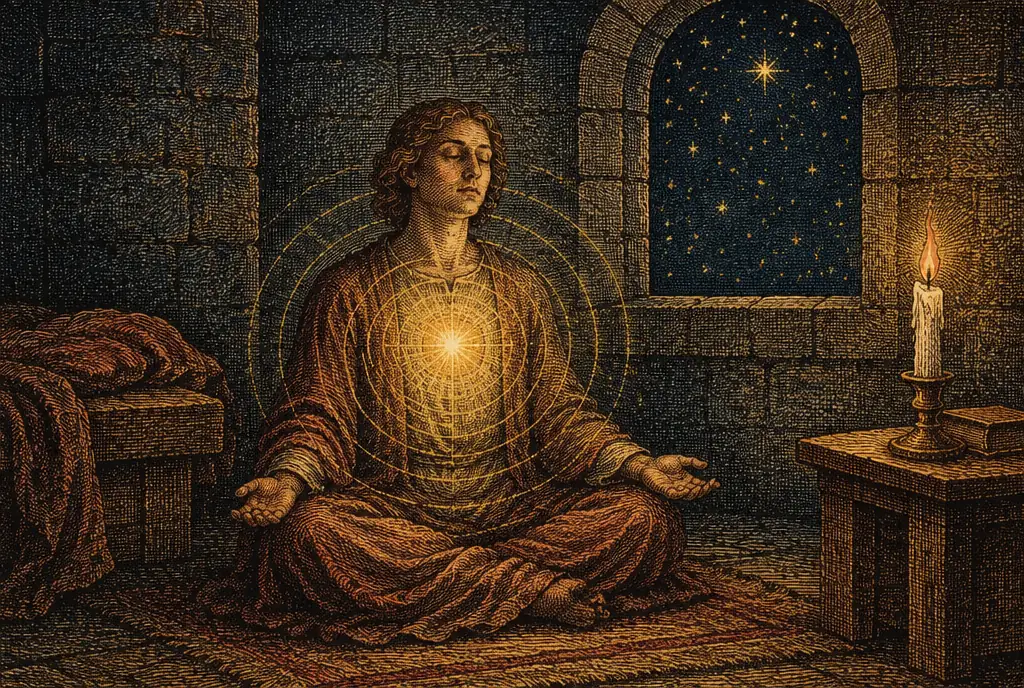
Parapsychology is the experimental study of claimed abilities such as telepathy, clairvoyance, precognition and psychokinesis. It grew out of Victorian psychical research and took its name in the 1930s.
A plain educational schematic; it does not diagnose a condition or replace professional care.
Understand the chapter you are in.
Your life’s turning points, measured from your birth.
Walk through Alex’s whole example first


Prefer to explore first?
 The Road of AgesThe turning points of your whole life, from your own chart
Walk my road
Is parapsychology a science?
Parapsychology asks whether people can gain knowledge or affect matter by means science does not yet recognise, and it tries to answer by experiment. Its practitioners call the supposed faculty psi. Their methods are those of psychology: random targets, blind judging, statistics. A small number of universities have housed such work, and its researchers have a professional body, the Parapsychological Association, founded in 1957.
The field has exposed several of its own frauds and tightened its controls over decades. Even so, its central results remain small and cannot be repeated on demand, and most scientists regard it as unproved. Critics and defenders largely agree on the data and disagree on what a small, unstable effect means.
On the tree of the hidden arts: The sixth sense.
What sets Parapsychology apart
Parapsychology differs from the psychical research it grew out of in method. The Victorians collected testimony and sat with mediums; Rhine's laboratory counted guesses and applied statistics, and asked ordinary students where earlier workers had sought gifted individuals. It also differs from most fringe subjects in its habits: it has peer reviewed journals, publishes its failures, and has unmasked several of its own leading experimenters.
- Word: German Parapsychologie, Max Dessoir, 1889
- Laboratory: Duke University, North Carolina, from the early 1930s
- Journal: Journal of Parapsychology, founded 1937
- Professional body: Parapsychological Association, 1957; AAAS affiliate since 1969
- Working term: psi, for the supposed faculty behind ESP and PK
Often mistaken for something else: Psychical research is the older, wider tradition of case collecting and sitting room investigation; parapsychology is its experimental branch, confined to what can be counted.
The story behind Parapsychology
The German philosopher Max Dessoir coined Parapsychologie in 1889. J. B. Rhine adopted the English form for the laboratory he and William McDougall set up at Duke University in the early 1930s, to mark a break with the sitting room studies of the Society for Psychical Research. The Journal of Parapsychology began in 1937. The Parapsychological Association became an affiliate of the American Association for the Advancement of Science in 1969.
Why Parapsychology matters
Parapsychology is where the claims of the sixth sense are counted and checked, so its record is the fairest answer to whether they hold.
How to read Parapsychology
The word marks controlled, statistical work; older case collecting is called psychical research and newer writing often says psi research.
Parapsychology in practice: an example
A study pairs senders and receivers in sealed rooms, chooses each picture by a random process, and has judges match descriptions without knowing the targets.
Where readings of Parapsychology go wrong
A course, test or certificate offered under this name does not show that a person has any ability.
Sources and editorial method
This entry summarizes the tradition in the Almanac's own words; where no source is listed, it is an editorial summary rather than a primary text, and symbolic readings are named as the tradition's, not as fact.
- Source
- The Great Almanac Dictionary
- Category
- Consciousness & Spiritual Psychology
- Aliases
- psychical research, psi research, parapsychologist, study of psychic phenomena
- Last updated
- 2026-09-26
See Parapsychology in your personal almanac
A definition tells you what it is; your own birth chart tells you what it means for you. The Oracle casts your real chart and answers for your love, your work, and your year ahead, in conversation. It opens with the 7-day Oracle trial.
Speak with the OracleRelated terms
More in Consciousness & Spiritual Psychology
- Resonance
- Soul Mission
- Trauma Response
- Anapanasati
- Co-Regulation
- Dream Journal
- Gulf of Tonkin Incident
- Life Review
From the reference page to your own chart
Every word here
is in your own chart.
- Your life’s turning points, measured from your birth
- A practical next step to consider
- It opens with 7 days free: the AI Oracle on thirty hidden arts, and your daily horoscope
$0 today, then $19/month after 7 days. Cancel anytime.
Common questions
Is parapsychology a science?
It uses scientific methods and has been affiliated with the American Association for the Advancement of Science since 1969. Its findings have not been reliably repeated, and many scientists therefore class the claims as unproved.
What does psi mean?
Psi, the Greek letter, is the neutral label researchers use for whatever might lie behind extrasensory perception and psychokinesis. It was proposed in 1942 so that the thing could be named without assuming how it works.
Where is parapsychology studied?
In a few university units and private institutes. The best known have been the laboratory at Duke University, later the Rhine Research Center, and the Koestler unit at the University of Edinburgh, founded in 1985.


