
Heraclitus
About 540 to about 480 BC
Who was Heraclitus, and what is truly known of them?
What is known
Greek philosopher of Ephesus in Ionia, active about 500 BC. He wrote one book, now lost; about 130 fragments survive as quotations in later authors, and Diogenes Laertius reports that he laid it up in the temple of Artemis. The fragments speak of an order, the logos, that is common to all and that most people fail to grasp; of opposites that are one, as the road up and the road down are one road; and of the world as an ever-living fire, kindled and quenched in measure. Plato gives him the image of the river into which nobody steps twice. Antiquity called him the Obscure for his riddling style, and the Stoics took their fire and their logos from him.
The teaching
Taught from the fragments of his lost book, as later writers quote them.
The logos common to all
His book opened with its theme. There is a logos, an account and an order, that always is, and people fail to understand it, both before they hear it and once they have heard it. All things come to pass according to this logos, and yet people are like those who have never met it, even when they meet the words and deeds he sets out, dividing each thing according to its nature and saying how it is. They do not notice what they do awake, just as they forget what they do asleep.
So one must follow what is common. The logos is common to all, yet most people live as if they had a private understanding of their own. For those awake there is one world shared by all, while each sleeper turns away into a world of his own. Thinking is common to all, and those who speak with sense must hold fast to what is common, as a city holds to its law, and more firmly still, for all human laws are nourished by one divine law. Listening not to him but to the logos, he says, it is wise to agree that all things are one.
How to learn it
Much learning does not teach understanding; if it did, it would have taught Hesiod and Pythagoras, Xenophanes and Hecataeus. Yet those who love wisdom must inquire into a great many things, and he prefers what can be seen, heard and learned. The senses are witnesses, but eyes and ears are bad witnesses for people whose souls do not understand their language. Gold seekers dig up much earth and find little, and whoever does not expect the unexpected will not find it, for it is hard to track down and hard to reach.
Nature loves to hide, and the lord whose oracle is at Delphi neither speaks out nor conceals, but gives a sign. He began the search with himself: I searched myself, he says, and it belongs to everyone to know themselves and to think well. Wisdom is to speak the truth and to act according to nature, listening to it.
The ever-living fire
This world order, the same for all, no god and no human made; it always was and is and shall be an ever-living fire, kindled in measures and quenched in measures. All things are exchanged for fire and fire for all things, as goods for gold and gold for goods. The turnings of fire are first sea, and of sea half is earth and half the burning wind; and earth melts back into sea, measured by the same proportion as before. The thunderbolt steers all things.
The measures hold. The sun does not overstep his measures; if he did, the Furies, servants of Justice, would find him out. The sun is new every day. Nothing in the world of fire stands still, and nothing in it is out of measure: its order is the order of its changing.
The road up and the road down
Opposites are one. The road up and the road down are one and the same. The sea is the purest water and the foulest: for fish it is drinkable and life-giving, for people undrinkable and deadly. In a circle the beginning and the end are common. Hesiod, the teacher of most, did not know day and night, for they are one. God is day and night, winter and summer, war and peace, plenty and hunger, and he changes as fire does when it is mixed with spices and named for the scent of each.
The same is in us, living and dead, waking and sleeping, young and old: these change and become those, and those change back and become these. Cold things grow warm, the warm grows cold, the wet dries and the parched grows moist. Sickness makes health sweet and good, hunger makes plenty, weariness rest. Immortals are mortals and mortals immortals, living each other's death and dying each other's life. To god all things are fair and good and just; people have taken some things as unjust and others as just.
The harmony of the bow and the lyre
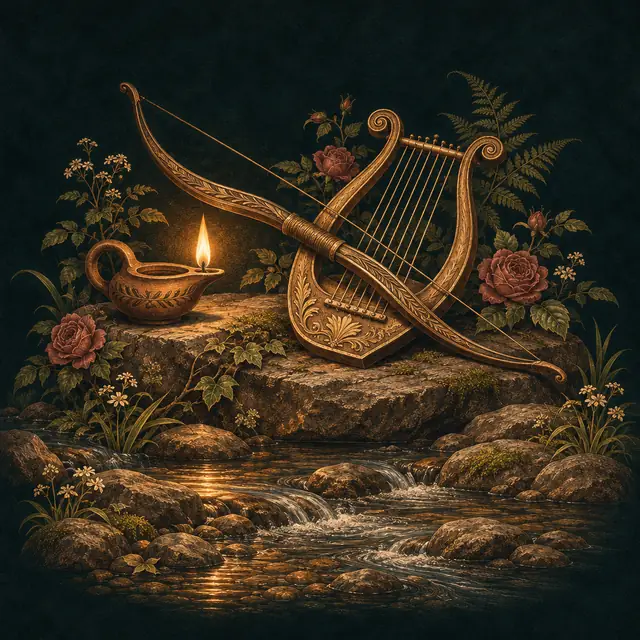
People do not understand how what is at variance agrees with itself: it is a harmony that turns back on itself, like that of the bow and the lyre. A bow is strung by pulling its arms against the string, a lyre by stretching its strings against the frame, and each works only while the tension holds. What is drawn apart is drawn together; out of all things comes one, and out of one all things. The hidden harmony is stronger than the visible one.
War is father of all
War is common to all, justice is strife, and all things come to pass through strife and necessity. War is father of all and king of all: some it shows as gods and some as men, some it makes slaves and some free. So he faults Homer for praying that strife might vanish from among gods and men, for without high and low notes there would be no harmony, and without opposites no living thing. Strife is not the enemy of the order; it is the order at work.
The river
Upon those who step into the same rivers, different and again different waters flow. The river stays the same river because its waters never stay: its sameness is made of change. Changing, it rests. Even the barley drink, the kykeon, separates if it is not stirred: what holds together is held together by motion.
The soul, dry and moist
The soul has a depth no one can reach: travelling every road, one would not find its limits, so deep is its logos, and its logos grows of itself. For souls it is death to become water, for water death to become earth; but out of earth water is born, and out of water soul. A dry soul is wisest and best. A man who is drunk is led by a beardless boy, stumbling and not knowing where he goes, because his soul is wet.
Character is a person's daimon: what each one is, and not a spirit outside, shapes a life. It is hard to fight against desire, for whatever it wants it buys at the price of the soul. Insolence must be put out sooner than a fire, and the people must fight for their law as for their city wall. What awaits people when they die is nothing they expect or imagine.
The one wise thing
The wise is one thing: to know the thought by which all things are steered through all. That one wise thing is unwilling and willing to be called by the name of Zeus. Of all whose words he had heard, none came so far as to see that the wise is set apart from all. He faults the worship of his day for missing it: people stained with blood purify themselves with blood, as if someone who had stepped in mud should wash in mud, and they pray to statues as one might chat to houses, not knowing what gods and heroes are.
Orders and memberships
No order is documented. Diogenes Laertius says he gave up the “kingship” of Ephesus to his brother; Strabo describes it as a hereditary title of the founder’s family, with a priestly office. A fragment preserved by Clement of Alexandria has him condemn the mystery rites as people practised them.
The legend
The story of his death: that he turned against mankind, lived on grasses in the hills, fell ill with dropsy and buried himself in dung to draw the water out. It is told by Diogenes Laertius some seven centuries later and looks built from his own sayings. The “weeping philosopher” is a Roman picture, and “everything flows” is not found in those words in the fragments.
Their works
- His book, in fragmentsBook, about 500 BC
Heraclitus wrote one book, later called On Nature, which is lost; about 130 sayings survive quoted by other writers. They speak of the logos common to all, of the unity of opposites, of the world as an ever living fire kindled and quenched in measure, and of the river that is never the same. Their riddling form earned him the name the Obscure.
Which quotations are his own words and which are paraphrase by those who quote him is often disputed.
Ask the Oracle about it - Die Fragmente der VorsokratikerCollection, 1903
Hermann Diels gathered the fragments and the ancient reports of the early Greek thinkers, Heraclitus among them, in Greek with German translation. His numbering of the fragments, later revised with Walther Kranz, is still used by everyone who cites them.
Ask the Oracle about it - Lives of the Philosophers, Book NineBiography, 3rd century AD
Diogenes Laertius begins his ninth book with Heraclitus: his scorn for his fellow citizens and for Homer and Pythagoras, the book laid up in the temple of Artemis at Ephesus, and the harsh story of his death. Much of it is anecdote drawn from his own sayings, and it is the source of most of what is told of his life.
Ask the Oracle about it
How the house tells a life
This life is told from the record, with what is documented, what is legend and what was forged kept apart. A membership in an order is stated only where documents show it. A person’s chart explains none of their deeds.
The arts it feeds
Lives near it in time
Thinkers and teachers
Lao TzuSun TzuEmpedoclesSocratesPlatoZhuangziPhilo of AlexandriaMarcus ManiliusValentinusPatanjaliPtolemyMarcus AureliusThe whole tree

