
Empedocles
About 490 to about 430 BC
Who was Empedocles, and what is truly known of them?
What is known
Greek philosopher, poet and physician of Acragas in Sicily. He wrote in verse; fragments survive of what the ancients called On Nature and Purifications, and a papyrus at Strasbourg, published in 1999, added new lines. He taught that all things are made of four “roots”, earth, water, air and fire, joined and parted by two powers, Love and Strife: the first statement of the four elements that natural philosophy kept for two thousand years. The verses also tell of a spirit exiled for bloodshed and born again as boy, girl, bush, bird and fish, and they forbid the killing of animals. He is said to have refused the kingship of his city, and Aristotle is reported to have named him the inventor of rhetoric.
The teaching
Taught from the surviving verses of his poems On Nature and Purifications.
Nothing is born and nothing dies
There is no birth of any mortal thing and no end in ruinous death; there is only mixing, and the parting of what was mixed, and birth is a name that people give to it. Fools, whose thoughts do not reach far, suppose that what was not before can come to be, or that something can perish and be wholly destroyed. But nothing can come from what in no way is, and for what is to be utterly destroyed is impossible and unheard of. When the elements mix into the form of a man, a beast, a bush or a bird, people call it being born, and when they part they call it wretched death; he speaks as custom does, but knows better.
The four roots
All things are made of four roots: fire, air, water and earth. In the poem they carry the names of gods: shining Zeus, life-bringing Hera, Aidoneus, and Nestis, who wets the springs of mortals with her tears. Nestis is water; the other three names were read differently even in antiquity, most often Zeus as fire, Hera as air and Aidoneus as earth. The roots are equal and of the same age, each with its own office and its own character, and each prevails in turn as time comes round.
From these four comes all the variety of the world, as a painting comes from a painter's colours. Painters, men well taught in their craft, take pigments of many colours, mix them in harmony, more of one and less of another, and make from them likenesses of all things, trees and men and women, beasts and birds and fish, and the long-lived gods. So the mind should not be deceived that mortal things have any source but these.
Love and Strife
Two powers move the roots. Love, whom he also calls Aphrodite, Joy and Harmony, draws unlike things together and makes one out of many; Strife drives them apart and makes many out of one. Strife is equal in weight everywhere, and Love dwells among the roots, equal in length and breadth. She is seen with the mind and not with the eyes, and yet she is inborn in mortal limbs: by her people think kind thoughts and do the works of peace.
So the tale is double. At one time things grow to be one out of many, at another they grow apart to be many out of one; double is the birth of mortal things and double their passing. The roots never cease their constant exchange, now all coming together into one by Love, now each borne apart by the hatred of Strife; and since they never stop changing, they are always, unmoved through the cycle.
The cycle and the perfect round
When Love wholly prevails, the roots are mingled into one: the Sphairos, a god perfectly round and rejoicing in his circular solitude, in whom no limb can be told apart, with no arms branching from his back, no feet, no swift knees. Then, as the time fixed by a broad oath comes round, Strife grows in his limbs, and all the limbs of the god shake in turn. The roots begin to part; and when Strife has reached the lowest depth of the whirl and Love has come to its centre, things gather again, one by one. Worlds of separate things like ours come to be in the times between, while one power gains on the other.
How living things were formed
Living things too were made by Love joining what Strife had parted. On the earth sprang up many heads without necks, arms wandering without shoulders and eyes astray without foreheads. As Love gained, these met as chance would have it: creatures with two faces and two chests, cattle with the faces of men and men with the heads of cattle. Those whose parts happened to fit together as if made for a purpose lived, and the rest perished. An ancient summary gives four stages: first separate limbs, then monstrous joinings, then whole forms rising from the earth, and last the creatures born of one another.
Like knows like
We know the world because we are made of it. With earth we see earth, with water water, with air the bright air, with fire consuming fire; with love we see love, and strife with grievous strife. Thinking has its seat in the blood: in the seas of blood that leap to and fro around the heart dwells what people call thought, for the blood around the heart is thought.
He explains the body by things at hand. The eye is like a lantern: as a man about to go out on a stormy night lights a flame and sets it in a lantern whose linen screens keep off the winds while the light leaps through, so the fire of the eye, shut in its fine membranes, shines out and lets us see. Breath comes and goes as water does in the bronze vessel a girl plays with: while her hand closes its neck, the air inside keeps the water out, and when she lifts her hand the water rushes in.
How to take in the teaching
His counsel to his pupil Pausanias is to use every sense, each in its own way. The powers spread through our limbs are narrow, and people see only a little of life before they are carried off like smoke, each believing only what he happened to meet. So trust sight no more than hearing, nor the ear above the tongue, nor any other limb that offers a path to understanding, but grasp each thing in the way it is clear. And take the teaching in deeply: pressed into the mind and watched over with pure attention, it stays and grows; but if the mind reaches after the thousand worthless things people chase, it leaves, longing for its own kind, for all things have wisdom and a share of thought.
The exiled spirit
Purifications tells the soul's own story. There is an oracle of Necessity, an ancient decree of the gods, eternal and sealed with broad oaths: whenever one of the daimons, whose lot is long life, stains his limbs with blood, or follows Strife and swears falsely, he must wander thrice ten thousand seasons far from the blessed, born in every form of mortal thing, exchanging one hard path of life for another. The force of air drives him into the sea, the sea spits him onto the dry earth, earth casts him into the rays of the blazing sun, and the sun into the whirl of air; each takes him from the other, and all hate him. He says he is one of these, an exile from the gods and a wanderer, for he put his trust in raging Strife.
Born into this world, he wept and wailed at the unfamiliar place, a joyless meadow where Murder and Wrath dwell. The way back climbs through the best of each kind: among beasts the soul becomes a lion that lies on the mountain, among trees the laurel; at last such souls are born among men as seers, singers of hymns, physicians and leaders, and from there they rise as gods highest in honour, sharing the hearth and table of the immortals, free of human sorrow and untiring.
The reign of Kypris
Once, he teaches, Love ruled alone. There was no war god then, no battle cry, no Zeus as king, nor Kronos nor Poseidon; Kypris was queen, and people won her favour with holy images, painted figures of animals, perfumes, and offerings of myrrh and frankincense, pouring libations of golden honey on the ground. The altar was not soaked with the slaughter of bulls; that was the greatest defilement among men, to tear out a life and eat the noble limbs. All creatures were tame and gentle to people, beasts and birds alike, and kindness burned bright.
From this comes his law against killing. Will you not cease from the harsh-sounding slaughter, he asks; do you not see that you are devouring one another in the carelessness of your minds? A father lifts up his own son, changed in form, and slays him with a prayer, and a son seizes his father and children their mother, tearing out their life and eating the flesh of their own kin. He curses the day he first set his lips to the deed of eating flesh, and he gives the rule in two words: fast from wickedness.
God as holy mind
The divine cannot be brought near to the eyes or grasped by the hands, the broadest road by which persuasion enters human minds. It has no human head set on limbs, no branches springing from its back, no feet, no swift knees: it is mind alone, holy and beyond speech, darting through the whole world with swift thoughts. Blessed is the one who has gained the wealth of divine understanding, and wretched the one who keeps a dark opinion of the gods.
Orders and memberships
No membership is documented. Ancient writers count him among the followers of Pythagoras, and his teaching on rebirth and on abstaining from flesh is of that kind; the historians Timaeus and Neanthes, quoted by Diogenes Laertius, say the Pythagoreans barred him from their lectures for making their doctrines public.
The legend
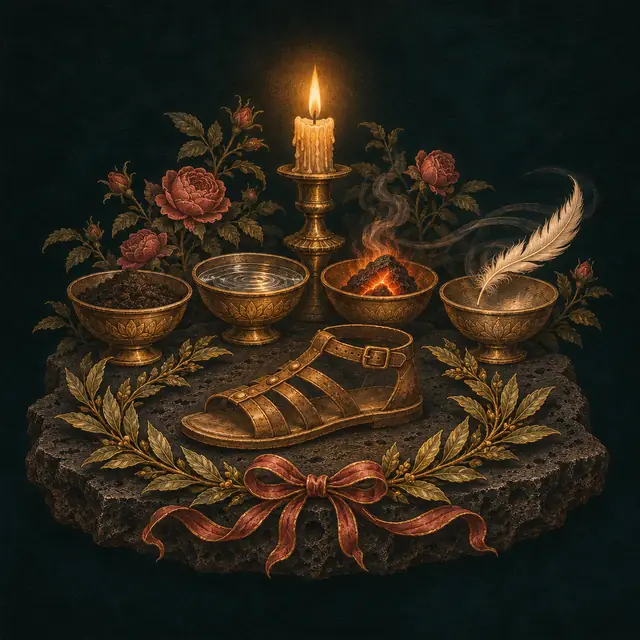
That he leapt into the crater of Etna so as to be thought a god, and that the mountain threw back one bronze sandal. That he stayed the winds with bags of ass’s skin and revived a woman who had not breathed for thirty days. Diogenes Laertius collected these tales centuries later. In his own verses he does say that he walks among his townsmen as a god, crowned with ribbons and garlands.
Their works
- On NaturePoem, 5th century BC
A poem in Greek hexameters of which some hundreds of lines survive in quotation. It teaches that all things are mixtures of four roots, earth, water, air and fire, brought together by Love and driven apart by Strife in a cycle without end. Through Aristotle this became the doctrine of the four elements on which medicine and alchemy rested for two thousand years.
Ask the Oracle about it - PurificationsPoem, 5th century BC
A poem addressed to the people of Acragas, of which fragments survive. The speaker calls himself an exiled spirit, fallen through bloodshed and born again as boy and girl, bush, bird and fish, and he forbids the eating of flesh. It stands with Pythagoras in the oldest Greek teaching of the soul’s many lives.
Scholars still argue whether this and On Nature were two poems or parts of one.
Ask the Oracle about it - The Strasbourg papyrusPapyrus, published 1999
Torn strips of an ancient copy of his poem, kept unread in the university library at Strasbourg until Alain Martin and Oliver Primavesi published them. They added some seventy new lines on the cycle of Love and Strife and on the forming of living things, the largest addition to his surviving verse in modern times.
Ask the Oracle about it - The Death of EmpedoclesPlay, 1797 to 1800
Friedrich Hölderlin wrote three drafts of a tragedy on the philosopher’s leap into Etna, seen as a return to nature by a man the city had rejected, and finished none of them. The fragments are among the great unfinished works of German poetry.
Ask the Oracle about it - Empedocles on EtnaPoem, 1852
Matthew Arnold’s dramatic poem shows the philosopher alone on the mountain, weary of a world that has lost its joy, before he throws himself into the crater. Arnold withdrew it the next year as too full of a suffering with no outlet, and restored it later at Robert Browning’s request.
Ask the Oracle about it
How the house tells a life
This life is told from the record, with what is documented, what is legend and what was forged kept apart. A membership in an order is stated only where documents show it. A person’s chart explains none of their deeds.
The arts it feeds
Lives near it in time
Thinkers and teachers
Lao TzuSun TzuHeraclitusSocratesPlatoZhuangziPhilo of AlexandriaMarcus ManiliusValentinusPatanjaliPtolemyMarcus AureliusThe whole tree

