
Socrates
About 470 to 399 BC
Who was Socrates, and what is truly known of them?
What is known
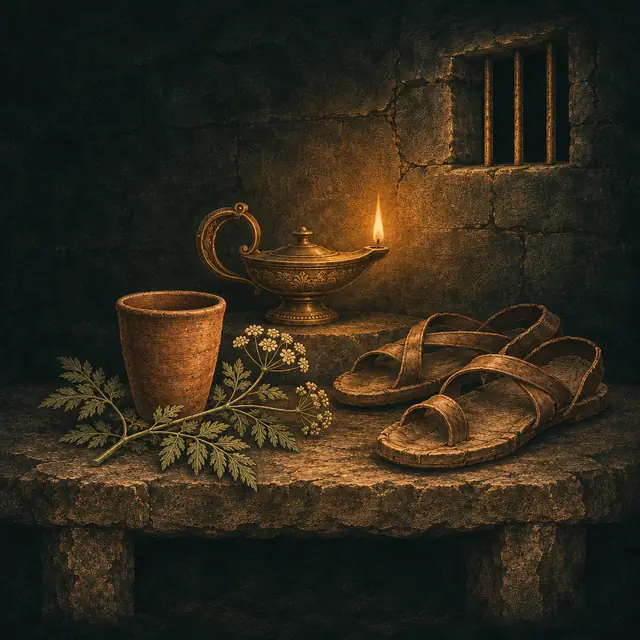
Athenian philosopher, son of a stonemason and a midwife, who wrote nothing. He is known through his pupils Plato and Xenophon and through Aristophanes, who mocked him in the comedy Clouds in 423 BC. He fought as a foot soldier at Potidaea, Delium and Amphipolis, and spent his days questioning fellow citizens about courage, justice and the good, while claiming no wisdom of his own. In 406 BC he refused to put an unlawful motion to the vote, and under the Thirty he refused an order to arrest an innocent man. In 399 BC a jury of about five hundred tried him for not honouring the city’s gods, bringing in new divine things and corrupting the young. He was condemned and died in prison by drinking hemlock.
The teaching
Taught from what his pupils Plato and Xenophon record, above all the Apology, the Crito and the Memorabilia.
Human wisdom
Socrates claims no wisdom beyond one kind. Questioning those thought wise, he found that they believed they knew what they did not, while he did not believe he knew what he did not know, and in that small thing he was wiser. The god, he concludes, uses him as an example: among people the wisest is the one who sees, as Socrates does, that his wisdom is worth little or nothing. Human wisdom is to know the limits of what one knows, and every inquiry he makes begins there.
What is it?
His question is always the same: what is it? What is courage, what is piety, what is justice, what is virtue? He does not want a list of brave deeds or pious acts but the one form that makes them all what they are, as bees differ in size and colour and yet are all bees by something they share. An answer is offered; he asks questions about it; the one who answered agrees to each step and finds at the end that he has agreed to the opposite of what he said.
Such talk often ends in perplexity, and Socrates holds that this is a gain. Meno complains that he is like the flat torpedo fish that numbs whoever touches it; Socrates answers that he numbs others only because he is numb himself, and that one who knows he does not know will now gladly search. No one sets out to learn what he believes he knows already.
The midwife of souls
He calls his art midwifery, after his mother's. Like the midwives, who no longer bear children themselves, he is barren of wisdom, and the god compels him to deliver others but forbids him to give birth. Those who keep company with him seem at first quite ignorant, but as the talk goes on they bring forth many fine things, learned from no one but themselves. His work is to help the birth and then to test whether the child is a phantom and a falsehood or a living truth; some leave him too soon and lose what they had conceived.
The care of the soul
His whole teaching to his city is one exhortation. Are you not ashamed, he asks, to care for money, reputation and honour, and not to care for wisdom and truth and for how your soul may be as good as possible? Virtue does not come from wealth; from virtue come wealth and every other good for human beings, in private and in public. He goes about doing nothing but persuading young and old to care for the soul first, and for the body and possessions after.
He compares himself to a gadfly that the god has fastened on the city, a great and noble horse grown sluggish with its size and needing to be stung awake. And he gives the reason he cannot keep quiet: to talk every day about virtue and the other things about which he examines himself and others is the greatest good for a human being, and the unexamined life is not worth living.
No one does wrong willingly
Everyone wants what is good. When someone does wrong, it is because he has mistaken the bad for the good; no one goes willingly towards what he knows to be bad. Virtue is therefore a kind of knowledge, and the virtues are one: courage, justice, self-control and piety are each the knowledge of what is truly good and bad. The trouble is like that of the eyes, to which near things look large and far things small; what saves a life is an art of measuring, which sees pleasures and pains at their true size, near or far.
Better to suffer wrong than to do it
From this follows his hardest teaching. Doing wrong is worse than suffering it, because the wrongdoer harms the one thing that matters most, his own soul. One who has done wrong is better off punished than unpunished, as the sick are better off with the doctor than without, for just punishment is the soul's medicine and to escape it is to keep the disease.
So one must never do wrong, not even in return. In the Crito he will not escape from prison, though his friends have arranged it, because to answer wrong with wrong, or to harm anyone whatever one has suffered from them, is never right. He imagines the Laws of Athens standing before him and asking whether he would destroy them, after they gave him his birth, his rearing and his education, and after he chose to live under them for seventy years: if he thinks them unjust, he must persuade the city, not break its law.
No harm to a good man
No evil can come to a good man, in life or after death, and the gods do not neglect his affairs. So he does not fear death, which no one knows to be an evil and which may be the greatest of goods. It is one of two things. Either it is like a dreamless sleep, and then it is a wonderful gain, for few days and nights of any life are better than such a night; or it is a journey to another place where all the dead are, and then there is no greater joy than to meet the poets and heroes of old and to examine them there as here, to find out who among them is wise.
On the day of his trial, he tells his judges, the divine sign that from his childhood had held him back from wrong steps did not oppose him once, and from its silence he reasons that what is happening to him is good. The sign itself is taught on the page of daimons and intelligences, in the spirit realm.
Self-mastery and the choice of Heracles
Xenophon's Socrates puts self-mastery at the base of every virtue. A man ruled by his belly, by sleep or by pleasure is the slave of the worst masters, and nothing good can be learned or done until these are mastered. To need nothing is divine, and to need as little as possible is nearest to the divine; so he eats and dresses plainly, and finds more pleasure in it than the luxurious find at their tables.
He tells the young the tale of Heracles at the parting of the ways, which he takes from Prodicus. Two women come to the young hero. One, who calls herself Happiness and whom her enemies call Vice, offers the short and easy road of every pleasure; the other, Virtue, offers the long road of toil, and tells him that the gods give nothing good to human beings without labour and care. Whoever wants the gods' favour must serve them, whoever wants friends must be kind to them, and whoever wants a strong body must train it with sweat.
His piety is as plain. He asks the gods simply for good things, since they know best what is good, and holds that a small offering from small means is as dear to them as a great one from the rich. When a young man is proud of his learning, he sends him to the inscription at Delphi, know thyself, and explains it: as a buyer tests a horse for strength and temper before he can say he knows it, so a person must test himself to know his own powers and their limits.
Orders and memberships
None. He founded no school and took no fee; the schools were founded by his pupils, Plato’s Academy first among them. Plato has him speak in the language of the mysteries, but no initiation of his is recorded.
The legend
His divine sign, the daimonion. Plato and Xenophon both report that he spoke of a voice that held him back from certain acts; later writers, Plutarch and Apuleius among them, made it a guardian spirit of his own. The oracle at Delphi that named no one wiser is his own story in Plato’s account of the trial. “Know thyself” was carved at Delphi and is not his, and “I know that I know nothing” is not found in those words.
Their works
- ApologyDialogue, early 4th century BC
Plato’s account of the speech Socrates made at his trial in 399 BC. He explains how the oracle at Delphi set him questioning those thought wise, speaks of the divine voice that holds him back, and, once condemned, refuses to beg for his life or to stop philosophising. It is the portrait of him the world remembers.
How close it is to the words Socrates actually spoke cannot be known.
Ask the Oracle about it - PhaedoDialogue, 4th century BC
Plato sets the last day of Socrates in prison, where he argues with his friends that the soul is immortal and that philosophy is a training for death. It ends with him drinking the hemlock calmly and asking that a cock be offered to Asclepius. Platonists of every age took its teaching on the soul as their own.
Ask the Oracle about it - CloudsPlay, 423 BC
Aristophanes’ comedy, staged in Athens while Socrates was alive, shows him swinging in a basket to study the heavens and running a school that teaches how to win any argument, just or unjust. Plato’s Apology names this caricature as one cause of the prejudice that brought him to trial.
Ask the Oracle about it - MemorabiliaMemoir, 4th century BC
Xenophon, a soldier and writer who had known Socrates, set down conversations to defend his memory against the charges. His Socrates is more practical and pious than Plato’s, giving advice on friendship, household and duty, and the book is the chief second witness to the man.
Ask the Oracle about it - The Death of SocratesPainting, 1787
Jacques Louis David painted the moment of the Phaedo when Socrates reaches for the cup while teaching, his friends in grief around him and Plato seated at the foot of the bed. Now in the Metropolitan Museum in New York, it made the scene an emblem of courage on the eve of the French Revolution.
Ask the Oracle about it
How the house tells a life
This life is told from the record, with what is documented, what is legend and what was forged kept apart. A membership in an order is stated only where documents show it. A person’s chart explains none of their deeds.
The arts it feeds
Lives near it in time
Thinkers and teachers
Lao TzuSun TzuHeraclitusEmpedoclesPlatoZhuangziPhilo of AlexandriaMarcus ManiliusValentinusPatanjaliPtolemyMarcus AureliusThe whole tree

