

Mystical systems
Bardo
Direct answer
Bardo is a Tibetan word meaning a state in between; in Tibetan Buddhism it names above all the states a mind is held to pass through between dying and being born again.
$0 today, then $19/month after 7 days. Cancel anytime.
At a glance
- Also called
- intermediate state in Buddhism, antarabhava
- Found in
- Mystical Systems
- Related
- Bardo Thodol, Samsara, Reincarnation, Barzakh
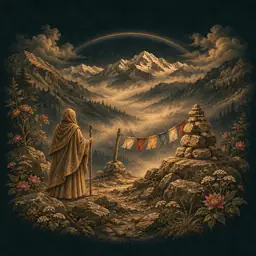

Bardo is a Tibetan word meaning a state in between; in Tibetan Buddhism it names above all the states a mind is held to pass through between dying and being born again.
A lineage map for books and systems; it avoids presenting symbolic traditions as literal fact.
Understand the chapter you are in.
Your life’s turning points, measured from your birth.
Walk through Alex’s whole example first


Prefer to explore first?
 The Road of AgesThe turning points of your whole life, from your own chart
Walk my road
What does bardo mean?
Bardo joins two Tibetan words, bar, between, and do, two. Any gap between two states is a bardo, and the Tibetan schools commonly count six: this life, dreaming, deep meditation, the process of dying, the state just after death in which reality appears nakedly, and the state of seeking a new birth. In common use the word means the last three.
The tradition holds that the passage after death lasts up to forty-nine days, in seven-day stages, and that what the mind meets there is its own nature, appearing first as light and then as peaceful and fierce figures. Guidance is read aloud to the dead person for that reason. The teaching is also applied to life: every ending is a bardo, and a chance to see clearly.
On the tree of the hidden arts: Death and what follows.
What sets Bardo apart
What sets the bardo teaching apart is its claim that the passage can be used. The moments after death are described as the clearest chance a mind has to recognise its own nature, and a person can train for them in life, since sleep, dreaming and every ending are held to rehearse the same gap. It is also timed, in seven-day steps to forty-nine days, which gives Tibetan mourning its calendar.
- Tibetan: bar do: between two
- Sanskrit: antarabhava, intermediate existence
- Usual count: six bardos: living, dreaming, meditating, dying, reality, becoming
- Length after death: up to forty-nine days, in seven periods of seven
- Not accepted by: the Theravada school, which teaches immediate rebirth
Often mistaken for something else: Samsara is the whole round of birth and death; a bardo is one gap within it, between one state and the next.
The story behind Bardo
An intermediate state between lives, in Sanskrit antarabhava, was debated by the early Buddhist schools in India; some accepted it and the Theravada school rejected it, as it still does. Tibetan teachers developed the idea in great detail from about the eleventh century, and the cycle of texts revealed by Karma Lingpa in the fourteenth century became its best known statement.
Why Bardo matters
Bardo gives a name and a dignity to in-between times, which most people find hard to bear and are quick to fill.
How to read Bardo
Tibetan Buddhists use it for the passage after death and for the practices that prepare for it; others have borrowed it for any threshold.
Bardo in practice: an example
A reader who has just left a job of twenty years calls the weeks before the next one a bardo, and uses them to look around.
Where readings of Bardo go wrong
Bardo is a teaching of a living religion, with teachers of its own. Buddhists themselves differ on whether such a state exists.
Sources and editorial method
This entry summarizes the tradition in the Almanac's own words; where no source is listed, it is an editorial summary rather than a primary text, and symbolic readings are named as the tradition's, not as fact.
- Source
- The Great Almanac Dictionary
- Category
- Mystical Systems
- Aliases
- the bardo, bardo meaning, intermediate state in Buddhism, antarabhava, six bardos
- Last updated
- 2026-09-26
See Bardo in your personal almanac
A definition tells you what it is; your own birth chart tells you what it means for you. The Oracle casts your real chart and answers for your love, your work, and your year ahead, in conversation. It opens with the 7-day Oracle trial.
Speak with the OracleRelated terms
More in Mystical Systems
From the reference page to your own chart
Every word here
is in your own chart.
- Your life’s turning points, measured from your birth
- A practical next step to consider
- It opens with 7 days free: the AI Oracle on thirty hidden arts, and your daily horoscope
$0 today, then $19/month after 7 days. Cancel anytime.
Common questions
What does bardo mean?
It is Tibetan for a state in between. Most often it means the states that Tibetan Buddhism describes between the death of a person and their next birth.
How long does the bardo last?
The tradition gives up to forty-nine days, counted in seven periods of seven days, which is why prayers are said for the dead for seven weeks.
Do all Buddhists believe in the bardo?
No. Tibetan and most East Asian traditions teach an intermediate state. The Theravada tradition of Sri Lanka and South-East Asia holds that rebirth follows death at once.


