

Mystical systems
Ars Moriendi
Direct answer
Ars Moriendi: Ars moriendi, Latin for the art of dying, is the name of a fifteenth-century Christian guide to dying well, and of the many books that followed it.
$0 today, then $19/month after 7 days. Cancel anytime.
At a glance
- Also called
- art of dying, the art of dying well, craft of dying
- Found in
- Mystical Systems
- Related
- Memento Mori, Purgatory, Bardo Thodol, Terminal Lucidity
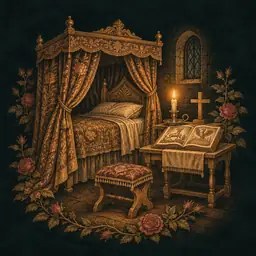

Ars moriendi, Latin for the art of dying, is the name of a fifteenth-century Christian guide to dying well, and of the many books that followed it.
A lineage map for books and systems; it avoids presenting symbolic traditions as literal fact.
Understand the chapter you are in.
Your life’s turning points, measured from your birth.
Walk through Alex’s whole example first


Prefer to explore first?
 The Road of AgesThe turning points of your whole life, from your own chart
Walk my road
What does ars moriendi mean?
The Ars moriendi is a Latin handbook written about 1415 for people facing death and for those at the bedside. It came out of decades of plague, when a priest could not be counted on to arrive in time, and it put the comfort and the questions he would have brought into the hands of ordinary people.
A shorter version of about 1450 was built around eleven pictures. Five show the temptations of the deathbed, which it names as doubt, despair, impatience, pride and attachment to possessions; five show the answering comfort; the last shows a good death. Printed from woodblocks with little text, it could be followed by those who could not read, and about a hundred editions appeared before 1500.
On the tree of the hidden arts: Death and what follows.
What sets Ars Moriendi apart
The Ars moriendi is a book for lay people at a moment the clergy had always managed, and that shift is its importance. It stages the deathbed as a contest inside the dying person, with five trials and five comforts, and gives the friends in the room a part to play. The short version worked almost without words: eleven woodcuts told the whole lesson, which is why it travelled across languages so fast.
- Long version: about 1415, by an unknown Dominican
- Short version: about 1450, built on eleven woodcuts
- The five trials: doubt, despair, impatience, pride and attachment to goods
- Spread: about a hundred editions before 1500
- Later heir: Jeremy Taylor's Holy Dying, 1651
Often mistaken for something else: Memento mori is a reminder for the healthy to live well; the ars moriendi is a manual for the hour of death itself.
The story behind Ars Moriendi
The longer text is thought to be the work of an unknown Dominican, perhaps written at the request of the Council of Constance, which met from 1414 to 1418. The picture book spread through Germany, the Low Countries, France and England. The form lasted: William Caxton printed an English version about 1490, and Jeremy Taylor's Holy Dying of 1651 is a Protestant descendant.
Why Ars Moriendi matters
Ars Moriendi treated dying as something a person does, with help, and not only something that happens to them, an idea the hospice movement took up again.
How to read Ars Moriendi
Historians use the name for the whole literature of preparing for death; writers on care at the end of life speak of a modern art of dying.
Ars Moriendi in practice: an example
A hospice volunteer reads that the old book told friends to stay, pray aloud and keep the room calm, and recognises her own training.
Where readings of Ars Moriendi go wrong
Ars Moriendi is a Christian book of its time. Its counsel to stay with the dying carries over; its theology belongs to those who share it.
Sources and editorial method
This entry summarizes the tradition in the Almanac's own words; where no source is listed, it is an editorial summary rather than a primary text, and symbolic readings are named as the tradition's, not as fact.
- Source
- The Great Almanac Dictionary
- Category
- Mystical Systems
- Aliases
- art of dying, the art of dying well, ars moriendi meaning, craft of dying
- Last updated
- 2026-09-26
See Ars Moriendi in your personal almanac
A definition tells you what it is; your own birth chart tells you what it means for you. The Oracle casts your real chart and answers for your love, your work, and your year ahead, in conversation. It opens with the 7-day Oracle trial.
Speak with the OracleRelated terms
More in Mystical Systems
From the reference page to your own chart
Every word here
is in your own chart.
- Your life’s turning points, measured from your birth
- A practical next step to consider
- It opens with 7 days free: the AI Oracle on thirty hidden arts, and your daily horoscope
$0 today, then $19/month after 7 days. Cancel anytime.
Common questions
What does ars moriendi mean?
It is Latin for the art of dying. It names a guide written about 1415 on how to die well, and more widely the tradition of such books.
Why was the Ars moriendi written?
It followed generations of plague in Europe, when many died without a priest. The book gave lay people the words and the comfort to offer at a deathbed.
What are the five temptations in the Ars moriendi?
The picture version shows five: loss of faith, despair, impatience, pride in a good life, and clinging to possessions. Each is answered by a picture of comfort.


