
Harry Houdini
1874 to 1926
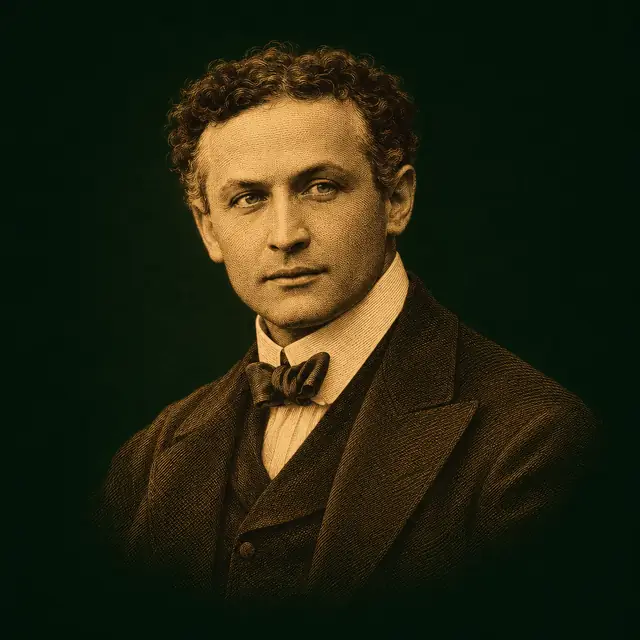
Who was Harry Houdini, and what is truly known of them?
What is known
Born Erik Weisz in Budapest and brought as a child to Appleton, Wisconsin, he became the best-known escape artist of his time and was president of the Society of American Magicians from 1917 until his death. After his mother died in 1913 he went to mediums hoping for a word from her, and found tricks he knew from the stage. From 1922 he exposed them in lectures and in A Magician Among the Spirits (1924), sat on the Scientific American committee that tested the Boston medium “Margery” in 1924, and in 1926 spoke before Congress for a law against paid fortune-telling. He died in Detroit of a ruptured appendix, on 31 October 1926.
The teaching
Taught from his own books, above all A Magician Among the Spirits (1924) and Miracle Mongers and Their Methods (1920).
A trick is a trick
Houdini's teaching begins from his own trade. Every escape he made was method, practice and nerve, and he said so; he claimed no power. From that comes the test he carried into the séance room: if a conjurer can produce an effect under the same conditions, the effect proves nothing about spirits. The one who claims a wonder must show it, and it is not enough that the sitter cannot explain it.
He held that he could reproduce, in the same conditions, anything the mediums he had sat with presented, and he offered a reward to any medium who would show a phenomenon he could neither explain nor repeat.
Raps and tables
Modern Spiritualism began with raps, and he teaches where they came from. Margaret Fox, one of the two sisters whose rappings began the movement, stood on a stage in New York in 1888 and showed how she made them by cracking the joints of her toes. Tables tilt and turn under the sitters' hands because the hands push, often without their owners knowing it, or because the medium's knee or foot lends help under the cloth.
The cabinet and the rope tie
The Davenport brothers had themselves bound hand and foot in a cabinet; when the doors closed, bells rang, instruments played and hands appeared at the opening, and when the doors opened the brothers sat tied as before. Houdini knew Ira Davenport in Ira's last years, and tells that Ira showed him the rope tie and said the brothers had never in public affirmed a belief in Spiritualism. The tie is made so that the performer can steal slack, slip a hand free, do the work in the dark and slip it back before the doors open.
Slates, photographs and voices
Slate writing, in which a message appears between two slates bound together, he shows to be done by slates written beforehand and covered with a loose flap of the same colour that falls away, by slates exchanged while the sitter's eye is elsewhere, or by a scrap of pencil fixed to the medium's finger and writing under the table. Spirit photographs are made by plates exposed beforehand, by double exposure and by plates exchanged in the dark room; he had himself photographed beside the ghost of Lincoln to show how easily it is done.
In the dark séance a trumpet painted with luminous bands floats about the room, held on a rod or in the medium's own hand, and voices speak through it. The sitters believe the medium's hands are held, but by an old move the two neighbours are brought to hold the same hand, and the other is free. Darkness is the medium's first tool, he teaches, and nothing that needs it has been shown.
The box for Margery
For the committee that tested the Boston medium Margery he built a box in which she sat with only her head and hands outside, so that nothing her body did could reach the bell box and the objects on the table. In earlier sittings he had kept his leg pressed against hers, the calf bandaged through the day so that it grew sensitive, and he felt, he said, the slow movements by which she reached the bell. The method is the lesson: control of hands and feet, light wherever possible, and an observer who knows how tricks are done.
The wonder workers
Miracle Mongers turns the same eye on the stage: the fire eaters, the poison swallowers, the strong men and the human ostriches. Each feat, he shows, is trained skill, preparation or plain deceit, and some are dangerous even to the trained. The house teaches them as he does, so that a wonder is not taken for a power, and never as something to try.
The sitter and the dead
He went to the mediums himself, hoping for a word from his mother, and so he teaches the sitter as well as the trick. Grief is the best witness a medium could wish for: it wants the message to be true and it forgets the misses. His counsel is to go with someone who knows how tricks are done, to ask for light and for control, to accept nothing that happens in the dark as proof, and never to pay for the voice of the dead. He pressed for laws against fortune telling for money because the grieving paid the most.
His last test was set for his own death. A true message, he held, must carry what could not have been learned another way, and so he and his wife agreed a message in a code of their own that no medium could know.
Orders and memberships
Made a Freemason in St Cecile Lodge No. 568, New York, in 1923, and a Shriner in 1926. Documented. He belonged to no occult order and said plainly that his own feats were tricks.
The legend
That he drowned in his water cell, which comes from a film of 1953; that the blows a student gave him in Montreal certainly killed him, which doctors dispute; and that he came back. His widow Bess held a sitting each year for ten years with a code they had agreed. In 1929 the medium Arthur Ford claimed to deliver it; she first agreed and then withdrew, and she ended the sittings in 1936.
Their works
- A Magician Among the SpiritsBook, 1924
His book on Spiritualism, telling of the mediums he had sat with and showing how slate writing, spirit photographs and voices in the dark were made by tricks he knew from the stage. It records his friendship with Conan Doyle and how it ended. It remains a classic of the exposure of fraud.
Ask the Oracle about it - The Unmasking of Robert-HoudinBook, 1908
His attack on the French magician from whom he had taken his stage name, arguing that Robert-Houdin had claimed the inventions of others. It shows his long study of the history of magic. Historians of conjuring have found it unfair in places.
Ask the Oracle about it - Miracle Mongers and Their MethodsBook, 1920
A book on fire eaters, poison swallowers, strong men and other performers of seeming miracles, and how their feats were done. It drew on his large collection of books on magic and the stage. It shows his wish to explain what others presented as wonders.
Ask the Oracle about it - Houdini Exposes the Tricks Used by the Boston Medium MargeryAccount, 1924
A pamphlet he printed after the Scientific American committee tested the medium Margery, setting out how he believed she produced her effects. It belonged to a bitter public dispute with her supporters. The committee as a whole did not award her its prize.
Ask the Oracle about it - The Water Torture CellPerformance, 1912
His escape from a narrow tank of water, hung upside down with his feet locked in stocks, first shown in Berlin and then for the rest of his career. It became his most famous act. The legend that he drowned in it comes from a film of 1953; he died of a ruptured appendix.
Ask the Oracle about it
How the house tells a life
This life is told from the record, with what is documented, what is legend and what was forged kept apart. A membership in an order is stated only where documents show it. A person’s chart explains none of their deeds.
The arts it feeds
Lives near it in time
Lives and legends
Florence FarrRudolf SteinerStanislas de GuaitaPapusMax HeindelGrigori RasputinCarl JungAleister CrowleyEdgar CaycePamela Colman SmithAlice BaileyH. Spencer LewisThe whole tree

