
Stanislas de Guaita
1861 to 1897
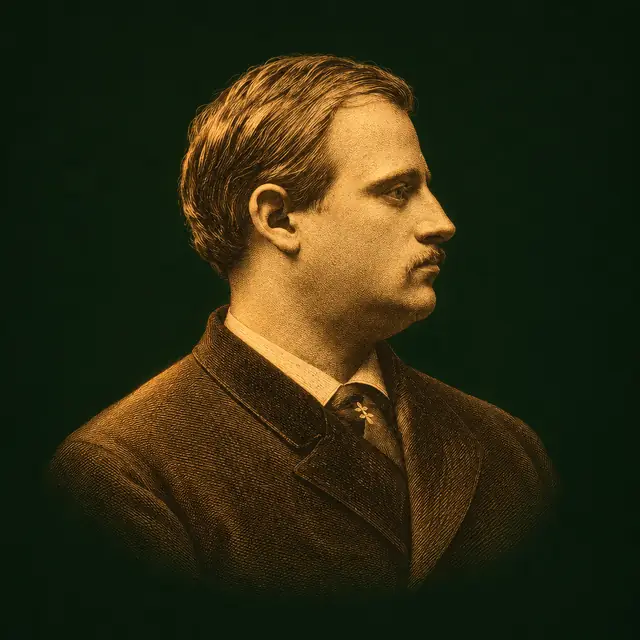
Who was Stanislas de Guaita, and what is truly known of them?
What is known
French poet and occultist, born at the château of Alteville in Lorraine to a noble family of Italian descent. After early books of verse he read Éliphas Lévi and gave himself to the study of magic, in the volumes he called Essays on the Accursed Sciences (1886 to 1897). In 1888 he founded the Kabbalistic Order of the Rose-Croix in Paris with Joséphin Péladan, with grades earned by examination. The inverted five-pointed star holding a goat’s head, now a common emblem, was first printed in his last book. He quarrelled publicly with a defrocked priest, Joseph-Antoine Boullan, fought a duel over it, and died at Alteville at thirty-six.
The teaching
Taught from his Essays on the Accursed Sciences (1886 to 1897), above all The Serpent of Genesis.
The serpent of Genesis
De Guaita's great work takes its name and its key from the serpent of Eden. The serpent, in his reading after Lévi, is the astral light, the universal agent of the magicians: the living, plastic force that runs through all nature, carries images and desires, and answers the will. It is neither good nor evil in itself. Directed by a will joined to the divine order it is the instrument of the sage; followed blindly, with the will given over to desire, it becomes the tempter, the force that draws spirit down into matter, and that fall is the story Genesis tells.
A work on the plan of the tarot
He built The Serpent of Genesis on the plan of the tarot, as Lévi had built his Dogme and his Rituel: three books of seven chapters, each chapter set under one of the first twenty-one trumps. The first book, The Temple of Satan, describes the works of evil, the sorcerer, the sabbath, possession and the black mass; the second, The Key of Black Magic, gives the theory that explains them; the third, The Problem of Evil, was to answer the question of evil itself.
What black magic is
The sorcerer, in his teaching, is not the master of dark powers but their slave. Black magic is the will turned to selfish ends, to harm, to possess, to dominate, and every such working hands the will over to the blind currents of the astral light, which then carry the operator where they will; the sorcerer ends possessed by what he called up. Satan, for de Guaita, is no rival god. He is the name of that downward current, the force of egoism and of matter set against spirit, and the goat's head in the reversed star, which he printed, is its sign; the figure is taught in Baphomet.
Bewitchment and its return
The Key of Black Magic explains bewitchment by the same light. A will charged with hatred and fixed on an image or a token of its victim, he holds, sends a current toward that person through the astral light; but a current of hatred finds no hold on a soul that is pure and calm, and it runs back along its own path to strike the one who sent it. The defence he teaches is therefore inward: a pure life, a steady will and a mind that does not answer fear with fear. The house adds what it teaches in Curses and fear: the fear of a curse does real harm, and its remedy is steadiness, not counter-magic.
The order of the Rose-Cross
His Kabbalistic Order of the Rose-Cross was a school, not a lodge of wonders. Its members rose by examination through three grades, bachelor, licentiate and doctor of the Kabbalah, and its work was study: the Kabbalah, the hidden traditions of the West and Christian mysticism, under a council of twelve, six of them known and six unknown.
Orders and memberships
The Kabbalistic Order of the Rose-Croix, which he founded in 1888 and led until his death, and the Martinist Order of his friend Papus, on whose council he sat from 1891.
The legend
That he killed Boullan by spells cast from Paris. When Boullan died at Lyon in 1893 the novelist Huysmans and the journalist Jules Bois said so in the newspapers, and de Guaita answered with a challenge; the pistols were fired and nobody was hit. His own early death is put down by some to morphine, which he used, and by others to kidney disease.
Their works
- Rosa mysticaPoem, 1885
A book of poems from his years in Paris, written under the influence of Baudelaire and the Parnassians. It shows the poet he was before he turned to magic. It is little read now, but it shaped the reputation he first had in Paris.
Ask the Oracle about it - Au seuil du mystèreBook, 1886
At the Threshold of Mystery, the first volume of what he called his Essays on the Accursed Sciences. It surveys the occult writers he admired, Éliphas Lévi above all, and sets out his view of magic as a serious tradition of thought. It began his place among the French occultists of the 1880s.
Ask the Oracle about it - Le Temple de SatanBook, 1891
The first part of his larger work The Serpent of Genesis, a long study of sorcery, black magic and Satanism through history. It includes his attack on Joseph-Antoine Boullan, which led to the public quarrel with Huysmans and Jules Bois. It is learned in the style of its time and openly hostile to the practices it describes.
Ask the Oracle about it - La Clef de la magie noireBook, 1897
The Key to Black Magic, the second part of The Serpent of Genesis and his last book. It is here that the inverted five pointed star holding a goat’s head was first printed, an emblem now widely used. A third part was left unfinished at his death.
Ask the Oracle about it
How the house tells a life
This life is told from the record, with what is documented, what is legend and what was forged kept apart. A membership in an order is stated only where documents show it. A person’s chart explains none of their deeds.
The arts it feeds
Orders and mystery schoolsThe Tree of LifeSymbolsMagic and protection
Lives near it in time
Lives and legends
MacGregor MathersLéo TaxilArthur Edward WaiteJoséphin PéladanFlorence FarrRudolf SteinerPapusMax HeindelGrigori RasputinHarry HoudiniCarl JungAleister CrowleyThe whole tree

