
Florence Farr
1860 to 1917
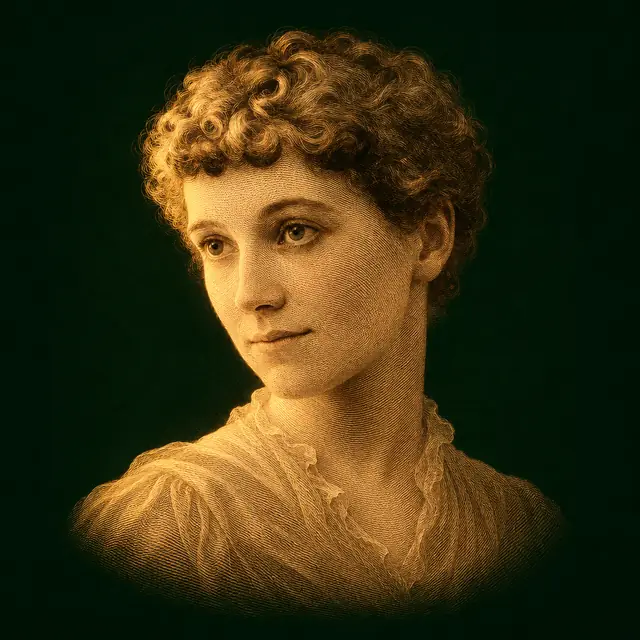
Who was Florence Farr, and what is truly known of them?
What is known
English actress, director and musician, born at Bickley in Kent. On the London stage she was the first Rebecca West in Ibsen’s Rosmersholm (1891), and in 1894 she produced the season that first staged Shaw’s Arms and the Man and a play by Yeats. She joined the Golden Dawn in 1890, rose to lead its English temples from 1897, and wrote a short book, Egyptian Magic (1896). With Yeats she gave recitals of verse chanted to a psaltery. In 1912 she left for Ceylon to head a girls’ college near Jaffna, and she died of cancer in Colombo in 1917.
The teaching
Taught from her Egyptian Magic (1896) and The Music of Speech (1909), with the plays she made from her order's work.
The magic of the word
Egyptian Magic reads the religion of Egypt, as the Egyptologists of her day had recovered it, through the ideas of her order, and its centre is the word. For the Egyptians, as she sets them out, a name is a part of the being who bears it, and to know the true name of a god or a spirit is to have power with it. The magician does not beg. He speaks as a god, taking on the name and the person of Osiris, Horus or Thoth, and in that character his words are spoken with a god's authority.
The dead were armed in the same way. The chapters of the Book of the Dead are words of power for the journey through the underworld, by which the soul passes its gates and answers its guardians by their names, and the amulets laid on the body, the scarab, the pillar of Osiris, the knot of Isis and the eye of Horus, carry those words in a form.
The parts of a person
Behind the book stands the Egyptian teaching that a person is made of several parts that death separates: the body; the ka, the double, which lives on at the tomb and is fed by offerings; the ba, the soul, pictured as a bird with a human head, which goes between the tomb and the world of the dead; the heart, which is weighed at the judgement; the shadow; the name; and the khu, the shining spirit, which goes among the gods. The magic of the book is the care of all of them, in life and after death.
The music of speech
The Music of Speech teaches an art she worked out with Yeats and Arnold Dolmetsch: the chanting of verse on musical notes. The reciter speaks each syllable on a note within the range of the speaking voice, closer to plainchant than to song, so that the rhythm and the sense of the words are never lost and the music serves the poem. Dolmetsch made her a psaltery whose strings gave the notes, and the poems were set down in a simple notation for speaking.
Behind the method lies a belief she shared with Yeats: that poetry was once chanted by bards, that speech carried on sound has a power plain speech has lost, and that the old art could be recovered. Words spoken so, in her teaching, reach the hearer as an incantation does, by rhythm as well as by sense.
The stage and the rite
For Farr the theatre and the temple were near kin, and her Egyptian plays brought them together. What Egyptian Magic teaches of the magician, that he takes on a god's name and person and speaks in the god's voice, is what her actors did on the stage, in ritual speech and costume, so that an audience might feel something of what a ceremony works on those who take part in it.
Orders and memberships
Initiated into the Isis-Urania Temple of the Golden Dawn in July 1890 and its chief in England from 1897; she resigned in 1902 after the order’s quarrels and a public scandal, and joined the Theosophical Society that year. All documented.
The legend
That an Egyptian adept taught her inwardly. She told the order so herself, of a small group she led from 1896; the only sources are her own papers and those of her companions. The rites she worked were written in London in her own lifetime, not in Egypt.
Their works
- Egyptian MagicBook, 1896
A short book in the series Collectanea Hermetica, edited by her fellow Golden Dawn member William Wynn Westcott. It gathers what was then known of Egyptian religion and magic from the Egyptologists, read through the ideas of her order. It shows the Egyptian turn of the small group she led from 1896.
Ask the Oracle about it - The Dancing FaunNovel, 1894
Her short novel in John Lane’s Keynotes series, a witty and bleak tale of a cynical man and the women around him. It belongs to the New Woman writing of the 1890s and shows her views on marriage and freedom. It was published in the same year as her season of plays in London.
Ask the Oracle about it - The Beloved of Hathor and The Shrine of the Golden HawkPlay, about 1901
Two short plays on Egyptian themes that she wrote with Olivia Shakespear and staged in London in 1902. They put the imagery of her order’s Egyptian work on stage, with ritual speech and costume. They mark the point where her magic and her theatre met most closely.
Ask the Oracle about it - The Music of SpeechBook, 1909
Her account of chanting verse to the psaltery, the method she worked out with Yeats and Arnold Dolmetsch and used in their recitals. It sets out how words might be spoken on musical notes without losing their sense. It is the record of the art for which she was best known in her later London years.
Ask the Oracle about it - Modern Woman: Her IntentionsBook, 1910
A book of essays on women’s lives, work and freedom, written shortly before she left England for Ceylon. She argued for women’s independence in marriage and in earning a living. It shows that her feminism stood beside her stage and her magic throughout her life.
Ask the Oracle about it
How the house tells a life
This life is told from the record, with what is documented, what is legend and what was forged kept apart. A membership in an order is stated only where documents show it. A person’s chart explains none of their deeds.
The arts it feeds
Orders and mystery schoolsThe Hermetic principlesSound and mantra
Lives near it in time
Lives and legends
William Wynn WestcottCharles LeadbeaterMacGregor MathersLéo TaxilArthur Edward WaiteJoséphin PéladanRudolf SteinerStanislas de GuaitaPapusMax HeindelGrigori RasputinHarry HoudiniThe whole tree

