
William Wynn Westcott
1848 to 1925
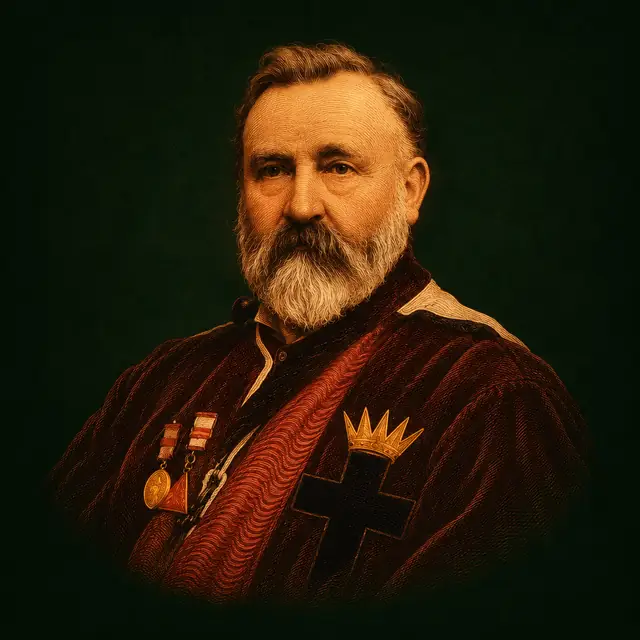
Who was William Wynn Westcott, and what is truly known of them?
What is known
English physician, born at Leamington, who practised in Somerset and from the 1880s was a coroner in London, holding the post for north-east London until 1918. A Freemason from 1871, he became head of the Societas Rosicruciana in Anglia, a study society for Masons, and translated the Sefer Yetzirah (1887). In 1888, with Samuel Mathers and William Woodman, he founded the Hermetic Order of the Golden Dawn, its rituals worked up from a set of papers in cipher. He withdrew from the order in 1897, it is said after his superiors learned of his part in it. He retired to Durban in South Africa and died there.
The teaching
Taught from his Sepher Yetzirah (1887), his Numbers (1890) and the Collectanea Hermetica he edited.
The Book of Formation
Westcott taught the Kabbalah from its shortest text. The Book of Formation, which he put into English, teaches that the world was made by thirty-two paths of wisdom, the ten numbers and the twenty-two letters, and that the letters are three mothers, seven doubles and twelve simples; that teaching is given in full in The twenty-two paths. To his version he added a short later text, The Thirty-Two Paths of Wisdom, which names an intelligence for every path: the first is the Admirable or Hidden Intelligence, the tenth the Resplendent, the eleventh the Scintillating and the thirty-second the Administrative. The Golden Dawn's papers carry those names.
Numbers and their virtues
His Numbers gathers what the Pythagoreans, the Kabbalists and the Christian writers said of each number; the Pythagorean decad is taught in Pythagoras and number. Beyond it he follows the Kabbalists, for whom every Hebrew letter is also a number and every word a sum, so that words of equal sum are held to be joined in meaning: one, Achad, and love, Ahebah, both make thirteen. Seventy-two is the count of the names of God that the Kabbalists draw from three verses of Exodus, each of seventy-two letters, and the seven of the planets, days and metals, the twelve of the signs and tribes and the twenty-two of the letters all have their place in it.
The Oracles, the Pymander and the Golden Verses
The Collectanea Hermetica he edited were a course of reading for the members of the orders. In the Divine Pymander they met the Hermetic teaching of mind and its return to God, taught in Poimandres. In the Chaldean Oracles, which Westcott edited from the old translations of Thomas Taylor and Isaac Cory, they met the Father and his paternal mind, the fire from which all things come, and the soul's descent into the body and its way back. The Oracles counsel the soul not to stoop down into the darkly splendid world below, where a faithless depth lies, but to hasten upward to the light and to the rays of the Father, from whom it was sent.
Beside them he printed the Golden Verses of the Pythagoreans, whose rule of life the student was to keep: honour the gods and parents, master the appetites, and before sleep go over every act of the day, asking what was done amiss, what was done, and what was left undone that ought to have been done.
An order as a school
Westcott taught that an order of this kind is first of all a school. Its members were to read, be examined and earn each grade, and he wrote or set many of the papers they learned from, so that the outer order of the Golden Dawn was as much a course of study as of ritual; its grades and rites are taught in The Golden Dawn. The Rosicrucian society he led for Masons was a school of the same kind, given to the Kabbalah, the Hermetic books and the history of the Rosicrucians. His own motto, dare to be wise, says what he asked of both.
Orders and memberships
Freemasonry, from his initiation in a Somerset lodge in 1871; the Societas Rosicruciana in Anglia, which he led from the early 1890s; the Theosophical Society; and the Golden Dawn, which he co-founded in 1888 and left in 1897.
The legend
That the Golden Dawn was chartered by an old German Rosicrucian order through an adept at Nuremberg, Fräulein Sprengel. The order told its members so; no such adept or lodge has ever been found.
What was forged, or is false
The letters from “Fräulein Sprengel” that authorised the first temple. In 1900 Mathers accused Westcott in writing of having forged them, Westcott gave no clear answer, and the historian Ellic Howe showed in 1972 that their German is not a native speaker’s. The cipher papers themselves are real, on paper watermarked 1809 and thought to be written in the 1870s or 1880s; their author is not known for certain.
Their works
- Sepher YetzirahTranslation, 1887
His English version of the short Hebrew Book of Formation, on the creation of the world through the ten numbers and twenty-two letters. It was used in the teaching of the Golden Dawn.
Ask the Oracle about it - Numbers: Their Occult Power and Mystic VirtuesBook, 1890
A short book on the meanings given to numbers by Pythagoreans, Kabbalists and others. It was among the most read of his writings. It draws on Westcott’s reading in Greek and Hebrew sources, and its claims for numbers are those of the traditions it reports.
Ask the Oracle about it - Collectanea HermeticaCollection, 1893 to 1896
A series of small books he edited, reprinting Hermetic, alchemical and Chaldean texts, among them the Divine Pymander and the Chaldean Oracles. It made older texts easy to come by for the members of the orders.
Ask the Oracle about it - The Cipher ManuscriptsPapers, 1870s or 1880s
Some sixty leaves in cipher giving outlines of five rituals, from which the Golden Dawn was worked up in 1888. They are real, on paper watermarked 1809, and Westcott said he had them from an older source.
Their author is not known for certain.
Ask the Oracle about it - The Sprengel lettersLetters, 1887 to 1888
Letters in German from a Fräulein Sprengel of Nuremberg that authorised the first temple of the Golden Dawn. In 1900 Mathers accused Westcott of forging them, and in 1972 the historian Ellic Howe showed that their German is not a native speaker’s.
Held to be forged, most likely by Westcott himself; no such adept has been found.
Ask the Oracle about it
How the house tells a life
This life is told from the record, with what is documented, what is legend and what was forged kept apart. A membership in an order is stated only where documents show it. A person’s chart explains none of their deeds.
The arts it feeds
Orders and mystery schoolsThe Tree of LifeThe Hermetic principles
Lives near it in time
Lives and legends
Helena BlavatskyHenry Steel OlcottDaniel Dunglas HomeThe Fox sistersAnna KingsfordAnnie BesantCharles LeadbeaterMacGregor MathersLéo TaxilArthur Edward WaiteJoséphin PéladanFlorence FarrThe whole tree

