
Annie Besant
1847 to 1933
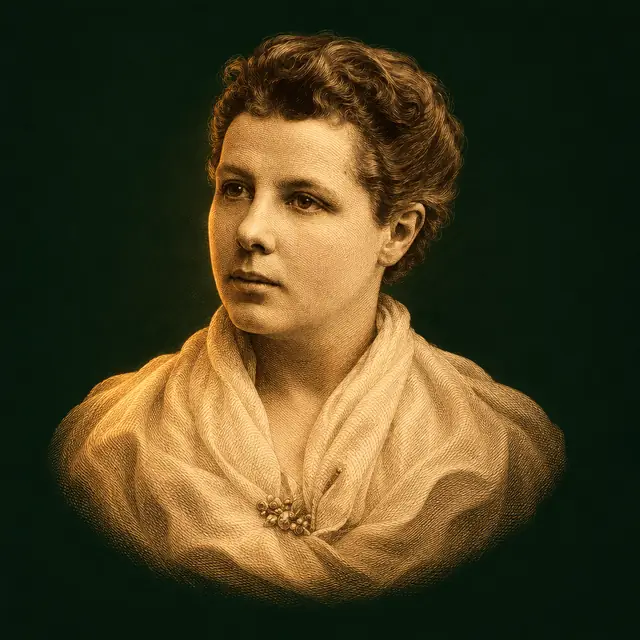
Who was Annie Besant, and what is truly known of them?
What is known
English reformer, born Annie Wood in London. Parted from her clergyman husband in 1873, she became a leading freethinker beside Charles Bradlaugh; the two were tried in 1877 for publishing a pamphlet on birth control, and she lost custody of her daughter. She joined the Fabian socialists and helped the London match-girls to win their strike of 1888. In 1889, after reviewing The Secret Doctrine, she joined the Theosophical Society, and was its president from 1907 until her death at Adyar. In India she founded the Central Hindu College at Benares (1898), led the Home Rule League, was interned in 1917, and that year presided over the Indian National Congress.
The teaching
Taught from her own books, from The Law of Population (1877) to Thought Power (1901), and her Bhagavad Gita (1895).
The planes and the bodies
Besant teaches Theosophy as a system of nature. A human being is a spirit clothed in bodies, one for each of the planes: the physical with its etheric double, the astral body of desire, the mental body, and the causal body that lasts from life to life. The seven planes, the bodies and the thought forms she drew with Leadbeater are taught in full in The planes and the cord. Her own teaching is of the laws by which the spirit grows through them.
Karma: thought, desire and action
Karma, she teaches, is no reward or punishment from outside but the law of cause and effect, working in the mind and the moral life as surely as in matter. It acts in three ways. Thought builds character: what a person thinks on, they become. Desire attracts its object: what a person longs for draws them to the places and the people where it can be had. Action makes circumstance: the happiness or the pain a person causes others comes back as the conditions of their own life.
She divides it by time as well. There is the whole store of the past, too great to be worked out in one life; the ripe part of it that this life must meet, which is fixed; and the karma being made now, which is free. The past cannot be undone, but its future fruit can be changed by new thought, and so the doctrine is a call to work and not to resignation.
Thought power
Thought Power teaches the training of the mind. Concentration comes first: the mind is fixed on one thing and, whenever it wanders, brought gently back, without strain, as often as it takes, and the power grows with practice as a muscle does. Meditation follows: at a fixed time each day, best in the early morning, the mind dwells on a lofty idea, a virtue or an ideal figure, until thinking about it passes into contemplation of it.
By the same means character is built. To gain a virtue such as patience, she counsels, one meditates on it daily and pictures oneself patient in the very trials that try one, so that when the trial comes the habit made in thought acts of itself. Worry is thought going round in a rut, and it is broken by turning the mind on purpose to a contrary thought. A good thought sent to another is, she holds, a real help, as an ill thought is a real harm.
The path of discipleship
The path begins before its gate. The Path of Discipleship names four qualifications to be won by long effort: discrimination between the real and the unreal; dispassion toward the fruits of action, in this world and in any heaven; six mental attainments, which are control of the mind, control of conduct, tolerance, endurance, faith and balance; and the longing for liberation. They come from the Hindu teaching of the path, and the life of the probationer is spent in building them.
Beyond the gate are four great initiations, which she names in the Buddhist way: the one who has entered the stream, the one who returns once, the one who does not return, and the arhat, the worthy one. On the way the disciple casts off fetters: first the delusion of a separate self, doubt and superstition; then desire and hatred; and at the last the clinging to life in form and beyond form, pride, restlessness and ignorance. Beyond the arhat stands the Master, who has nothing more to learn on earth and stays to help.
The Gita and the duty of action
Her Bhagavad Gita is a book of yoga for those who live in the world. Action cannot be given up, since even the life of the body is action, but it can be freed: the yogi acts because the work is right and leaves its fruit to God. Better one's own duty done imperfectly than another's done well. Yoga is balance, an evenness of mind in success and failure, and yoga is skill in action. The Lord dwells in the heart of every being, and a whole life lived in that knowledge becomes an offering.
Before Theosophy: the law of population
Before Theosophy she taught as a freethinker, and that teaching stands on its own. The Law of Population takes up Malthus: population tends to grow faster than the food to feed it, and where it does, poverty, overcrowding, hunger and early death keep the numbers down. Late marriage, the remedy Malthus himself offered, she rejects as a cause of misery in its own right. The humane check is the limiting of families within marriage by preventive means, which she holds to be moral and even a duty: fewer births, healthier mothers, and children who can be fed, clothed and taught.
The same conviction runs through White Slavery in London: those who know how the poor are made to live have a duty to say so in public, and the girls of the match factory, with their fines and their poor wages, were not to be left without a voice.
Orders and memberships
The Theosophical Society from 1889. She was also initiated in Paris in 1902 into Le Droit Humain, the Masonic order that admits women with men, founded its first London lodge the same year, and headed its British branch.
The legend
That she and Charles Leadbeater saw the atoms of the chemical elements by clairvoyance, and read the past lives of their circle. Both were printed as findings, in Occult Chemistry (1908) and elsewhere, and chemistry has not borne the first out. In 1911 they proclaimed the boy Jiddu Krishnamurti the vehicle of a coming World Teacher; in 1929 he dissolved the order built round him and refused the part.
Their works
- Thought FormsBook, 1901
Written with Charles Leadbeater, a book of coloured plates showing the shapes and colours they said thoughts and feelings take, as seen by clairvoyance. Its pictures are often named among the sources of abstract painting.
Ask the Oracle about it - Occult ChemistryBook, 1908
Written with Leadbeater, it describes the atoms of the chemical elements as they said they saw them by clairvoyance. It was printed as a finding, and chemistry has not borne it out.
Ask the Oracle about it - The Law of PopulationBook, 1877
Her own pamphlet on birth control, written after she and Charles Bradlaugh were tried for printing an older one. It sold widely, and it cost her the custody of her daughter.
Ask the Oracle about it - White Slavery in LondonEssay, 1888
Her article in her paper The Link on the pay and conditions of the girls at the Bryant and May match factory. It led to the match-girls’ strike, which they won.
Ask the Oracle about it - An AutobiographyBook, 1893
Her own story of her path from clergyman’s wife to freethinker, socialist and Theosophist, written soon after she joined the Theosophical Society. It tells of her trial of 1877, the loss of her daughter and her work for the match-girls.
Ask the Oracle about it - The Bhagavad GitaTranslation, 1895
Her English version of the Gita, made with the help of Indian scholars, which went through many editions in India. It was part of her work for Hindu learning that led to the Central Hindu College at Benares.
Ask the Oracle about it
How the house tells a life
This life is told from the record, with what is documented, what is legend and what was forged kept apart. A membership in an order is stated only where documents show it. A person’s chart explains none of their deeds.
The arts it feeds
Lives near it in time
Lives and legends
Andrew Jackson DavisHelena BlavatskyHenry Steel OlcottDaniel Dunglas HomeThe Fox sistersAnna KingsfordWilliam Wynn WestcottCharles LeadbeaterMacGregor MathersLéo TaxilArthur Edward WaiteJoséphin PéladanThe whole tree

