
Arthur Edward Waite
1857 to 1942
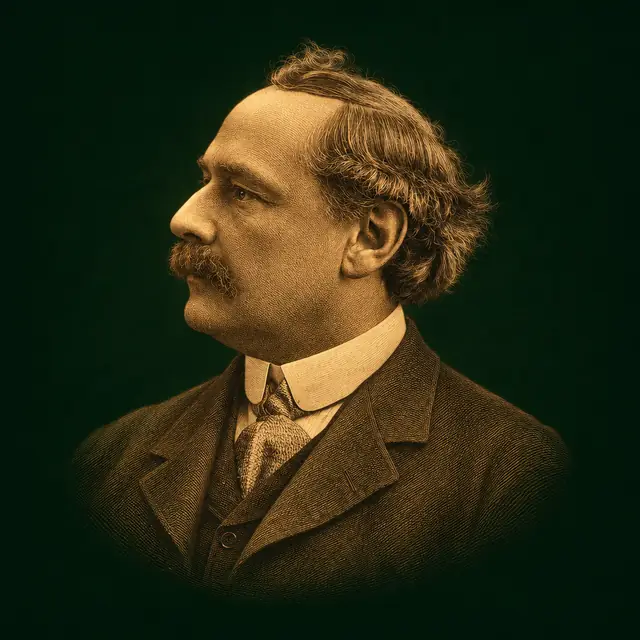
Who was Arthur Edward Waite, and what is truly known of them?
What is known
Writer and translator on magic, alchemy, the Kabbalah and the Grail, born in Brooklyn and raised in London. He put Éliphas Lévi into English from 1886, compiled The Book of Black Magic and of Pacts (1898) and wrote long, sceptical histories of the Rosicrucians and of Freemasonry. In 1909 he commissioned Pamela Colman Smith to draw a tarot of seventy-eight cards, published by Rider in London that December, and wrote the book that went with it, The Key to the Tarot, reissued with her pictures as The Pictorial Key to the Tarot. He wrote there that the cards have no known history before the fourteenth century.
The teaching
Taught from his own books, above all The Hidden Church of the Holy Graal (1909) and The Pictorial Key to the Tarot (1911).
The doctrine behind the veil
The meaning Waite gave each card, and his way of laying them out, are taught in full in The tarot and in Bring your own draw. What is his own is the way he divides the subject. Fortune told by the cards is, in his teaching, their lowest use and belongs to what he calls the outer method; above it stands the doctrine behind the veil, in which the twenty-two trumps picture the soul's way from the Fool, the spirit in search of experience, to the World, the universe come to understand itself in God. The pictures are for contemplation before they are for divination.
The way of divine union
What mattered most to Waite was mysticism, and he defines it plainly: the soul's direct experience of God and its return to union with God, its source. Every rite, symbol and doctrine he studied he weighed by that end. Magic, which seeks powers and phenomena, is at best a distraction from it and at worst its opposite; the goetic rites of the grimoires, which he printed so that they might be known for what they are, he judges folly or worse. The mystic asks nothing of God but God.
The way, in his account, is the old one of the Christian contemplatives: the turning of the will from self toward God, the purifying of desire, prayer that grows quieter as it deepens, and at last a union in which the soul knows itself in God. It asks nothing extraordinary of the body, and its proof is the life it makes.
The hidden church of the Graal
The Hidden Church of the Holy Graal reads the Grail romances as the trace of an inward Christian tradition. In Robert de Boron's telling, the first to make the Grail the cup of the Last Supper, Christ himself gives Joseph of Arimathea the vessel and certain secret words, and Waite sees in that gift the sign of a sanctuary behind the visible Church, a line of keepers sprung from Joseph rather than from Peter, guarding the deepest sense of the Eucharist: the presence of God received in the soul.
The quest is the soul's own. The knight who asks the question that heals the wounded king, and comes at last to see the Grail unveiled, is the seeker who reaches the experience of God; those who fail are the many who see the vessel pass and never ask what it means. The Grail, for Waite, is not an old pagan cauldron given a new name but the Christian sacrament in its most inward form.
The secret tradition
Behind the Kabbalah, the Rosicrucians and the higher grades of Masonry Waite looked for one thing, which he calls the secret tradition: the experience of the soul's way to God, set down under the symbols of each. The lost Word of the Masons, the rose on the cross and the cup of the Grail are, in his reading, pictures of the same quest. He held at the same time that the age of a society is to be shown from its documents and not asserted, and that a rite is to be judged by what it means and not by the antiquity claimed for it.
A rite without magic
When the Golden Dawn split, he rewrote its rituals for the branch he led, taking out their magic and keeping the Tree of Life as a ladder of contemplation, and his Fellowship of the Rosy Cross was built to the same plan. Its grades mark stages of the soul's ascent to God, not degrees of power, and its work is prayer and meditation on the symbols, not the calling of any spirit.
Orders and memberships
Initiated into the Hermetic Order of the Golden Dawn in January 1891; he left, rejoined in 1896, and after the split of 1903 led a branch of his own, replaced in 1915 by his Fellowship of the Rosy Cross. Made a Freemason in 1901 and admitted to the Societas Rosicruciana in Anglia in 1902. All documented.
The legend
That the tarot keeps a secret doctrine handed down from ancient Egypt. Waite himself called that story an invention of the eighteenth century, though he held that the pictures carry a mystical meaning of their own. It is also often assumed that he designed every card; how far the scenes of the forty numbered cards are his or the artist’s is not recorded.
Their works
- The Pictorial Key to the TarotBook, printed 1911
His guide to the pack he commissioned, first issued as The Key to the Tarot in 1910 and then with all of Pamela Colman Smith’s pictures. It gives a meaning for each card and a short history in which he set aside the tale of an Egyptian origin. Through the pack it accompanies, it has shaped how most readers have met the tarot for a century.
Ask the Oracle about it - The Rider Waite Smith tarotDeck, 1909
The pack of 78 cards drawn by Pamela Colman Smith to his direction and published by Rider in London in December 1909. It was the first widely sold pack to give every numbered card a full scene, and most tarot packs made since follow it. For decades it carried his name and the publisher’s and not the artist’s.
How far the scenes of the numbered cards are his or the artist’s is not recorded.
Ask the Oracle about it - The Mysteries of MagicTranslation, 1886
A digest of the writings of Éliphas Lévi, chosen and put into English by Waite. It was his first book on magic and one of the first ways English readers met Lévi at all. He later gave a fuller version of Lévi’s chief work as Transcendental Magic in 1896.
Ask the Oracle about it - The Real History of the RosicruciansBook, 1887
An early history that printed the Rosicrucian manifestos of the seventeenth century in English and weighed the claims made for the brotherhood. Already sceptical, it found no proof that the order had ever existed as it described itself. He returned to the subject at much greater length in The Brotherhood of the Rosy Cross in 1924.
Ask the Oracle about it - The Book of Black Magic and of PactsBook, 1898
A compilation and study of the old grimoires, the handbooks of ritual magic, with long passages translated from them. Waite wrote it as a historian and a critic, and said plainly that he thought their goetic rites foolish or worse. It became a standard source for anyone studying the grimoire tradition.
Ask the Oracle about it - The Hidden Church of the Holy GraalBook, 1909
A long study of the Grail romances, arguing that behind them lies a tradition of inward Christian mysticism kept apart from the visible Church. It shows the mystical side of his thought, which mattered more to him than the tarot ever did. Scholars of the romances do not follow its argument, but it was widely read.
Ask the Oracle about it
How the house tells a life
This life is told from the record, with what is documented, what is legend and what was forged kept apart. A membership in an order is stated only where documents show it. A person’s chart explains none of their deeds.
The arts it feeds
Tarot, runes, I ChingOrders and mystery schoolsThe Tree of LifeAlchemy
Lives near it in time
Lives and legends
Anna KingsfordAnnie BesantWilliam Wynn WestcottCharles LeadbeaterMacGregor MathersLéo TaxilJoséphin PéladanFlorence FarrRudolf SteinerStanislas de GuaitaPapusMax HeindelThe whole tree

