
Max Heindel
1865 to 1919
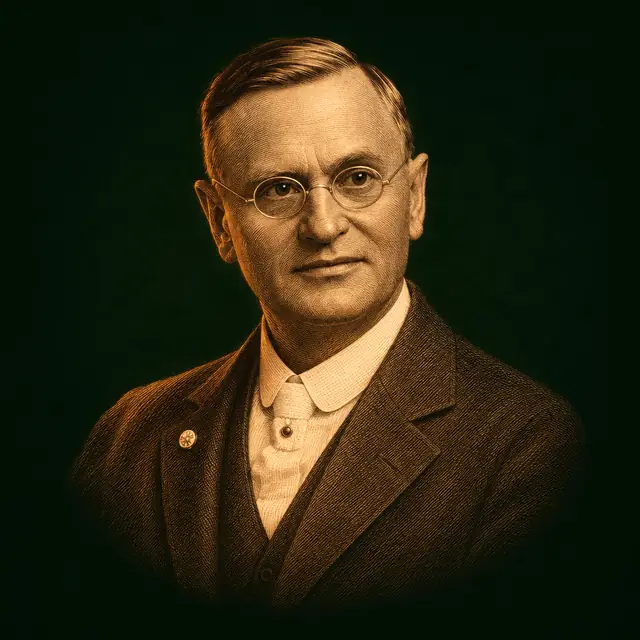
Who was Max Heindel, and what is truly known of them?
What is known
Born Carl Louis von Grasshoff at Aarhus in Denmark, a ship’s engineer who settled in Los Angeles in 1903 and joined the Theosophical Society there. In 1907 he went to Germany and heard Rudolf Steiner lecture. Back in America he published The Rosicrucian Cosmo-Conception (1909), whose first edition was dedicated to Steiner, and founded the Rosicrucian Fellowship, which from 1911 had its seat at Mount Ecclesia, Oceanside, California. It taught by correspondence a Christian mysticism joined to astrology and to healing by prayer, and it still exists.
The teaching
Taught from The Rosicrucian Cosmo-Conception (1909) and the lessons of his Rosicrucian Fellowship.
The seven worlds and the bodies
The Rosicrucian Cosmo-Conception teaches that the universe is built of seven worlds, interpenetrating one another and differing in the fineness of their matter: from the highest, the World of God, through the World of Virgin Spirits, the World of Divine Spirit, the World of Life Spirit and the World of Thought, down to the Desire World and the Physical World. The human being is a threefold spirit, Divine Spirit, Life Spirit and Human Spirit, clothed in a mind and in three bodies: the dense body; the vital body, which carries the forces of life and of memory; and the desire body, the vehicle of feeling.
The vital body is the key to much of his teaching. It is made of ether, it builds and repairs the dense body, and it is the seat of memory, in which the pictures of a whole life are kept.
The panorama of the past life
At death the silver cord that joins the higher bodies to the dense body is loosed, and for about three and a half days the spirit, still in the vital body, watches the whole life just ended pass before it, backward from death to birth. Heindel asks that the dying be kept in quiet, without loud grief at the bedside, and that the body be neither embalmed nor burned during those days, so that the panorama is not disturbed, since its pictures are etched into the desire body and become the ground of all that follows.
In purgatory, in the lower Desire World, the spirit lives through the pain it caused others, scene by scene, until its evil habits are burned out; in the first heaven it lives through the good it did, and the lesson of each is distilled into conscience and virtue for the next life. In the second heaven, in the World of Thought, it works on the patterns of its next body and surroundings, and in time it is drawn back to birth.
Retrospection and concentration
The Fellowship's two daily exercises follow from this. Each night, before sleep, the student reviews the day backward, from evening to morning, looking at each scene as an onlooker would, feeling sorrow for every wrong and gratitude for every good, and resolving to do better. What is judged and repented each night, Heindel holds, need not be lived through again after death, and the review makes the student's own conscience the judge, day by day.
Each morning, on waking, the student holds the mind for a few minutes on a high ideal, steadily, and passes from concentration on it to meditation. Those who take the Fellowship's pledge as probationers also keep from meat, strong drink and tobacco, which he counts part of the purifying of the bodies.
The order and its emblem
Heindel's account of the Rosicrucian Order, the brotherhood the manifestos tell of in The Rosicrucians, makes it a school of twelve brothers gathered round a thirteenth, founded by the teacher who bore the name Christian Rosenkreuz and working unseen for the spiritual growth of the West. Its emblem is the rose cross: a white cross wreathed with seven red roses and a golden star at its centre, the roses for the blood made pure and free of passion and the star for the spirit, so that cross, roses and star together picture the purified life the student is to reach.
Healing and the stars
The Fellowship heals by prayer. Invisible helpers, he teaches, work by night on the sick whose names are sent to the Fellowship, and its members meet in healing services timed by the moon's entry into a cardinal sign, to send out the force of their prayer together. The house teaches it as what he held and promises no cure from it: it stands beside medicine and never in its place.
Astrology serves the same end. The horoscope, in his teaching, is the record of the destiny a person has made in earlier lives, read so that they may know themselves and work with it, and he forbade his students to tell fortunes or to cast horoscopes for money. Nothing in a chart is to be used to judge or to treat an illness.
The Christ and the year
His Christian mysticism follows the sun's year. The Christ, in his teaching, is the great spirit of the sun, who entered the man Jesus at the baptism and at Golgotha entered the earth itself, becoming its indwelling spirit. Each year his life descends into the earth in autumn, is born in it at the winter solstice, works in it through the winter and is released again at Easter, and the feasts of the Church keep that rhythm.
Orders and memberships
A member and for a time vice-president of the Los Angeles lodge of the Theosophical Society, about 1904 to 1905, and founder of the Rosicrucian Fellowship in 1909. Both documented. No tie between his fellowship and the Rosicrucians of the seventeenth-century manifestos is documented.
The legend
That an Elder Brother of the Rosicrucian Order came to him in Germany, tested him and led him to a temple near the Bohemian border, where the teaching was given. The only source is his own account. Readers have long noted how closely his book follows Steiner’s lectures of those years.
Their works
- The Rosicrucian Cosmo-ConceptionBook, 1909
His main book, setting out the evolution of the world and of the soul, rebirth and the Christian mysteries, in the teaching he called Rosicrucian. Its first edition was dedicated to Rudolf Steiner, and readers have long noted how closely it follows Steiner’s lectures of those years. It remains the core text of the Rosicrucian Fellowship.
He said its teaching came from an Elder Brother of the Rosicrucians; the only source is his own account.
Ask the Oracle about it - The Rosicrucian MysteriesBook, 1911
A shorter book giving his account of the Rosicrucian order, the founding legend of Christian Rosenkreuz and the inner life of the student. It was written as an introduction for those not ready for the longer book. No tie between his fellowship and the Rosicrucians of the seventeenth century is documented.
Ask the Oracle about it - Rays from the Rose CrossMagazine, from 1913
The magazine of the Rosicrucian Fellowship, edited from Mount Ecclesia at Oceanside, with lessons on astrology, healing by prayer and Christian mysticism. It carried his teaching to members by post. It is still published by the fellowship.
Ask the Oracle about it - The Message of the StarsBook, 1918
A book of astrology written with his wife Augusta Foss Heindel, joining the reading of horoscopes to a section on diagnosing illness from the chart. It was much used in American astrology of its time. Its medical astrology is no guide to health.
Ask the Oracle about it
How the house tells a life
This life is told from the record, with what is documented, what is legend and what was forged kept apart. A membership in an order is stated only where documents show it. A person’s chart explains none of their deeds.
The arts it feeds
Orders and mystery schoolsThe Hermetic principlesThe sky in the scriptures
Lives near it in time
Lives and legends
Arthur Edward WaiteJoséphin PéladanFlorence FarrRudolf SteinerStanislas de GuaitaPapusGrigori RasputinHarry HoudiniCarl JungAleister CrowleyEdgar CaycePamela Colman SmithThe whole tree

