
Grigori Rasputin
1869 to 1916
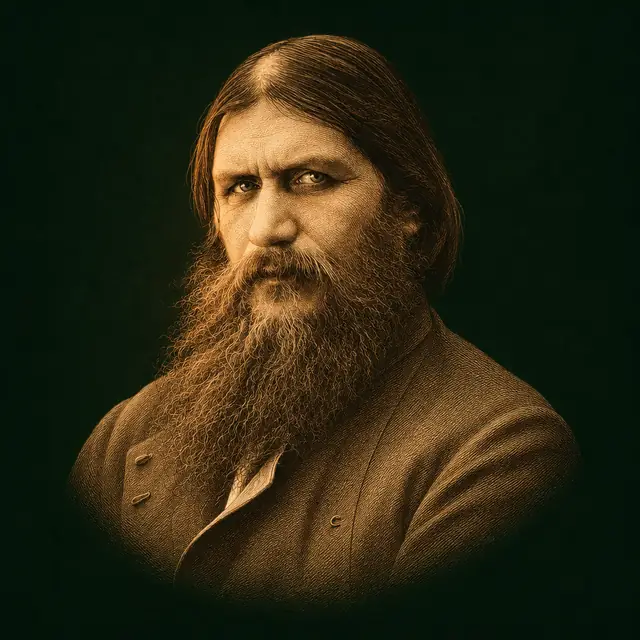
Who was Grigori Rasputin, and what is truly known of them?
What is known
Siberian peasant and wandering holy man who gained the trust of Tsar Nicholas II and Empress Alexandra because their son Alexei, who had haemophilia, seemed to recover when he prayed. He was murdered in Petrograd in December 1916 by a group led by Prince Felix Yusupov.
The teaching
Taught from his two dictated books, The Life of an Experienced Wanderer (1907) and My Thoughts and Reflections (1915).
The wanderer's road
Rasputin's piety is the piety of the Russian strannik, the wanderer who leaves house and goods to walk from one holy place to the next, living on what is given and praying as he goes. His own account begins with a life lived in the world, loving what is in the world and finding no comfort in it, and with a question that would not leave him: how is a person saved? He looked for an example among the clergy and was often disappointed, yet decided that a poor priest is still a priest, and set out on foot.
On the road he walked forty or fifty versts a day and asked nothing of storm, wind or rain. He ate seldom, in one province on potatoes alone, and for half a year he did not change his linen or touch his own body, as a hidden discipline. For three years he wore iron chains, and then laid them aside, having found, he says, the chains of love.
Labours by measure
The hardships are not the point of the road, and he says so plainly. He advises no one to ask for miracles or to take on great feats, but to take on labours according to their measure. The enemy, in his telling, envies every good deed and attacks the one who strives through weariness, hunger and sickness of the body, and the answer is a short prayer and a discipline kept in private. Once, praying bareheaded in a hard frost, he fell into a fever; what he draws from it is humility, not pride in endurance.
Nor does he send people to the cloister. He advises against leaving a wife to retire into a monastery, and holds that a person should first prove their faith in their own village, among their own people. The limits that fasting, cold and vigil need are taught on the ascetic art's pages; his road is told here as he told it, and not as a pattern to copy.
Nature as the first teacher
Nature, he says, taught him to love God and to speak with him. He prayed while he worked and while he watched the horses at pasture, and he read the Gospel every day. Spring is for him a great feast of the spirit, an Easter of the soul, when the heart that seeks the Lord blossoms as the earth does. Even the gnats and gadflies that tormented him while he gathered bast on the islands he would not strike, since they too were God's creatures, and from them he learned patience.
Love without distinction
Love is the measure he returns to. He loved, he says, without distinction, and fed the wanderers who came to him from what little he had. He sets love above learning and above every feat of the body. The simple peasant, in his eyes, stands great before the Lord, nearer to Christ than the rich man, who may race along behind a troika and still carry a carriage full of gloom.
Prayer, for him, is not shut inside the church. In his later book he writes that one may pray to God in the dance as well as in a monastery, as David danced before the Ark. He honours the priest in the church whatever the man may be outside it, and lays the priest's failings at the enemy's door and not the office's.
The pilgrim at Jerusalem
His second book follows his pilgrimage to Jerusalem: the holy places, the tears and thanksgiving of the pilgrims, and the joy of the Orthodox Easter, which he sets beside the Catholic feast, joyless in his eyes, and cries that the Orthodox are the happy ones. It also tells the humble beginning he wished to be remembered, when he came to the capital with a single rouble and knelt before a doorman who struck him.
The prayers at the sickbed
At court he stood for one thing above all: prayer for the heir. The empress believed that the boy's bleeding eased when Rasputin prayed, and in 1912, when Alexei lay near death at Spała, he sent word that God had seen her tears and heard her prayers, that the little one would not die, and that the doctors should not trouble him too much. The bleeding stopped, and the family took it for an answer. That is what was claimed, and the house tells it so: the bleeding of haemophilia can ease of itself, and prayer is no treatment for it.
Orders and memberships
He was never a priest or a monk of the Russian Church, and belonged to no secret order. A charge that he was of the Khlyst sect was investigated and not proven.
The legend
That poison and bullets could not kill him. The tale is Yusupov’s own; the post-mortem found death by gunshot.
Their works
- The Life of an Experienced WandererBook, 1907
A short account of his years as a wanderer to holy places, dictated by Rasputin, who barely wrote, and taken down by others. It shows the plain piety of a Russian pilgrim of his time. It is one of the few texts in his own words.
It was taken down from his speech and edited by others.
Ask the Oracle about it - My Thoughts and ReflectionsBook, 1915
A small book of his meditations on a pilgrimage to Jerusalem and on prayer and faith, printed in Petrograd. Like the earlier text it was dictated and edited. It shows how he wished to be seen, as a simple man of God.
It was taken down from his speech and edited by others.
Ask the Oracle about it - RasputinAccount, 1927
The account by Prince Felix Yusupov of the murder he led in December 1916, published in exile. It is the source of the tale that poison and bullets could not kill Rasputin. The post mortem examination found death by gunshot, and historians read Yusupov’s book as a defence of himself.
Ask the Oracle about it - The Real RasputinAccount, 1929
A memoir by his daughter Maria, who had lived with him in Petrograd. It offers a loving portrait of her father against the many hostile accounts of the time. Like the others, it must be read with care.
Ask the Oracle about it
How the house tells a life
This life is told from the record, with what is documented, what is legend and what was forged kept apart. A membership in an order is stated only where documents show it. A person’s chart explains none of their deeds.
The arts it feeds
Lives near it in time
Lives and legends
Joséphin PéladanFlorence FarrRudolf SteinerStanislas de GuaitaPapusMax HeindelHarry HoudiniCarl JungAleister CrowleyEdgar CaycePamela Colman SmithAlice BaileyThe whole tree

