
Joséphin Péladan
1858 to 1918
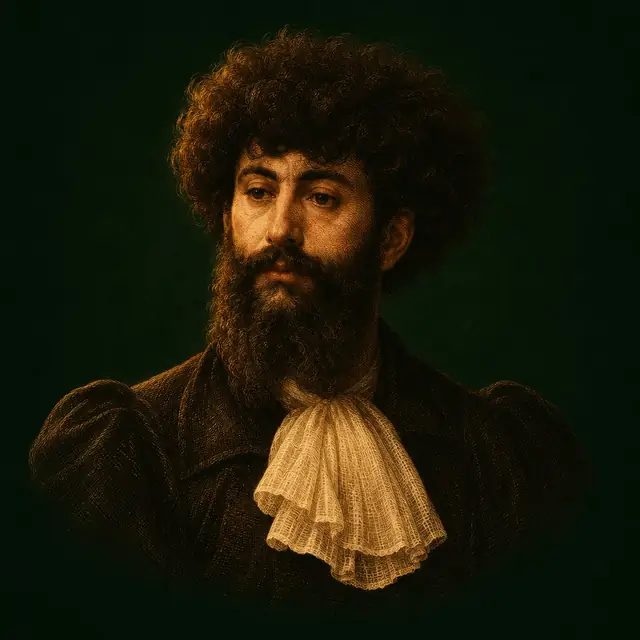
Who was Joséphin Péladan, and what is truly known of them?
What is known
French novelist and art critic, born at Lyon into a devout and eccentric Catholic family. His first novel, Le Vice suprême (1884), made him known in Paris, where he dressed in robes and took the Babylonian title Sâr. In 1888 he founded the Kabbalistic Order of the Rose-Croix with Stanislas de Guaita, broke with it within three years as too little Catholic, and set up his own Order of the Catholic Rose-Croix, of the Temple and the Grail. From 1892 to 1897 it held six yearly Salons de la Rose-Croix, which showed the Symbolist painters; Erik Satie wrote music for the first.
The teaching
Taught from his own books, above all Comment on devient mage (1892), with the rules of his Salons de la Rose+Croix.
How one becomes a magus
Comment on devient mage is addressed to a young man of its day, and it teaches that a magus is not born but made, by his own hand, out of the ordinary man he is. The work is a cultivation of the self: to master the passions instead of serving them, to refuse the vulgar in thought and in taste, to keep solitude and silence, to hold to the Catholic faith, and to give the whole will to an ideal. The magus, in Péladan's teaching, is an aristocrat of the soul, whatever his birth.
The enemy is materialism, the worship of money, use and the crowd, which he sees as the sickness of the Latin world. Against it the magus sets beauty, faith and will, and his counsel is ascetic in the old sense of training: rule over the senses, sobriety, and the turning of their energy into thought and art.
Art as a sacrament
For Péladan art is a form of prayer and the artist a priest. Beauty is a way to God, the visible form of the ideal, and a masterpiece is a descent of the divine into matter, which is why art must never be put to the service of mere copying, politics or trade. The order he founded exists, as its rules declare, to restore the cult of the ideal, with tradition for its ground and beauty for its means.
The rules of the Salon
The rules of the Salons de la Rose+Croix say what that means in paint. They turn away history painting, patriotic and military scenes, pictures of everyday life, portraits that do no more than record a sitter, rustic scenes, landscapes unless composed in the manner of Poussin, seascapes, humorous subjects, still lifes, flowers and animals. They welcome the Catholic ideal and mysticism, legend, myth, allegory and dream, the paraphrase of great poetry and every kind of lyric art. The painter is to show the soul of things and not their surface.
The androgyne
Péladan holds the androgyne to be the highest image of beauty: the figure in whom the male and the female are joined and each refined by the other, which he finds in the art of the Renaissance and in Leonardo above all. In his teaching it stands for a soul in which strength and tenderness, will and intuition, are made one, and his novels set it beside the magus and the initiate against the fall of the age.
The Temple and the Grail
His own order joins three loyalties in its name: the Rose-Cross, the Temple and the Grail. It holds itself a Catholic order, obedient to the Church, and it takes its ideal from the knights of the Temple and from the quest of the Grail, which Péladan read through Wagner, whose Parsifal he counted a summit of modern art. Its works were to be works of painting, theatre and music, and its hope was to turn the age back to the ideal through beauty.
Orders and memberships
The Kabbalistic Order of the Rose-Croix, as co-founder in 1888, and his own Catholic Rose-Croix from about 1891. Both were new societies of Paris men of letters, and neither had a document from an older brotherhood.
The legend
That he was heir to the kings of Babylon and to the Rosicrucians of the seventeenth century. The first was a pose he half meant; the second he claimed through his brother, a physician, and nothing supports it.
Their works
- Le Vice suprêmeNovel, 1884
His first novel, a tale of a decadent Italian princess and the magus Mérodack who tries to save her, set in a Paris he saw as morally lost. It made him known overnight and opened his long cycle of novels. Its preface by Barbey d’Aurevilly helped launch it, and its figure of the magus became his own public role.
Ask the Oracle about it - La Décadence latineNovel, 1884 to 1925
The cycle of novels he called an éthopée, a study of manners, running to about twenty volumes. Taken together they present the Latin world as falling into decline, with magi, androgynes and initiates as the few who stand against it. They mix Catholic mysticism, occult themes and the language of art criticism.
Ask the Oracle about it - Le Fils des étoilesPlay, 1892
A pastoral drama set in ancient Chaldea, which he called a Wagnerian play. Erik Satie, then the composer of his order, wrote preludes for it, and they were played at the first Salon de la Rose+Croix. It shows his wish to join theatre, music and mystical ideals in one work.
Ask the Oracle about it - Comment on devient mageBook, 1892
How One Becomes a Magus, the first of a series of books of moral and mystical instruction he grouped as the Amphitheatre of Dead Sciences. It is less a manual of magic than a guide to an aristocratic and Catholic ideal of self cultivation. Its counsel is addressed to young men he hoped to win from the materialism of his day.
Ask the Oracle about it - Salons de la Rose+CroixExhibitions, 1892 to 1897
Six yearly exhibitions of painting held in Paris under the rules of his Catholic Rose-Croix, which barred landscapes, scenes of daily life and history painting in favour of the ideal and the mystical. They showed many of the Symbolist painters, among them Fernand Khnopff and Carlos Schwabe. They are the part of his work that art historians still study most.
Ask the Oracle about it
How the house tells a life
This life is told from the record, with what is documented, what is legend and what was forged kept apart. A membership in an order is stated only where documents show it. A person’s chart explains none of their deeds.
The arts it feeds
Lives near it in time
Lives and legends
Annie BesantWilliam Wynn WestcottCharles LeadbeaterMacGregor MathersLéo TaxilArthur Edward WaiteFlorence FarrRudolf SteinerStanislas de GuaitaPapusMax HeindelGrigori RasputinThe whole tree

