

Mystical systems
Sheol
Direct answer
Sheol is the name the Hebrew Bible gives to the place where all the dead go, righteous and wicked alike: deep, dark and silent, and not a place of reward or punishment.
$0 today, then $19/month after 7 days. Cancel anytime.
At a glance
- Also called
- Hebrew underworld, place of the dead in the Old Testament
- Found in
- Mystical Systems
- Related
- Gehenna, Hades, Last Judgment, Purgatory
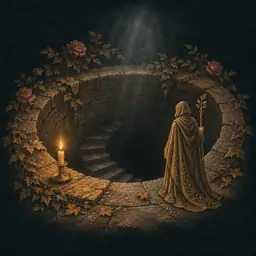

Sheol is the name the Hebrew Bible gives to the place where all the dead go, righteous and wicked alike: deep, dark and silent, and not a place of reward or punishment.
A lineage map for books and systems; it avoids presenting symbolic traditions as literal fact.
Understand the chapter you are in.
Your life’s turning points, measured from your birth.
Walk through Alex’s whole example first


Prefer to explore first?
 The Road of AgesThe turning points of your whole life, from your own chart
Walk my road
What is Sheol in the Bible?
Sheol is where the dead are in most of the Hebrew Bible. It lies below, it is dark and still, and those in it are cut off from the living and, in several psalms, from the praise of God. Jacob expects to go down to Sheol mourning his son; Job speaks of it as a place where the weary are at rest. It holds everyone, and nothing is said of judgement there.
The word occurs about sixty-five times, and its origin is uncertain. The hope that the dead will rise appears late in the Hebrew Bible and is clearest in the Book of Daniel. After that, Jewish writers spoke more of the resurrection and the world to come, and Sheol faded into the background.
On the tree of the hidden arts: Death and what follows.
What sets Sheol apart
Sheol is marked by what it lacks. There is no judgement in it, no sorting of good from bad, no fire and no bliss, and in several psalms no praise of God. People go down to it, never up, and do not return. That bareness is why the hope of resurrection, when it comes in the later books, reads as something new. The word is treated almost as a proper name and never takes the Hebrew definite article.
- Occurrences: about sixty-five in the Hebrew Bible
- Greek rendering: Hades, in the Septuagint
- King James renderings: the grave, the pit and hell
- Who goes there: everyone: Jacob, Job and the wicked alike
- Origin of the word: not known for certain
Often mistaken for something else: Gehenna is a place of punishment for the wicked in later teaching; Sheol in the older books is the common lot of all the dead.
The story behind Sheol
The Greek translation made in Alexandria from the third century BCE rendered Sheol as Hades. The King James Bible of 1611 translated it variously as the grave, the pit and hell, which has confused English readers since; most modern versions leave the word as it is. In the centuries around the turn of the era, books such as 1 Enoch began to divide the realm of the dead into separate places for the righteous and the wicked.
Why Sheol matters
Sheol shows that the oldest biblical books hoped for long life and descendants more than for heaven, a fact that surprises many readers.
How to read Sheol
Translators now usually keep the Hebrew word, and scholars use it to mark off the older biblical view from the later hope of resurrection.
Sheol in practice: an example
A reader comparing two Bibles finds hell in one psalm and Sheol in the same line of the other, and learns that the Hebrew says only the second.
Where readings of Sheol go wrong
Sheol is not hell. Reading later teachings about punishment back into the word misreads the texts in which it stands.
Sources and editorial method
This entry summarizes the tradition in the Almanac's own words; where no source is listed, it is an editorial summary rather than a primary text, and symbolic readings are named as the tradition's, not as fact.
- Source
- The Great Almanac Dictionary
- Category
- Mystical Systems
- Aliases
- Sheol meaning, Sheol in the Bible, Hebrew underworld, place of the dead in the Old Testament
- Last updated
- 2026-09-26
See Sheol in your personal almanac
A definition tells you what it is; your own birth chart tells you what it means for you. The Oracle casts your real chart and answers for your love, your work, and your year ahead, in conversation. It opens with the 7-day Oracle trial.
Speak with the OracleRelated terms
More in Mystical Systems
From the reference page to your own chart
Every word here
is in your own chart.
- Your life’s turning points, measured from your birth
- A practical next step to consider
- It opens with 7 days free: the AI Oracle on thirty hidden arts, and your daily horoscope
$0 today, then $19/month after 7 days. Cancel anytime.
Common questions
What is Sheol in the Bible?
It is the place of the dead in the Hebrew Bible, pictured as deep, dark and silent. All the dead go there, the righteous and the wicked alike.
Is Sheol the same as hell?
No. Sheol is not a place of punishment and holds everyone. The King James Bible sometimes translated it as hell, which is the source of the confusion.
What is the difference between Sheol and Hades?
Sheol is the Hebrew term and Hades the Greek. When the Hebrew Bible was put into Greek, Hades was chosen to translate Sheol, and the New Testament uses it in that sense.


