
The Greek underworld
Hades, the river and the ferryman: where the Greeks said the dead go.
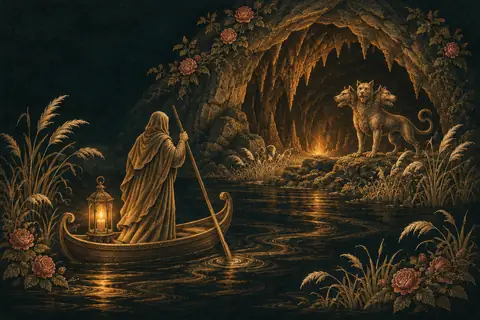
What did the Greeks say of the underworld and the journey there?
What it is
The Greeks called the realm of the dead Hades, after the god who rules it. In Homer it lies at the far edge of the world, and the dead there are shades, without strength or pleasure. Later tellings give it a geography. Hermes, as psychopomp or guide of souls, leads the dead down; the ferryman Charon carries them over the Styx for a coin; the dog Cerberus keeps the gate. The many drift in the Asphodel Meadows, the great offenders are held in Tartarus, and a favoured few come to Elysium, a place of ease.
The teaching
As the Greek and Roman tradition of Homer, Plato and Virgil teaches it.
The shade
In Homer, death parts a person in two. The body stays behind for the fire. What goes down to Hades is the psyche, the shade: a likeness of the living person, with their face and even their wounds, but without strength, warmth or understanding. Odysseus's mother explains it to him among the dead. When life leaves, she says, the sinews no longer hold the flesh and bones together, the fire consumes them, and the soul slips away and hovers like a dream. The shades flit and twitter like bats in a cave. Only the prophet Tiresias keeps his mind there, by the gift of Persephone. She is the realm's queen: the daughter of Demeter, whom Hades, brother of Zeus and king of the dead, carried off below, and who spends part of each year with him and part in the upper world with her mother.
The guide, the ferry and the fare
The dead do not find the way alone. Hermes, the guide of souls, leads them down with his golden wand. At the water's edge waits Charon, the old ferryman, who takes the fare, a small coin called an obol that the living lay in the mouth of the dead. In most Greek tellings he ferries them over the Acheron; in Virgil and many later writers the crossing is over the Styx.
The fare is not enough without the rites. The shade of Patroclus comes to Achilles in a dream and begs to be buried quickly, so that he may pass the gates, for the other shades keep him back. In Virgil the unburied crowd the bank for a hundred years, stretching out their hands in longing for the farther shore, until at last they are allowed to cross.
The five rivers
Rivers bound and cross the realm, and their names say what they hold. Styx is the hateful, the river by whose water the gods swear their most binding oath. Acheron is woe. Cocytus is wailing. Pyriphlegethon, the fire-blazing, runs with flame. Lethe is forgetting, and whoever drinks its water loses the memory of their life.
The hound at the gate
At the gate lies Cerberus, the hound of Hades. Hesiod gives him fifty heads, and later art three. He fawns on those who come in, wagging his tail and laying back his ears, and devours any who try to leave. Only the great figures of myth get past him: Heracles drags him up into the light as the last of his labours, Orpheus lulls him with the lyre, and in Virgil the Sibyl throws him a cake of honey and drugged grain so that Aeneas can go by.
The judges at the crossroads
In the myth Socrates tells at the end of Plato's Gorgias, Zeus decrees that the dead be judged naked, stripped of body, rank and fine clothes, by judges who are naked too, so that soul looks upon soul and nothing hides the truth. His sons sit in a meadow where the road divides: Rhadamanthys judges those who come from Asia, Aeacus those from Europe, and Minos gives the final word when they are in doubt. One road leads to the Isles of the Blessed and the other to Tartarus. The judges read a soul as a doctor reads a body: a life of cruelty and lies leaves it scarred and crooked, and a life of justice leaves it straight.
The Asphodel Meadow
Most of the dead go neither up nor down. In Homer they wander the Asphodel Meadow, a plain of pale flowers, keeping something of their old manner and nothing of their old strength. Agamemnon still grieves over his murder, Achilles still asks after his son, and Ajax, still angry over the armour of Achilles, turns away from Odysseus without a word. It is not a punishment. It is the common lot, faint and joyless, and the poems tell it to show how much the living have.
Tartarus
Tartarus lies as far beneath the earth as the sky is above it: Hesiod says that a bronze anvil would fall nine days and nights from the sky to the earth, and nine more from the earth to Tartarus. The Titans are shut there behind bronze gates. Of the great offenders against the gods, Odysseus sees three. Tityos lies stretched over the ground while two vultures tear at his liver. Tantalus stands in a pool up to his chin, and the water drains away whenever he stoops to drink, while the wind tosses the fruit above him out of reach. Sisyphus heaves a great stone up a hill, and just short of the top it rolls back down.
Plato gives the pit a second use. In the Phaedo those whose wrongs cannot be cured are thrown in and never come out. Those whose wrongs were great but curable, such as one who struck a parent in anger and repented all his life, are cast in for a year and then washed out by the rivers to the Acherusian lake. There they cry out to those they wronged and beg to be let out. If the wronged forgive them, their suffering ends; if not, they are swept back, and so again, until they are forgiven.
Elysium and the Isles of the Blessed
For a favoured few there is another lot. Homer's Elysian plain lies at the ends of the earth, where fair-haired Rhadamanthys rules and life is easiest: no snow, no heavy storm, no rain, only the west wind blowing cool from the Ocean. Hesiod sets the heroes of the age of Troy in the Isles of the Blessed beside deep-swirling Ocean, where the earth bears honey-sweet fruit three times a year. Pindar opens the isles to those who keep their souls from all wrong through three lives in this world and three in the next. Virgil moves Elysium below the earth and gives it its own sun and stars, broad meadows, games, dances and song: the home of the good, the pious, the poets, and those who made life better by their arts.
The tale of Er
Plato ends the Republic with the story of Er, a soldier who lay ten days among the dead of a battle and on the twelfth woke on his funeral pyre to tell what he had seen. The souls came to a meadow with two openings into the earth and two into the sky, and judges sat between them. The just were sent up to the right, through the sky, and the unjust down to the left, each wearing a token of the judgement. From the other openings souls returned from journeys of a thousand years, those from below dusty and worn, those from above clean, and told one another what they had seen: every wrong repaid tenfold, and every kindness rewarded in the same measure.
After seven days in the meadow they journeyed to a column of light that binds the heavens, brighter than a rainbow, where the spindle of Necessity turns, with a Siren on each of its whorls singing a single note, so that together they make one harmony. Around it sit the three Fates, daughters of Necessity: Lachesis singing of what was, Clotho of what is, and Atropos of what will be.
The choice of lives
A prophet takes lots and patterns of lives from the lap of Lachesis and proclaims that each soul will choose its own life and its own guardian spirit: the blame belongs to the one who chooses, and god is blameless. The patterns are of every kind, tyrannies, beauty, fame, obscurity, the lives of animals. The soul with the first lot, which had come down from the heavens after a life of good habit without wisdom, seizes at once the greatest tyranny, and only afterwards sees that it holds the eating of his own children.
The others choose by what their last life taught them. Orpheus, who died at the hands of women, chooses to be a swan; Ajax a lion; Agamemnon an eagle. Odysseus, with the last lot, cured of ambition by his labours, searches a long time and finds lying neglected the life of a private man who minds his own business, and says he would have chosen it had his lot been first. Each soul is given its guardian spirit, its choice is spun fast by Clotho and made irreversible by Atropos, and it passes beneath the throne of Necessity.
The river of forgetting
Then the souls cross the burning plain of Lethe and camp by the river of Unmindfulness, whose water no vessel can hold. All must drink a measure, those without wisdom drink more, and each as they drink forgets everything. At midnight there is thunder and an earthquake, and they are carried up to their births like shooting stars. Er was not allowed to drink, and so he remembered.
The Greek mysteries taught their initiates the other road. The gold leaves buried with some of the dead tell them to pass by the first spring, beside a white cypress, and go on to the lake of Memory, and to say to its guardians that they are a child of Earth and starry Heaven, parched with thirst, and to ask for a drink of its cold water.
How it is practised
These stories were never a rite for the living to perform, and the house gives none. They are read. A reader can take one scene, such as the meeting of Odysseus with his mother's shade, whom he tries three times to hold, and ask what it says about grief that still rings true. The Greeks also kept customs of remembrance: a coin, a lock of hair, wine and oil poured at the grave on set days. Saying someone's name aloud on the day they died is the plainest heir of that custom.
Where it comes from
The Odyssey, set down around the eighth or seventh century BCE, has Odysseus call up the shades with an offering, and the shade of Achilles tells him he would sooner be a poor man's hired hand among the living than a king among the dead. Plato closed the Republic, about 375 BCE, with the tale of Er, in which souls are judged, choose new lives and forget the old ones on the plain of Lethe. Virgil's Aeneid, left at his death in 19 BCE, mapped the place in full and shaped every later picture of it, Dante's among them.
What is known, and what is not
The poems and vase paintings are well preserved, so the picture is known. It was never a creed. Greek beliefs about death varied by city, cult and century: the mysteries of Eleusis promised initiates a better lot, small gold tablets buried with some of the dead gave them directions, and philosophers such as Epicurus held that death is simply the end. The coin for Charon is found in many graves and is absent from many more. All of it is story and custom, not report.
Its words
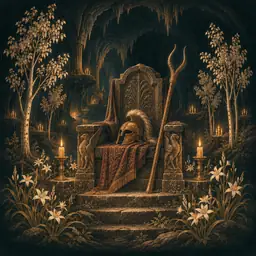 Hades
- The Greek god of the dead, and by extension his realm, where in Homer the dead are strengthless shades.
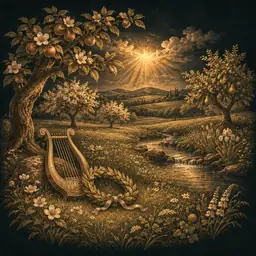 Elysium
- The happy place of Greek myth, kept for heroes and the favoured few: a plain at the ends of the earth in Homer, a part of the underworld in Virgil.
- Tartarus
- The pit far below Hades in Greek myth: first the prison of the Titans, later the place where poets and philosophers set the great offenders.
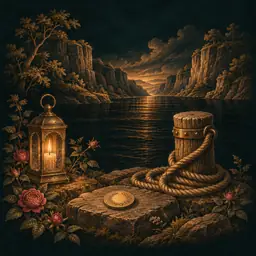 Styx
- The river of the Greek underworld by which the gods swore their most binding oath, and which later tellings have the dead ferried across.
- Charon
- The old ferryman of Greek and Roman myth who takes the buried dead over the river for a small coin. He judges no one.
- Lethe
- Forgetting: the plain and river of the Greek underworld whose water takes away the memory of a life, in Plato before souls are born again.
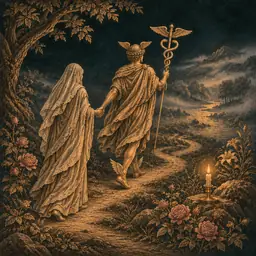 Psychopomp
- A guide of souls: the figure who leads the dead to their place, as Hermes does in Greek myth and Anubis in Egyptian.
- Valhalla
- Odin's hall in the Norse poems, where warriors chosen from the battle dead feast and fight until the last battle. Written down in Christian Iceland.
Ask the Oracle further
Who was Charon, and why did the Greeks bury a coin for the crossing to the underworld?What were Elysium and Tartarus in the underworld of the Greeks?
Before you practise
The Oracle tells what the traditions teach about death and names whose teaching it is. Nobody knows what follows, and it will not tell you where someone you have lost is now. If you are thinking of ending your life, please call your local emergency number or a crisis line now.
Its other branches
Near-death experiencesThe weighing of the heartThe Tibetan bardoJudgement and the world to comeDeathbed visionsHow the traditions mournThe whole artSearch the tree

