
Near-death experiences
What people who came close to death report, and why researchers do not agree on it.
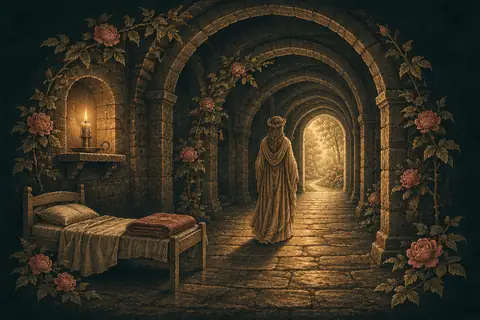
What do people report in near-death experiences, and what do researchers make of them?
What it is
A near-death experience is what some people report after coming close to death, for instance after the heart has stopped and been started again. The accounts share features: a feeling of peace, a sense of being apart from the body, a dark passage or a light, meeting figures, seeing one's life pass, which is called the life review, and a border that is not crossed. Not every account has all of them, and a minority are frightening. Many who have had one say that it changed how they live and that they fear death less.
The teaching
As the testimony Moody, Ring and Greyson gathered from those who came back teaches it.
The threshold seen from this side
Every account in this teaching comes from someone who lived. A heart stopped and was started again, an accident or an illness came close to the end, and the person woke and told what they remembered. What follows is the shape those memories take, in the order their tellers give. It describes a threshold seen from the near side. None of the tellers went past it, and they do not claim to say what lies beyond.
Words that do not fit
The first thing nearly every teller says is that it cannot be put into words. Raymond Moody, who gathered the first large collection of accounts, met this so often that he set it at the head of his list. People speak of a light and a clarity greater than waking life, of thoughts that ran faster and clearer than usual, and of time that seemed to slow or stop. Many say that whatever they tell is a rough translation, smaller than what happened.
The news, the quiet and the sound
Some hear themselves pronounced dead, by a doctor or a nurse in the room, and can later repeat what was said. Then, in most accounts, the pain stops. In its place comes a deep quiet and a sense of being entirely well, which Kenneth Ring, who counted the parts of the experience in the order they come, set as the first of five stages. Some hear a sound as it begins: a buzzing, a ringing, a rushing like wind, and now and then something they call music.
Leaving the body
In Ring's second stage the person finds themselves outside their body, usually above it, looking down at the bed, the road or the operating table and at the people working there. They describe the scene calmly, as if from a little way off, and sometimes in detail. Many try to speak to those below or to touch them, and find that no one hears or feels them. The body itself is often seen without alarm, as something set aside.
The darkness and the passage
The third stage is a darkness: a void, a valley or a tunnel through which the person moves, often quickly and sometimes with the sound rising around them. In the peaceful accounts it is not frightening. It has a direction, and at its end there is light.
The light
The light is the part tellers struggle most to describe. It is brighter than anything they have seen, and yet it does not hurt to look at. Many say it was not only a light but a presence, which knew them completely, accepted them as they were, and spoke without words. People name it from their own faith, as God, as Christ, as an angel, and those of no faith often give it no name at all. This seeing of the light is Ring's fourth stage.
Fewer go on into the light itself, his fifth stage, and describe another country: fields, gardens, a city, a landscape of colour and brightness. At each stage fewer people report it than at the stage before, so that the whole sequence, from the quiet to the entering of the light, is the rarest account of all.
Those who are met
Many meet people they knew who have died: a mother or father, a grandparent, a brother, a friend. The meeting is told as a welcome, and in a striking number of accounts it is these same people who say that the teller must go back. Some meet figures of their own religion, and some a guide they cannot name.
The review
Some see their whole life at once, or scene after scene at great speed, more vivid than memory. Many say they felt what their acts had done to others, the hurt and the kindness alike, as if from the other side. The review is rarely told as a sentence passed. Moody's tellers said that the presence seemed to ask, in effect, what they had done with their life, and that what counted in the end was how well they had learned to love and what they had come to know.
The border
Then comes a limit: a fence, a river, a door, a line, or simply the knowledge that past this point there is no return. Here the teller is sent back, or chooses to come back, very often for the sake of someone they love: a child still to raise, a husband or wife, work not yet finished. Some say they were told it was not their time. The return is sudden, often with pain, into the body on the bed.
The sixteen marks
Bruce Greyson drew the parts together as sixteen marks in four groups, and an account is scored by how many it holds and how strongly. In thought there are four: time slowed or stopped, thoughts running fast, the life reviewed, and a sudden sense of understanding everything. In feeling there are four: peace, joy, a sense of unity with all things, and the light. In the senses there are four: sight and hearing unusually vivid, an awareness of things happening elsewhere, glimpses of what was to come, and leaving the body. And beyond these there are four: another world, a presence or a voice, the dead or holy figures, and a border not crossed.
When it is frightening
Not every account is peaceful. A minority are distressing, and their tellers are often slow to speak of them. Greyson and Nancy Evans Bush described three kinds: the usual features felt as terror rather than peace; a void, an endless emptiness in which the person is utterly alone; and, more rarely, scenes like the hells of religious art. Such an experience says nothing about the worth of the person who had it, and they deserve the same hearing as anyone else.
Coming back
Those who come back speak of the return as hard as well as good. Most say they fear death less, care more for people and less for status and money, and feel that their life has a purpose to be lived out. Many also say that they felt alone afterwards: they were not believed, or did not dare to tell, and for a time found ordinary life strange. The accounts turn, in the end, toward living. Their tellers came back to finish something, and that is what they set out to do.
Anyone who reads these accounts and finds in them a pull toward dying, rather than toward living, should speak to someone today: a doctor, a crisis line, or the local emergency number.
How it is practised
There is nothing here to try, and the house offers no way to bring such an experience on. What a reader can do is read the accounts with care. Note who collected each one and how long after the event, since a memory is shaped each time it is retold. Listen without arguing when someone tells theirs: many people who have had one say they kept silent for fear of not being believed. Anyone still troubled by an experience of their own can take it to a doctor or a counsellor who knows this field.
Where it comes from
Accounts of this kind are old. Plato's tale of Er and the monk Bede's story of Drythelm, written about 731, both tell of a man who came back. In 1892 the Swiss geologist Albert Heim gathered what climbers remembered of their falls. The modern study began when Raymond Moody collected about 150 accounts in Life After Life in 1975 and gave the experience its name. In 1983 Bruce Greyson published a scale of sixteen questions that researchers still use. In 2001 Pim van Lommel's team reported in The Lancet that 62 of 344 Dutch survivors of cardiac arrest described one.
What is known, and what is not
These reports are well documented in many countries, from about one in ten to one in five survivors of cardiac arrest. What they show is disputed. Some researchers take them as a sign that the mind can work apart from the brain; most neuroscientists look to a brain losing oxygen and recovering, though no such account is confirmed. A study of 2014 hid pictures in resuscitation rooms to test reports of seeing from above, but the two patients who described watching were in rooms without one, so the test was never made. Nobody knows what follows death, and these accounts do not settle it.
Its words
 Near-Death Experience
- What some people report after coming close to death: peace, a sense of being apart from the body, a light, a border not crossed. The name dates from 1975.
- Life Review
- The seeing again of scenes from one's life that a minority of people report after coming close to death. Its cause is not known.
Ask the Oracle further
What do people most often report in a near-death experience?Do near-death experiences show that there is life after death?
Before you practise
The Oracle tells what the traditions teach about death and names whose teaching it is. Nobody knows what follows, and it will not tell you where someone you have lost is now. If you are thinking of ending your life, please call your local emergency number or a crisis line now.
Its other branches
The weighing of the heartThe Greek underworldThe Tibetan bardoJudgement and the world to comeDeathbed visionsHow the traditions mournThe whole artSearch the tree

