
The weighing of the heart
Egypt’s judgement of the dead: the heart on the scale against the feather of truth.
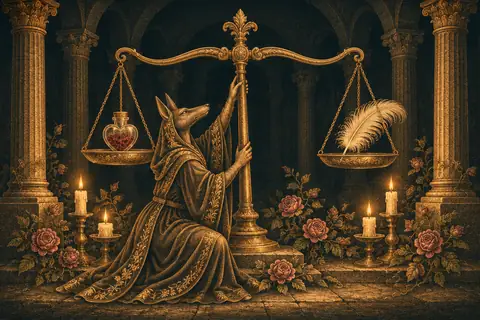
What was the weighing of the heart in the Egyptian Book of the Dead?
What it is
In the Egyptian picture of death the dead person travels through the Duat, a hidden country of gates, lakes and guardians, and comes to the Hall of Two Truths. There, in the weighing of the heart, the heart is set on a scale against the feather of Ma'at, the goddess and the principle of truth and right order. Anubis, the jackal-headed guide of the dead, steadies the balance and Thoth writes down the result. A heart as light as the feather passes on to Osiris and the Field of Reeds. A heavy one is eaten by Ammit, part crocodile, part lion and part hippopotamus, and that person is no more.
The teaching
As the Egyptian Book of the Dead teaches it.
The parts of a person
The Egyptian person is not one thing but several, and each part has its own fate at death. There is the body, preserved so that the other parts have a home. There is the heart, the seat of thought, memory and conscience, which is left in the body when the other organs are taken out. There is the name, which lives as long as it is spoken and written, and there is the shadow. There is the ka, the life force a person is born with, which lives on after death and is fed by offerings. There is the ba, pictured as a bird with a human head, which leaves the tomb by day and returns to the body at night. And there is the akh, the shining, effective spirit that a person becomes when the passage is made.
The pattern of Osiris
Every hope in the book follows the story of Osiris. The good king Osiris was murdered by his brother Seth and his body torn apart and scattered. His sister and wife Isis searched for the pieces with her sister Nephthys and gathered them, Anubis wrapped them as the first mummy, and Osiris lived again, no longer on earth but as king of the dead. Each of the dead who is rightly buried follows his path. The rites once done for him are done again for them, above all the opening of the mouth, in which a priest touches the mummy's mouth and eyes with sacred tools so that it may again breathe, eat, speak and see.
The road through the Duat
Death opens a journey through the Duat, the hidden country beyond the horizon that the Sun also crosses each night. It is a land of gates, caverns, rivers and lakes of fire, and each gate has its keeper, its watcher and its herald, many of them holding knives. The spells of the book are the traveller's equipment, and again and again they rest on one rule: to know the name of a thing is to have the power to pass it. At each gate the dead person declares that they know the keeper and know the keeper's name, and the way opens.
The Hall of the Two Truths
At the end of the road is the broad hall the book calls the Hall of the Two Truths. Osiris, lord of the dead, sits enthroned there, and forty-two judges sit with him. Anubis, the jackal-headed guide of the dead, leads the newcomer in by the hand. Before anything is weighed the dead person must speak, and the speech, set down in Spell 125, is the moral heart of the whole book.
The first declaration
The dead person greets the great god, the lord of the Two Truths, says that they know his name and the names of the forty-two who sit with him, and declares that they have come bringing truth and have driven wrongdoing away. Then follows a long list of denials. I have done no wrong to people. I have not ill-treated cattle. I have not robbed the poor. I have not caused pain. I have not made anyone go hungry. I have not made anyone weep. I have not killed, and I have not ordered anyone to kill.
The list goes on through the faults of an ordinary life in a farming land. I have not lessened the offerings in the temples. I have not taken milk from the mouths of children. I have not added to the weights of the balance or tampered with the plummet of the scales. I have not held back water in its season or built a dam against running water. It closes with one sentence said four times over: I am pure.
The forty-two judges
Then the dead person turns to the forty-two judges and addresses each one by a name and a place of origin, denying one wrong to each. The judges' names are strange and fearsome, the Far-strider, the Swallower of Shadows, the Breaker of Bones, the Eater of Entrails, so that each wrong seems to have a guardian who knows it well. To the Far-strider the dead person says that they have done no falsehood. To others they deny theft, greed, eavesdropping, quick temper, deafness to words of truth, and making others afraid. To be able to name each judge is itself part of the defence.
The heart on the scale
Now the heart is weighed. It is set in one pan of a great balance, and the feather of Ma'at, truth and right order, in the other. Anubis kneels to check the plummet, and Thoth, the ibis-headed scribe of the gods, stands ready with his palette to write down the result. The heart is the one witness that cannot be bribed or silenced, and the dead fear that it will speak against them.
So the book gives a spell to say to it, Spell 30B, which was carved on the heart scarab laid over the breast of the mummy. In it the dead person calls the heart the heart they had from their mother, the heart of all their ages, and begs it not to stand up as a witness against them, not to oppose them before the judges, and not to be hostile in the presence of the keeper of the balance.
True of voice
When the beam stands level, the heart and truth in balance, Thoth announces that the heart has been found true, and the gods declare the dead person maa kheru, true of voice: justified, acquitted, in the right. From then on the words are written after the name. Horus, the falcon-headed son of Osiris, takes the justified by the hand and leads them before Osiris, who sits enthroned with Isis and Nephthys standing behind him. The dead person is now called by the god's own name, the Osiris so and so, and joins his company.
The Devourer
Beside the balance crouches Ammit, the Devourer of the Dead, with the head of a crocodile, the forepart of a lion and the hindquarters of a hippopotamus. A heart that fails is given to her, and with it the person ends. The Egyptians feared this second death more than the first, because it leaves nothing: no ka to feed, no ba to fly, no name to be spoken. The book holds spells for not dying a second time, and its whole purpose is to bring the traveller safely past her.
Coming forth by day
The justified become an akh, and the title of the book says what an akh can do: come forth by day. The ba flies out of the tomb into the sunlight, sees the world of the living, and returns at night to the body. The book gives spells for taking any form one wishes, a falcon of gold, a heron, a swallow, a lotus, and for sailing in the boat of the Sun across the sky and through the night.
And it gives the Field of Reeds, a land like Egypt at its best, with canals and tall grain, where the justified plough, reap and live in plenty. So that they need not labour there themselves, small figures called shabtis are buried with them, and the shabti's spell tells each figure to answer, here I am, whenever its owner is called to work.
What the living do
The living had their part. The offering formula, carved on tombs and stelae, asks that the king's offering be granted to the gods so that they may give the dead person bread and beer, oxen and fowl, linen and every good and pure thing on which a god lives. Many tombs add an appeal to passers-by to say the offering aloud, since it costs nothing but breath. Saying a name was itself a gift: the Egyptians held that a name spoken keeps its owner in being, and that to wipe out a name is to wipe out the person. The scale in the hall was, for them, a reason to live rightly while there was time.
How it is practised
The Egyptians prepared for this judgement while they lived, and the list in Spell 125 can still be read as an examination of conscience: have I taken what was not mine, made anyone weep, turned the hungry away. Egyptians had the list copied onto the roll buried with them, and it is read today as a record of what they counted as wrong. The scale is a picture for weighing one's own conduct. It tells nothing about where any person who has died is now, and the house does not use it that way.
Where it comes from
The oldest writings are the Pyramid Texts, cut for kings about 2350 BCE. The Coffin Texts of the Middle Kingdom opened the same hopes to officials, and from about 1550 BCE the spells were copied on papyrus as the collection now called the Book of the Dead, which the Egyptians named the spells for coming forth by day. Spell 125 holds the declaration of innocence, a list of wrongs the dead person denies having done. The best known copy, the Papyrus of Ani, was made about 1250 BCE and is kept in the British Museum.
What is known, and what is not
The texts, the papyri and the tomb paintings are abundant and well dated, so what the Egyptians taught is known in detail. It was not one fixed doctrine: the spells varied from roll to roll, and ideas changed over two thousand years. Whether ordinary Egyptians feared the judgement or trusted the spells to carry them through is debated. The Duat and the scale are a religious teaching about what cannot be checked.
Its words
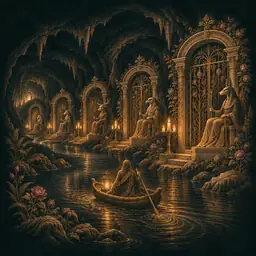 Duat
- The Egyptian realm of the dead, a hidden country of gates and guardians that the Sun also crosses each night.
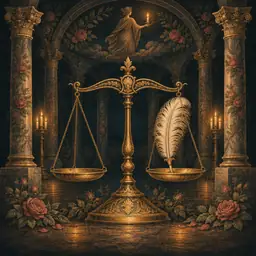 Ma'at
- The Egyptian goddess and principle of truth and right order, whose ostrich feather is the weight set against the heart.
- Weighing of the Heart
- The Egyptian judgement scene: the dead person's heart in one pan of a balance, the feather of Ma'at in the other, Anubis at the beam and Thoth recording.
- Book of the Dead
- The modern name for the Egyptian spells for coming forth by day: some two hundred spells, a selection of which was copied on a roll for the tomb.
- Field of Reeds
- Aaru, the Egyptian paradise: Nile farmland made perfect in the realm of Osiris, where those who pass the judgement plough and reap without want.
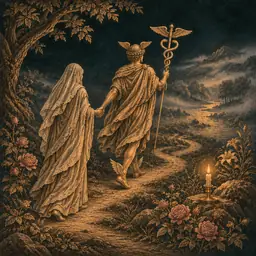 Psychopomp
- A guide of souls: the figure who leads the dead to their place, as Hermes does in Greek myth and Anubis in Egyptian.
Ask the Oracle further
What does the Egyptian Book of the Dead say happens after death?Who was Ammit, and what became of a heart that failed the weighing of the heart?
Before you practise
The Oracle tells what the traditions teach about death and names whose teaching it is. Nobody knows what follows, and it will not tell you where someone you have lost is now. If you are thinking of ending your life, please call your local emergency number or a crisis line now.
Its other branches
Near-death experiencesThe Greek underworldThe Tibetan bardoJudgement and the world to comeDeathbed visionsHow the traditions mournThe whole artSearch the tree

