
Mary the Prophetess
Active between about AD 100 and 300
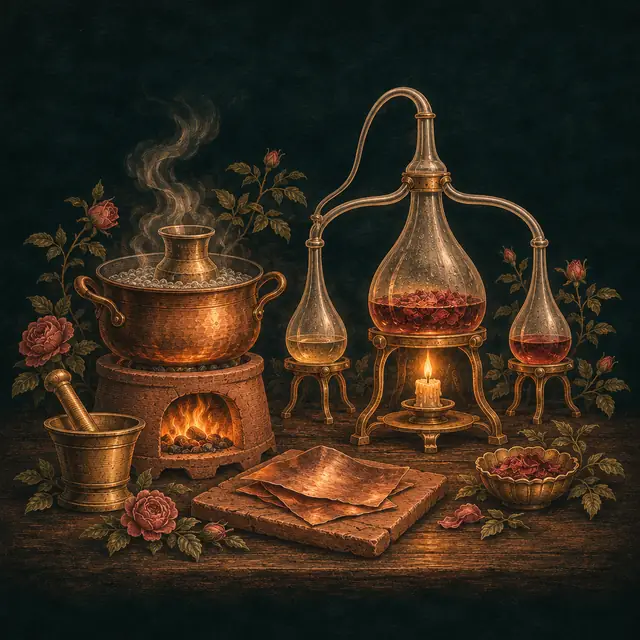
Who was Mary the Prophetess, and what is truly known of them?
What is known
The first alchemist of the Greek tradition whose practical teaching can be described: a woman who probably worked in Egypt at some time between the first and third centuries AD. Nothing she wrote survives on its own. She is known from quotations in Zosimos of Panopolis, about AD 300, who treats her as the chief authority among the ancients on apparatus. He credits her with descriptions of the tribikos, a still with three arms, of the kerotakis, a closed vessel in which metal leaf is hung in rising vapours, and of furnaces and how to seal their joints. The water bath, one vessel warmed inside another, has carried her name since the Middle Ages as the balneum Mariae, the bain-marie; whether the device was hers is not known.
The teaching
Taught from what Zosimos of Panopolis quotes of her teaching, with the later Practica under her name.
The art is in the vessels
Mary teaches the art through its instruments. What happens to a metal depends on the vessel it is worked in and on the measure of the fire, and so she sets out her vessels with a craftsman's exactness: their metal, their thickness, their length, and how their joints are sealed. The furnace, the still and the closed vessel are where the changes of the work are made to happen, and to know them is the beginning of the art.
The three-armed still
For the tribikos she has three tubes made of copper, a little thicker than a pastry cook's copper pan and about a cubit and a half long, fitted to a head set above an earthen vessel that holds the matter. Each tube runs into a flask of glass, and every joint is sealed with a paste of flour so that no vapour escapes. The vessel stands over a gentle fire: the vapour rises, cools in the head, and runs down the three arms into the flasks as a liquid.
The palette over the fire
The kerotakis takes its name from the painter's palette on which wax colours were kept soft over warm coals. Mary sets such a palette, with leaves of metal laid on it, high inside a closed vessel with a domed lid; below it lies the substance whose vapour is to work on the metal, sulphur, the sulphides of arsenic or quicksilver. The fire is kept low and steady for a long time. The vapour rises, bites into the leaves, condenses under the lid and runs back down to rise again, so that the metal is bathed over and over in a closed circle.
Later alchemists read in such vessels the order of the colours, black, white and yellow, by which they measured the progress of the work. Every substance in that vessel gives off poison when heated, and the apparatus belongs to the history of the art, not to any workbench of today.
Bodies and spirits
Her teaching on what happens in the vessel comes down in sayings. Unless the bodies are made bodiless and the bodiless made bodies, she says, and unless the two are made one, nothing that is looked for will come to pass. The fixed metal must give up its spirit, and the rising spirit must be fixed back into a body: the work lives in that exchange.
And again: join the male and the female, and what is sought is found. The male and the female are the two natures that must meet in the vessel, the fixed and the volatile, the body and the vapour. The riddle that counts from one to four, which later books hand down under her name, is taught on the page of Who the alchemists were, under Alchemy.
The later dialogue
A Latin dialogue of the Middle Ages, the Practica, puts her teaching in another voice. There Mary tells the philosopher Aros that the stone can be made in a short time. She bids him marry the gum with the gum in a true marriage, tells of a white herb that grows on small mountains, and names the vessel of Hermes, in which the work is done. It is a book of a later age written in her name, and it shows how her two lessons, the vessel and the marriage of the two natures, were remembered.
Orders and memberships
None is documented, and nothing is known of her teachers or pupils. Later alchemists report a saying of hers that the art belonged to the children of Abraham alone, which is the ground for calling her Jewish.
The legend
That she was Miriam, the sister of Moses, which is why later ages called her Mary the Prophetess. Medieval alchemists, Arabic and Latin, made the link, and others made her a pupil of the Persian sage Ostanes. The riddling saying that counts from one to four, the “axiom of Maria” that Jung prized, is first found under her name in a Byzantine compilation.
What was forged, or is false
The Latin dialogue of Mary and Aros, and other tracts printed under her name by the alchemists of the Renaissance, were written centuries after her, most of them turned from Arabic.
Their works
- Her teachings quoted by Zosimos of PanopolisAccount, about AD 300
Zosimos, the alchemist of Egypt, quotes her often as the chief of the ancients on apparatus, and through him she is known. He gives her descriptions of the tribikos, a still with three arms, of the kerotakis, a closed vessel in which metal leaf is hung above rising vapours, and of furnaces and how to seal them. His works come down in Byzantine manuscripts.
None of her own writing survives apart from these quotations.
Ask the Oracle about it - Practica Mariae ProphetissaeDialogue, medieval
A short Latin alchemical dialogue in which Mary teaches a philosopher named Aros the art of the stone, with talk of joining the male and the female and of the gum and the fire. It passed through Arabic tradition into Latin and was printed in Renaissance collections of alchemy.
It is attributed to her and is a much later work.
Ask the Oracle about it
How the house tells a life
This life is told from the record, with what is documented, what is legend and what was forged kept apart. A membership in an order is stated only where documents show it. A person’s chart explains none of their deeds.
The arts it feeds
Lives near it in time
Lives and legends
PythagorasApollonius of TyanaSimon MagusVettius ValensApuleiusIamblichusZosimos of PanopolisJabir ibn HayyanAbu Ma’sharMichael ScotAbraham AbulafiaMoses de LeónThe whole tree

