
Iamblichus
About 245 to about 325
Who was Iamblichus, and what is truly known of them?
What is known
Philosopher born at Chalcis in Syria of a noble family, who studied under Anatolius and probably under Porphyry and then kept his own school at Apamea. Against Porphyry’s doubts he wrote, in the person of an Egyptian priest, the reply known since Ficino’s Latin version of 1497 as On the Mysteries. It defends theurgy: rites with tokens, names and prayers through which, he holds, the gods themselves lift a soul that thinking alone cannot free. Four books survive of his ten on the Pythagorean teaching, among them On the Pythagorean Life, and he fixed the order in which Plato’s dialogues were read in the schools. The emperor Julian, a generation later, honoured him above all recent philosophers.
The teaching
Taught from his own books, above all On the Mysteries, with what Proclus records of his teaching on the soul.
The soul that comes down whole
Iamblichus begins with the soul's place. When it comes into a body, he teaches, it comes down whole: no part of it stays above in untroubled contemplation, as Plotinus had held. The soul in the body is truly in the body, turned outward toward the world of birth and bound by it. So it cannot lift itself back by thinking alone. Its return needs help from above, and that help is given through the rites the gods themselves established.
Contact before reasoning
Porphyry had begun by granting, for the sake of argument, that the gods exist, and Iamblichus answers that this is wrongly put. An inborn knowledge of the gods is present in our very being, before any judgement or choice, before reasoning and proof. It is not knowledge in the ordinary sense, of one thing by another, but a contact, a oneness with the gods that the soul has always had. Argument cannot reach it, and argument cannot take it away.
What the rite does
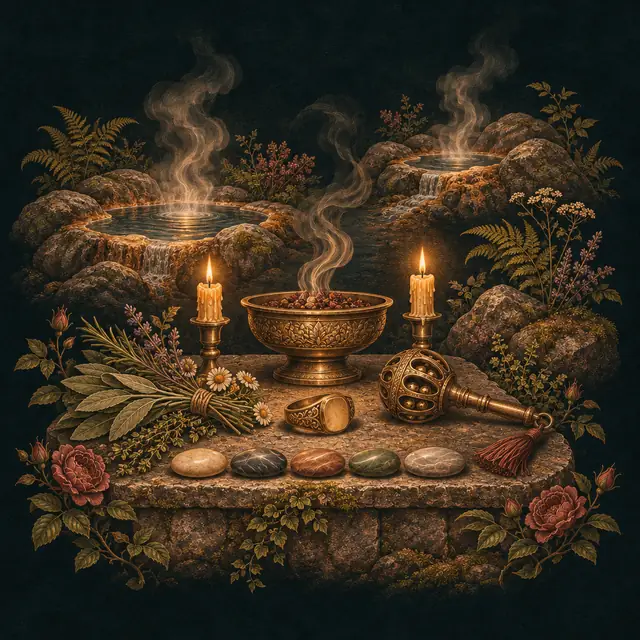
It is not thought that joins the theurgist to the gods, he teaches; if it were, philosophers would be joined to them by thinking alone. What joins him is the right performance of acts beyond telling, done as is worthy of the gods, and the power of silent tokens understood by the gods alone. The gods have sown their tokens through nature, in stones, plants and animals, in scents, sounds and names, and the rite gathers what belongs to a god and so becomes fit to receive it. The line between this god-work and sorcery is taught on the page of White and black magic, under Magic and protection.
Nothing in the rite forces the gods. They are not drawn down or swayed by passion; their light is always present, and the rite only turns the soul toward it so that the soul is lit. What changes in a rite is the worshipper, who is made like the gods and fit to share in them.
Prayer in three steps
Prayer has three steps. The first brings the soul together with the gods and gives it contact with them and knowledge of them. The second joins the soul's will to theirs, so that their gifts come down even before anything is asked. The third, the union beyond telling, rests the soul wholly in the gods. Prayer kept up long and often, he says, nourishes the mind, widens the soul to receive the gods, opens to people the things of the gods, accustoms their eyes to the brightness of the divine light, and little by little makes those who pray like the gods themselves.
Worship for two kinds of soul
Not every soul stands in the same place, and so worship has two forms. Most people live bound to the body and to nature, and for them there are rites with matter in them, offerings, sacrifices and holy places, which suit the gods who govern matter and the powers of the world. A few, and rarely, live by the mind alone, and their worship is without matter. Whoever has not yet risen to the second should not despise the first: the rites with matter are where the ascent begins, and nothing in the world, matter included, is cut off from the gods.
The sacred names are to be kept as they were handed down, in the tongues of the Egyptians and the Assyrians, and never translated. Those peoples were the first to receive the names of the gods, their languages are old and steady, and a name turned into Greek loses its power even when its meaning is kept. What sounds meaningless to us has its meaning for the gods.
Passions given their measure
Porphyry asked why some rites use obscene words and images if the gods are free of passion. Iamblichus answers that the images are tokens of the power that brings things to birth, and that the rites give the human passions a measured outlet. Passion held down grows stronger; let out briefly and in measure, it is satisfied and set at rest, as people are cleansed of their own feelings when they watch the feelings of others in comedy and tragedy. Such rites purify the worshipper; they do not move the gods.
True divination
Divination, rightly understood, is not a human skill but a gift of the gods. When a god takes hold of a prophet, the prophet's own life is set aside: the possessed do not know where they are, feel neither fire nor blows, and speak what is not theirs. At Claros the prophet drinks from the sacred spring; at Delphi the prophetess sits over the opening in the earth; at Branchidae the prophetess holds the rod or bathes her feet in the water; and in each the god comes.
The dreams the gods send are not ordinary dreams. They come when sleep is leaving the soul and waking has not yet begun: a voice tells briefly what must be done, or a light shines, or a spirit is felt passing unseen. Human divination by signs, by entrails, birds and stars, is a lower art that conjectures from the signs the gods have placed in the world, and it can err where the gift cannot.
Above fate
The soul has, as it were, two lives. One comes from the circling of the heavens and goes with their motions, and this is the soul that fate governs. The other comes from the first things known by the mind, shares in the power of the maker, and stands above the turning of the stars. Through that higher soul a person can be freed from fate, and the rites lead the soul upward and loosen fate's hold on it. The personal daimon, which he holds is given by the whole order of the world and not by a single star, is taught on the page of Daimons and intelligences, under The spirit realm.
The order of the dialogues
For his school Iamblichus fixed the road through Plato, and the order is itself a teaching. The student begins with the Alcibiades, on knowing oneself, since everything starts from that. Then come the Gorgias, on the virtues of the citizen, and the Phaedo, on the virtues that cleanse the soul from the body; the Cratylus and the Theaetetus, on words and on knowing; the Sophist and the Statesman, on nature; the Phaedrus and the Symposium, on beauty, love and the gods; and last of the first ten the Philebus, on the good, the end of them all. Two more crown the course: the Timaeus, which holds all of nature, and the Parmenides, which holds all of theology.
Number belongs on the same road. In his Pythagorean books mathematics stands between the things of sense and the things of the mind, and it is the soul's own ground: the study of number and figure draws the soul away from the senses and accustoms it to what does not change, so that it is ready for higher things. The sayings of the Pythagoreans he explains in the same spirit, as riddles that teach a way of life.
Orders and memberships
Head of his own school at Apamea, where philosophy and ritual were taught together and passed from master to pupil. No order with grades or a roll of members is documented.
The legend
Eunapius, writing about AD 400, tells that his pupils believed he rose ten cubits from the ground at prayer while his clothes turned to gold, and that Iamblichus laughed and told them it was not so. The same writer has him call up two spirits in the shape of boys from the hot springs at Gadara.
What was forged, or is false
The Theology of Arithmetic, long handed down under his name, is now usually held to be a later compilation from other writers and not his own book.
Their works
- On the MysteriesTreatise, about 300
A reply to Porphyry’s Letter to Anebo, written as from an Egyptian priest named Abammon. It defends theurgy, rites with tokens, names and prayers, as the gods’ own way of raising the soul where thought alone cannot. Ficino’s Latin version of 1497 gave it its present name, and it is the founding defence of ritual in the Platonist tradition.
Proclus names Iamblichus as the author, and most scholars accept it, though the book itself never does.
Ask the Oracle about it - On the Pythagorean LifeBiography, early 4th century
The first of his books on the Pythagorean teaching, a life of Pythagoras and a picture of his community: its silences, its diet, its friendship and its tests for entry. It gathers older sources now lost, and much of what later ages believed of Pythagoras as a holy man comes from it.
Ask the Oracle about it - ProtrepticusTreatise, early 4th century
An exhortation to philosophy, the second book of his Pythagorean series, made largely from older writings and among them long passages thought to come from a lost exhortation by Aristotle. It includes a set of Pythagorean sayings with their hidden meanings explained.
Ask the Oracle about it - The Theology of ArithmeticTreatise, late antiquity
A book on the numbers from one to ten and the gods, virtues and natures that each was held to stand for in Pythagorean thought. It was long read as the seventh book of Iamblichus’s series and is a chief source for number lore.
It is now usually held to be a later compilation from other writers, not his own book.
Ask the Oracle about it
How the house tells a life
This life is told from the record, with what is documented, what is legend and what was forged kept apart. A membership in an order is stated only where documents show it. A person’s chart explains none of their deeds.
The arts it feeds
Lives near it in time
Lives and legends
PythagorasApollonius of TyanaSimon MagusVettius ValensApuleiusMary the ProphetessZosimos of PanopolisJabir ibn HayyanAbu Ma’sharMichael ScotAbraham AbulafiaMoses de LeónThe whole tree

