
Who the alchemists were
From Alexandria and Jabir to Newton’s private papers.
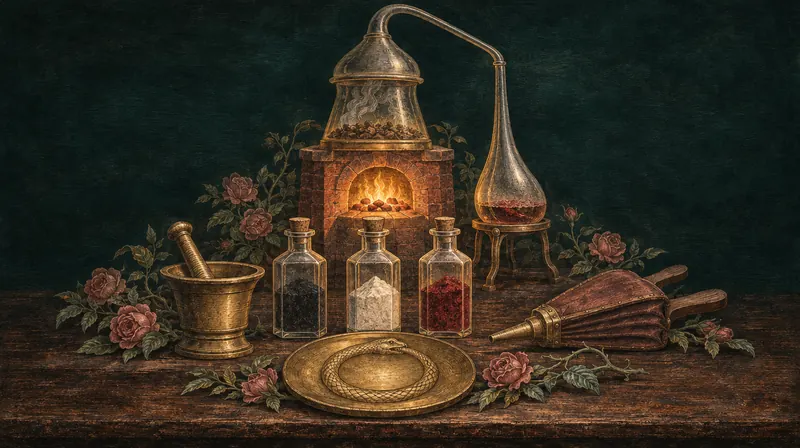
Who were the great alchemists, from Jabir to Isaac Newton?
What it is
The alchemists were physicians, monks, metalworkers, court servants and scholars, and a good number were frauds. The names that matter most are Zosimos in Roman Egypt; Mary the Jewess, whom he cites for her apparatus; the Arabic authors behind the name Jabir; the Latin writer called Geber; Paracelsus; and, at the end of the line, Robert Boyle and Isaac Newton, who both worked at furnaces for decades.
The teaching
As the line of alchemists from Zosimos to Newton teaches it.
Zosimos of Panopolis
Zosimos writes for a woman named Theosebeia, and he teaches that the work is done on the worker as well as on the metal. In one of his visions a priest stands at a bowl-shaped altar reached by fifteen steps and tells how he has been pierced, cut apart and burned so that he may be changed from body into spirit: the breaking and burning of the matter in the vessel, seen as a passion.
To Theosebeia he gives a rule. Do not run about seeking God, he tells her, but sit quietly at home, calm the body and its passions, and the true tinctures will come in their season; do not court the daimons for help. At the end he sends her to the Hermetic mixing bowl: hasten to Poimandres, be immersed in the bowl, and rise to your own kind.
Mary the Jewess
Mary, whom Zosimos honours among the first teachers of the art, gives it its most quoted riddle: one becomes two, two becomes three, and out of the third comes the one as the fourth. The work goes from a single matter to its opposites, from the opposites to a third that joins them, and back to a oneness richer than the start.
Two more sayings go under her name. Join the male and the female, and you will find what is sought. And nothing comes of the work unless the bodies are made bodiless and the bodiless made bodies again: matter turned to vapour and the vapour fixed. Her stills and furnaces were made for that, and the gentle water bath still bears her name.
The books of Jabir
The Arabic books under the name of Jabir ibn Hayyan teach that every metal is a sulphur and a mercury, and they add a science of measure, the balance. Each substance is made of the four natures, hot, cold, dry and moist, in a proportion that can be found, and in their system even the letters of a thing's Arabic name are weighed to find it. Change the proportion and the thing changes. Gold is the metal whose natures stand in perfect measure, and the elixir is the medicine that brings that measure to whatever lacks it, drawn from plants and animals as well as from stones.
Geber's Sum of Perfection
The Latin Summa perfectionis, written under the name Geber, sets the art out as a teaching to be learned by reason. It defines its operations one by one: sublimation, descension, distillation, calcination, solution, coagulation, fixation and ceration, which softens a matter until it melts like wax. It holds that the metals are made of very small particles, and that their size and packing decide whether a metal is heavy or light, fixed or fleeting.
It is strict about the worker as well. He must be of subtle mind, patient and persevering, sound in body and not hasty, and he must not begin a work he lacks the means to finish; a worker who is greedy or careless will not succeed, however good his books.
Paracelsus
Paracelsus teaches that alchemy is the art of separating the pure from the impure, and that its first use is medicine. He tells his readers to read the book of nature with their own eyes, and boasts of having learned from barbers, bath keepers, women, alchemists and common people as well as from learned physicians, because experience, not the authority of the ancients, is the teacher. He speaks of two lights: the light of nature, by which the physician learns, and the light of the spirit, by which the soul is taught, and the first must be read in nature itself.
Robert Boyle
Boyle teaches doubt as a method. In The Sceptical Chymist a chymist argues that fire does not divide a body into its true ingredients but makes new bodies, so neither the four elements nor the three principles are proved by what comes out of the flask. Matter, Boyle holds, is made of tiny corpuscles, and the qualities of things come from their size, shape and motion. Yet the same Boyle spent years seeking the mercury of the philosophers, and reported a mercury that grew hot when it was mixed with gold.
Isaac Newton
Newton reads the old books closely, copies them, compares their names and pictures, and works for decades at his own furnace. He holds that two kinds of action go on in matter: the gross, mechanical changes of common chemistry, and a subtler one he calls vegetation, a hidden working spirit that makes metals grow as plants grow. His notes speak in the old code, of the green lion, the net, the star and the doves of Diana, and his own English version of the Emerald Tablet stands among them.
What they share
Across some fourteen centuries the alchemists hold a handful of convictions in common: that matter is one and its forms can change; that nature tends toward perfection and the art can help her; that the work needs patience, a gentle fire and an honest worker; and that what happens in the vessel is a likeness of what happens in the heavens and in the soul. On almost everything else they differ, and each reads the riddles of the others in his own way.
Reading them one at a time is the way in. Each is best met in his own words, with the question of what he was trying to make and why, before he is fitted into the story of the art as a whole.
How it is practised
Reading the alchemists is done best one life at a time: where the person worked, who paid them, what they wrote down and what others later said about them. For each, the reader keeps two columns, what the documents show and what the legend adds. Flamel, Paracelsus and Newton each look different once the columns are filled in. The roots of this art on the tree lead to several of these lives.
Where it comes from
Mary the Jewess is credited with vessels still in use, and the water bath called the bain-marie carries her name. The Latin Summa perfectionis, written about 1300 under the name Geber, is now usually given to the Franciscan Paul of Taranto. Newton left about a million words on alchemy that he never printed. Keynes, who bought many of the papers in 1936, wrote that Newton was not the first of the age of reason but the last of the magicians.
What is known, and what is not
Dates and authorship in alchemy are often uncertain, because writers signed the names of older authorities to win a hearing. The works under the names Jabir, Geber, Ramon Llull and Thomas Aquinas are largely not by those men. The recipe for a homunculus, a little man grown in a flask, was printed under Paracelsus's name and its authorship is disputed. Newton's alchemy is fully documented in his own hand. How far it shaped his physics is still argued among historians.
Its words
- Magnum Opus
- The Great Work: the alchemists' name for the whole labour of making the stone, and in the inner reading for the work of a lifetime.
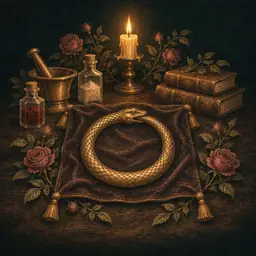 Ouroboros
- The serpent eating its own tail, drawn in Greek alchemical manuscripts with the words "the all is one".
- Athanor
- The slow furnace: a tower of charcoal that fed its own fire, so a sealed flask could be kept gently warm for weeks with little tending.
- Homunculus
- The little man of legend, said in a book printed under Paracelsus's name to grow in a warmed flask. The word lives on in neurology.
Ask the Oracle further
What did Isaac Newton actually do in alchemy, and what did he hope to find?Who was Mary the Jewess, and what did she give to alchemy?
Before you practise
Alchemy is read here as a picture of inner change. Never follow an old recipe: they used mercury, lead, antimony and acids, and nothing here is meant to be mixed, heated or swallowed.
Its other branches
Two alchemiesThe four stagesSalt, sulphur, mercuryThe philosopher’s stoneSeven metals, seven planetsThe whole artSearch the tree

