
The four stages
Blackening, whitening, yellowing, reddening.
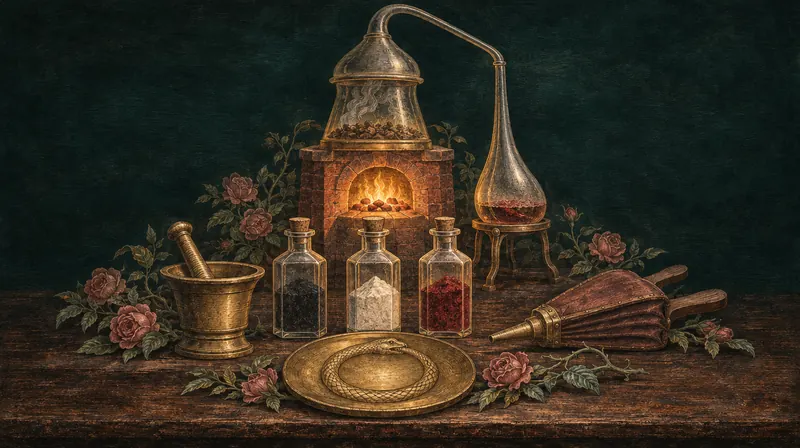
What are the four stages of alchemy: nigredo, albedo, citrinitas and rubedo?
What it is
The work is told as a run of colours. Nigredo, the blackening, is the breaking down of the starting matter. Albedo, the whitening, is its washing. Citrinitas, the yellowing, is a dawn before the end, and rubedo, the reddening, is the finished work. Each colour was something an alchemist expected to see in the flask, and each carried a meaning: death, cleansing, first light and union.
The teaching
As the alchemical tradition from Zosimos to Jung teaches it.
A work told in colours
The Great Work is told as a run of colours that the worker watches for in the glass, each the sign that one stage is done and the next begun. The Greek writers count four: melanosis, the blackening; leukosis, the whitening; xanthosis, the yellowing; and iosis, the reddening, a word that also carries the purple of the violet. In Latin these become nigredo, albedo, citrinitas and rubedo. Many later books drop the yellowing and count three, black, white and red, and the order is never reversed: the white comes out of the black, and the red out of the white.
Nigredo, the blackening
The work begins with a death. The matter is broken down in gentle heat until it rots and turns black, and the books picture this as a king killed or dissolved, a body in a tomb, a crow or a raven's head, a black sun. The blackening belongs to Saturn, slow and heavy. The books greet it with relief, not fear: a matter that will not blacken has not been opened, and without the death nothing new can come. Their sign for it is a darkness blacker than black.
In Jung's reading the nigredo is the meeting with the shadow, the part of oneself one would rather not see: a time of confusion, loss and dark moods, when an old way has fallen apart and nothing has yet taken its place. It is not to be fled or hurried, and the black, held patiently, is already the first matter of what comes next.
A darkness that does not lift, or that brings thoughts of harming oneself, is not a stage to wait out alone. It is a time to see a doctor or to call for help.
The peacock's tail
Between the black and the white the books describe a moment of many colours playing over the matter: the peacock's tail. It is the sign that the black is breaking up and the change has begun, and it passes. Read for a life, it is the restless time after a long darkness, when hopes and moods come and go; the books counsel patience, for the colours promise the white and are not yet the white.
Albedo, the whitening
Then comes the washing. The black matter is cleansed, again and again, until it turns white, and the books picture this as rain or dew falling on the dead body in the tomb, a white dove, a swan, a white queen, the Moon and silver. The white stone, which the books say turns base metal to silver, is made at this stage. The whitening is a first completion: pure, quiet and cool, lit by reflected light.
In the inner reading the albedo is the clearer, plainer time after a collapse, when a person can look back at what happened and see it, and insight comes quietly, like moonlight. It is a dawn, as Jung put it, but not yet the sunrise: understanding, not yet lived.
Citrinitas, the yellowing
The yellowing is the morning. The white matter takes a golden tinge, as the light of the Sun begins to show through the Moon's. The Greek writers count it a stage of its own; many Latin books fold it into the reddening. In the inner reading it is the time when understanding begins to warm into a way of living, and what was seen in the white begins to be done.
Rubedo, the reddening
The work ends in red. The white matter is given a stronger fire and it reddens, and the books picture the red king rising from the tomb, the marriage of the red king and the white queen, the phoenix reborn from its own fire, a rose, the Sun and gold. Here the opposites that were parted are joined for good, the fixed and the volatile, the masculine and the feminine, body and spirit, and the red stone is born, which the books call the medicine of metals and of men.
In the inner reading the reddening is the union of opposites in a person: what was understood in the white is lived in the red, in the blood, in the day's work and in the bonds with others. Jung saw in it the self made whole and lived, not only seen.
Multiplication and projection
Some books add two last steps after the red. Multiplication increases the stone's strength by taking it through the work again, and projection is the casting of a little of it onto a base metal to change the whole. Read inwardly, these steps ask a further question of a finished change: what does it do for the lives around it?
Ripley's twelve gates
Not every book counts the same way. George Ripley's Compound of Alchemy leads the work through twelve gates: calcination, solution, separation, conjunction, putrefaction, congelation, cibation, sublimation, fermentation, exaltation, multiplication and projection. Cibation is feeding, giving the matter new moisture little by little as it grows; fermentation is giving it the leaven of gold, as dough is given yeast; exaltation is raising it to its highest strength. Other books draw seven steps on a ladder, and the colours run through all of these counts.
Round and round
The books do not promise a single passage through the colours. The work is repeated, dissolved and bound again, and the matter goes through black, white and red more than once, finer each time. Its emblem is the serpent that bites its own tail, the ouroboros, drawn in the Greek manuscripts with the words the all is one. Used as a mirror, the stages name a time, not a rank: the black is not failure and the red is not a prize, and whoever stands in one of them can expect to come round again.
How it is practised
As a mirror, the stages give names to where a person is in a long change. A reader asks which colour fits: is this the black, where an old way has collapsed and nothing has replaced it; the white, a plainer and quieter time after; or the red, where something new is lived and not only understood? The order is a help, not a rule. People describe going round more than once, which is what the ouroboros, the serpent biting its own tail, pictures.
Where it comes from
The four colours appear in Greek alchemy, and Zosimos already speaks of blackening and whitening. Medieval and Renaissance Latin texts kept them, though many dropped the yellowing and counted three. Other authors used different counts altogether: George Ripley described twelve gates in 1471, and some emblem books show seven steps on a ladder. The motto solve et coagula, dissolve and coagulate, names the rhythm under every count. Jung took the colours as stages of what he called individuation, with the nigredo as the encounter with the shadow.
What is known, and what is not
The colour sequence is well attested in the texts, and colour changes are real in the chemistry: metals blacken, whiten and redden under the treatments described. The reading of the stages as steps of psychological growth is Jung's interpretation. It has not been tested as a model of how people change, and no stage can be assigned to a person by their birth chart.
Its words
- Nigredo
- The blackening: the first stage, in which the matter is broken down and rots. Jung read it as the meeting with what one would sooner not see.
- Albedo
- The whitening: the second stage, a washing after the black, pictured as the Moon, silver or a white queen.
- Citrinitas
- The yellowing: a third colour between white and red in the old Greek count of four, likened to dawn and left out by most later Latin books.
- Rubedo
- The reddening: the last stage, pictured as the Sun, gold or a red king, when what was separated is joined.
- Solve et Coagula
- Dissolve and coagulate: the two-beat motto of the method, first loosening a body into its parts and then fixing the cleaned parts together.
Ask the Oracle further
What does the nigredo of alchemy look like in an ordinary life?How would I know I am leaving the blackening stage of alchemy for the whitening?
Before you practise
Alchemy is read here as a picture of inner change. Never follow an old recipe: they used mercury, lead, antimony and acids, and nothing here is meant to be mixed, heated or swallowed.
Its other branches
Two alchemiesSalt, sulphur, mercuryThe philosopher’s stoneSeven metals, seven planetsWho the alchemists wereThe whole artSearch the tree

