
Two alchemies
The laboratory art, and the picture of inner change read in it.
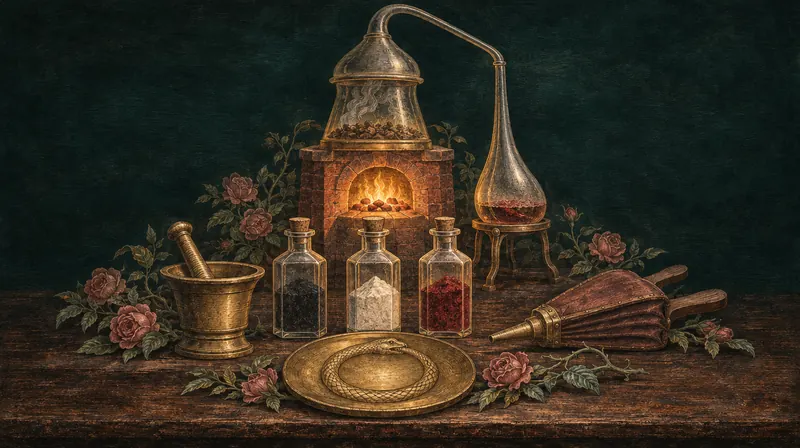
What is the difference between laboratory alchemy and the alchemy of the soul that Jung described?
What it is
There are two things called alchemy. The first is the laboratory art that ran from Roman Egypt to the age of Newton: people at furnaces trying to refine, dye and change metals, and to make medicines. The second is a way of reading that art as a picture of inner change, in which the lead is the unworked self and the gold is the self made whole. The two share the same books and pictures, so a single emblem, such as the two-headed rebis, can be read either way.
The teaching
As the alchemical tradition read with Carl Jung teaches it.
One matter, many forms
The laboratory art rests on a teaching about matter. All bodies are made of the four elements, fire, air, water and earth, and each element is a pair of qualities: fire is hot and dry, air hot and moist, water cold and moist, earth cold and dry. Change one quality and one element passes into another, as water heated rises as vapour. Beneath the elements lies a first matter with no form of its own, able to take any form. If that is so, no metal is fixed for ever: bring a base metal back toward its first matter, give it a nobler form, and it becomes another metal.
The metals, besides, are held to grow in the earth from a sulphur and a mercury, ripening slowly as fruit does, so that lead is gold that has not finished. Nature tends toward perfection, and the art only helps her: in the vessel the alchemist does quickly what nature does slowly underground.
Dissolve and bind
The whole method is often put in two words, dissolve and coagulate. The matter is broken down, by fire, by water, by rotting, until its old form is gone, and then it is joined and fixed in a new one. Around those two moves the books name many operations: calcination, which reduces a body to ash by fire; dissolution in a liquid; separation of the fine from the coarse; conjunction, the joining of opposites; putrefaction, a slow rotting in gentle heat; distillation and sublimation, in which a vapour rises and is caught; and fixation, which makes what flies stay put. A rule goes with them: make the fixed volatile and the volatile fixed.
The vessel and the fire
The work is done in sealed glass, the vessel the books call the philosophers' egg, set in the athanor, a furnace built to hold an even heat for weeks. Heat is given by degrees, the first of them likened to the warmth of a hen sitting on her eggs, and the books warn again and again that haste and a fierce fire ruin everything. The pelican, a vessel whose arms curve back into its own body, lets the vapour rise and fall back without end, and gives the art its picture of a work that feeds on itself.
The house says it plainly: none of this is to be tried. The old work used mercury, lead, antimony and acids, and here it is taught only as the books picture it.
Pray, read, work
The alchemist works in two rooms. Heinrich Khunrath's engraving of the art shows a man kneeling in prayer on one side and the furnaces of a laboratory on the other, and the books insist that the work needs a pure heart as much as a steady hand: the worker is to be patient, humble, sober and honest, and greed spoils the work as surely as a fierce fire. The Mutus Liber, a book told almost wholly in pictures, gives the rule in Latin on one of its last plates: pray, read, read, read, read again, work, and you will find.
Our gold is not common gold
The books warn their readers not to take their words at face value. Our gold, says the Rosarium philosophorum, is not common gold. In the same way the books set the mercury of the wise apart from the quicksilver sold in shops, and give the first matter a thousand names. The art writes in a code of kings and queens, lions and dragons, crows, doves and peacocks, so that each step can be pictured, and so that only those who have done the work can read it.
The inner reading
The second alchemy begins from that code. Carl Jung read it as a record of what the alchemists saw in their flasks without knowing it was their own. Watching the dark matter in the glass for days on end, they projected the contents of their own unconscious into it, so that the stages of the work describe a change in the worker. The king who dies, the bath, the marriage of Sun and Moon, the black that turns white and then red, are pictures of the psyche loosening its old order and coming to a new wholeness, which Jung called individuation.
The old books themselves give him a foothold. In Martin Ruland's dictionary of the art, meditation is defined as an inner dialogue with someone unseen: with God, with oneself or with one's good angel. Gerhard Dorn, a follower of Paracelsus, urged his readers to change themselves from dead stones into living philosophical stones.
The vessel is the person
In the inner reading nothing is heated but attention. The first matter is what one would rather not look at: a grief, a fault, a fear, a part of life written off. The vessel is a steady, closed attention in which it can be held without leaking away into distraction or being poured out on others. The fire is the feeling it stirs, kept at a heat that can be borne; too fierce, and the vessel cracks. The stages are the slow changes that follow, and the stone is the self made whole, which Jung called the Self.
The two alchemies share one rule: the work cannot be hurried. What the furnace books say of the fire, the inner reading says of a life: the gentle heat kept up for a long time does what no sudden blaze can.
Working with an image
Jung's own method was to take an image, from a dream or from an old emblem, and let it move and speak in the imagination while one watches and answers it, then to write or paint what came; he called this active imagination. Beside it he set the old pictures, to widen what a dream image might mean by showing where it had appeared before, and this he called amplification. A reader can begin more simply, with one emblem, a dated page of notes and a second look a month later.
Jung also warned that active imagination is not for everyone at every time. For a person in a fragile state the images can overwhelm instead of inform, and such work then belongs with a trained guide, or not at all.
How it is practised
The inner reading asks one question of an image: where is this in my own life? A reader takes a picture, such as a king dissolving in a bath, and sets it beside a change they are living through, an ending, a long wait or a reconciliation. Nothing is mixed or heated. A notebook, a dated entry and the same image looked at again a month later are the whole apparatus.
Where it comes from
The inner reading is older than Jung but he gave it its modern form. Mary Anne Atwood (1850) and Ethan Allen Hitchcock (1857) already argued that the true subject of alchemy was the human being. Jung, from the late 1920s, reported that his patients' dreams resembled alchemical pictures he had never shown them, and spent thirty years on the comparison, ending with Mysterium Coniunctionis in 1955 and 1956. Historians of science since the 1990s have pushed the other way and shown how much real chemistry the alchemists did.
What is known, and what is not
That alchemists ran real laboratories is documented: recipes have been repeated in modern labs and work as described. That they meant a hidden spiritual teaching is disputed. Lawrence Principe and William Newman argue that most of them meant chemistry, and that the purely spiritual reading is a nineteenth-century idea. The inner reading stands as a way of thinking with images, not as a claim about what the authors intended.
Its words
- Magnum Opus
- The Great Work: the alchemists' name for the whole labour of making the stone, and in the inner reading for the work of a lifetime.
- Prima Materia
- The first matter: the raw, unformed stuff the work begins from, which the texts call by hundreds of names and never plainly identify.
- Rebis
- The double thing: one crowned body with a male and a female head, the emblem books' picture of opposites joined at the end of the work.
Ask the Oracle further
Is the alchemy of the soul really what the old alchemists meant, or a later reading?Which alchemical image fits the change I am going through now?
Before you practise
Alchemy is read here as a picture of inner change. Never follow an old recipe: they used mercury, lead, antimony and acids, and nothing here is meant to be mixed, heated or swallowed.
Its other branches
The four stagesSalt, sulphur, mercuryThe philosopher’s stoneSeven metals, seven planetsWho the alchemists wereThe whole artSearch the tree

