

The inner life
Individuation
Direct answer
Individuation is Carl Jung's name for the lifelong process by which a person becomes a whole and undivided individual, bringing the conscious and unconscious sides of the psyche together.
$0 today, then $19/month after 7 days. Cancel anytime.
At a glance
- Found in
- Consciousness & Spiritual Psychology
- Related
- Archetype, Collective Unconscious, Shadow Work, Shadow Integration
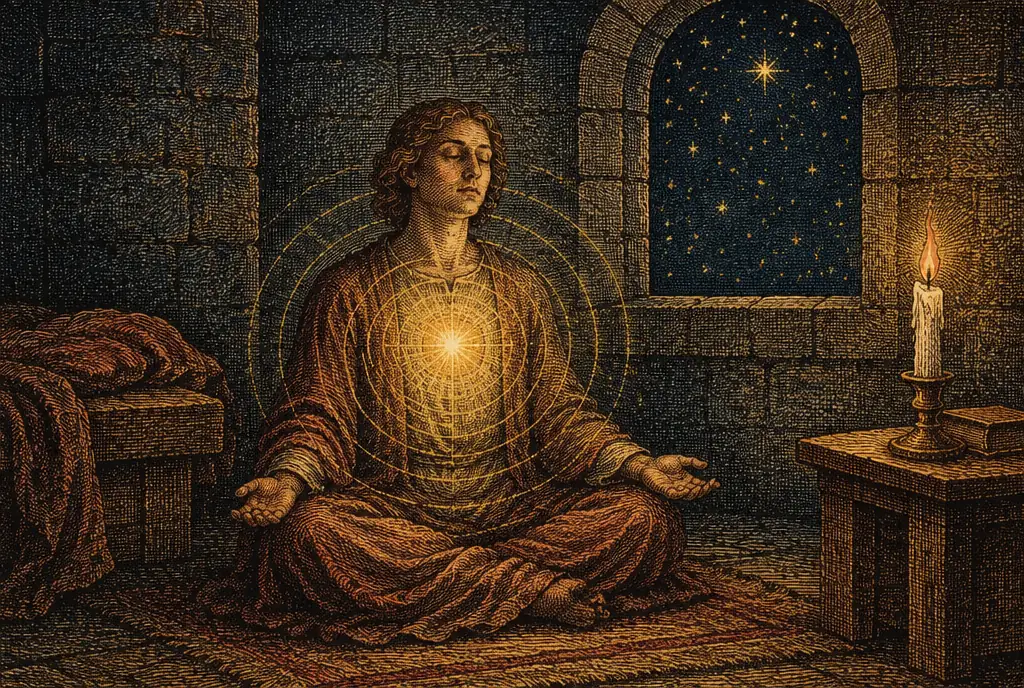
Individuation is Carl Jung's name for the lifelong process by which a person becomes a whole and undivided individual, bringing the conscious and unconscious sides of the psyche together.
A plain educational schematic; it does not diagnose a condition or replace professional care.
Understand the chapter you are in.
Your life’s turning points, measured from your birth.
Walk through Alex’s whole example first


Prefer to explore first?
 The Road of AgesThe turning points of your whole life, from your own chart
Walk my road
What does individuation mean?
Individuation means becoming an individual in the root sense: undivided. Jung described it as the natural direction of psychological growth, strongest in the second half of life, in which a person comes to terms with the parts of themselves they have not lived.
He sketched a rough order. First comes the shadow, the disowned side. Then the inner figure of the other sex, and later images of the Self, the centre of the whole personality, often pictured as a circle or a child. He stressed that the aim is completeness and not perfection, and that it makes a person more connected to others, not less.
On the tree of the hidden arts: Dreams.
What sets Individuation apart
Jung tied individuation to age. The first half of life, he said, is rightly spent building a place in the world, and the task changes about the midpoint, when what was left out begins to press. That makes it a psychology of the mature and old as much as of the young, which was unusual in his day. Its emblem in his writing is the mandala, the circular drawings his patients produced, which he read as pictures of a centre forming.
- Root sense: Latin individuus, undivided
- Defined: Psychological Types, 1921
- Order of meetings: shadow, then anima or animus, then the Self
- Emblem: the mandala, a circle with a centre
- Parallel he drew: the stages of the alchemical work
Often mistaken for something else: Self-improvement adds to the person one already presents; individuation, in Jung's account, means accepting the sides that the presented person left out.
The story behind Individuation
The word is old in philosophy, where a principle of individuation explained how one thing differs from another. Jung gave it his own meaning and defined it in Psychological Types in 1921. He later found a parallel in alchemy, reading its stages as pictures of the same process, and set this out in Psychology and Alchemy in 1944.
Why Individuation matters
Individuation is the thread Jung believed runs through a lifetime of dreams, so it changes the unit of reading from one dream to a long series.
How to read Individuation
Readers use it to ask what a run of dreams is moving toward, and which unlived side of themselves keeps appearing.
Individuation in practice: an example
A reader in mid-life who drops a role they have played for decades, and feels both loss and relief, might call the change a step in individuation.
Where readings of Individuation go wrong
Individuation names a direction and not a rank. No one is more individuated than another by any measure, and it is not individualism.
Sources and editorial method
This entry summarizes the tradition in the Almanac's own words; where no source is listed, it is an editorial summary rather than a primary text, and symbolic readings are named as the tradition's, not as fact.
- Source
- The Great Almanac Dictionary
- Category
- Consciousness & Spiritual Psychology
- Aliases
- individuation jung, individuation process, individuation meaning, what is individuation
- Last updated
- 2026-09-26
See Individuation in your personal almanac
A definition tells you what it is; your own birth chart tells you what it means for you. The Oracle casts your real chart and answers for your love, your work, and your year ahead, in conversation. It opens with the 7-day Oracle trial.
Speak with the OracleRelated terms
More in Consciousness & Spiritual Psychology
- Mindfulness
- Proportionality Bias
- Self-Regulation
- SSILD (Senses Initiated Lucid Dream)
- Wake-Initiated Lucid Dream (WILD)
- Binaural beats
- Copenhagen Interpretation
- False Flag
From the reference page to your own chart
Every word here
is in your own chart.
- Your life’s turning points, measured from your birth
- A practical next step to consider
- It opens with 7 days free: the AI Oracle on thirty hidden arts, and your daily horoscope
$0 today, then $19/month after 7 days. Cancel anytime.
Common questions
What does individuation mean?
In Jung's psychology it is the process of becoming a whole person, by recognising and bringing together the conscious personality and the unconscious sides one has not lived.
What are the stages of individuation?
Jung described a loose sequence: meeting the shadow, then the inner image of the other sex, then symbols of the Self. He did not present it as a fixed ladder, and people circle back.
Is individuation the same as individualism?
No. Individualism puts the self before others. Individuation, as Jung described it, makes a person more fully themselves and, in his words, gathers the world to oneself.


