

The inner life
Shadow Work
Direct answer
Shadow Work is reflective practice focused on noticing disowned, avoided, or unconscious parts of the self so they can be named responsibly rather than projected onto others.
Shadow Work is self-reflection on disowned traits, wounds, motives, and projections.
$0 today, then $12/month after 7 days. Cancel anytime.
At a glance
- Found in
- Consciousness & Spiritual Psychology
- Related
- Birth Chart, Zodiac, Transit
Shadow Work is self-reflection on disowned traits, wounds, motives, and projections.
A plain educational schematic; it does not diagnose a condition or replace professional care.
What does your own chart say about you?
Choose love, work or purpose. Your reading is written from your chart. Your reading uses your own birth details.
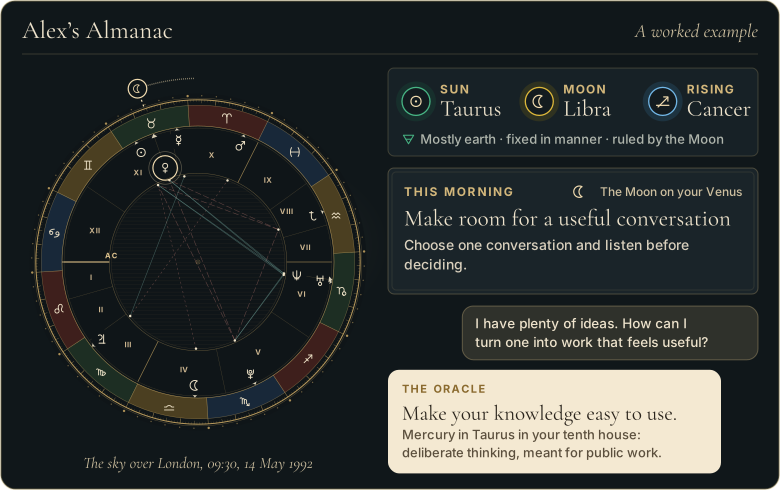
Walk through Alex’s whole example first
 The Road of AgesSee the turning points of your whole life, from your birth date
See your road's shape
The Road of AgesSee the turning points of your whole life, from your birth date
See your road's shape
Prefer to explore first?
 The Road of AgesThe turning points of your whole life, from your own chart
Walk my road
The Road of AgesThe turning points of your whole life, from your own chart
Walk my road
Free, by email
Your daily Almanac letter
One short letter at 7 each morning: the day’s theme read for your own chart, and one thing to do with it.
What sets Shadow Work apart
The phrase is a late twentieth-century popular one; Jung did not use it. What he wrote about, in Aion (1951) and elsewhere, is the shadow: the part of the personality kept out of sight because the conscious self will not accept it. Jung saw it as one of several figures in the psyche, alongside the persona, the anima or animus and the Self, and said it is met first in projection onto other people.
- Origin: Carl Jung's 'shadow', described in Aion (1951) and other essays
- Popular books: Robert Bly, A Little Book on the Human Shadow (1988); Zweig and Abrams, Meeting the Shadow (1991)
- Mechanism: projection: seeing in another person what one does not recognise in oneself
- Jung's range: the shadow also holds unlived good qualities, not only faults
- Status: a concept of analytical psychology, not a clinical category and not a term of the church
Often mistaken for something else: Therapy is a clinical process led by a trained professional; shadow work is a self-help phrase and carries none of that structure.
The story behind Shadow Work
Shadow Work draws heavily from Jungian psychology and later self-help, spiritual, and coaching cultures.
The spiritual meaning of Shadow Work
Spiritually, Shadow Work asks whether hidden motives can be brought into truth without shame spirals.
Shadow Work in the Bible
Christian readers can connect shadow language with confession and humility, but it should not replace repentance, forgiveness, pastoral care, or therapy when needed.
Why Shadow Work matters
Shadow Work matters because people often meet what they refuse to own through conflict, repetition, envy, shame, or projection. Done carefully, the idea can support honesty; done carelessly, it can become self-absorption or amateur therapy.
Where readings of Shadow Work go wrong
A common error is to use Shadow Work to process severe trauma alone, blame the victim, or avoid professional care.
A lecture on this, free to read

Sources and editorial method
This entry summarizes the tradition in the Almanac's own words; where no source is listed, it is an editorial summary rather than a primary text, and symbolic readings are named as the tradition's, not as fact.
- Source
- The Great Almanac Dictionary
- Category
- Consciousness & Spiritual Psychology
- Last updated
- 2026-09-26
See it in your own chart
A definition tells you what it is; your own birth chart tells you what it means for you. The Oracle casts your real chart and answers for your love, your work, and your year ahead, in conversation. It opens with the 7-day Seeker trial.
Speak with the OracleYour year, written once from your chart alone: the Cosmic Codex reads the whole of it, month by month. Open the Cosmic Codex
Related terms
More in Consciousness & Spiritual Psychology
- Spiritual Discernment
- Twin Flame
- Body Scan
- Cognitive Reappraisal
- Emotional Regulation
- Heart Coherence
- Kundalini Awakening
- Projection
From the reference page to your own chart
Every word here
is in your own chart.
- A personal reading about love, work or purpose, written from your chart
- A practical next step to consider
- It opens with 7 days free, with the AI Oracle and daily guidance
$0 today, then $12/month after 7 days. Cancel anytime.
Common questions
What is Shadow Work?
Shadow Work is reflective practice focused on noticing disowned, avoided, or unconscious parts of the self so they can be named responsibly rather than projected onto others.
Where does Shadow Work come from?
Shadow Work draws heavily from Jungian psychology and later self-help, spiritual, and coaching cultures.
What does Shadow Work mean spiritually?
Spiritually, Shadow Work asks whether hidden motives can be brought into truth without shame spirals.
What do people get wrong about Shadow Work?
A common error is to use Shadow Work to process severe trauma alone, blame the victim, or avoid professional care.
Free, by email
The Almanac, in your inbox at 7
One short letter at 7 each morning: the day’s theme read for your own chart, and one thing to do with it.