
The philosopher’s stone
What the alchemists said they sought, and what it stood for.
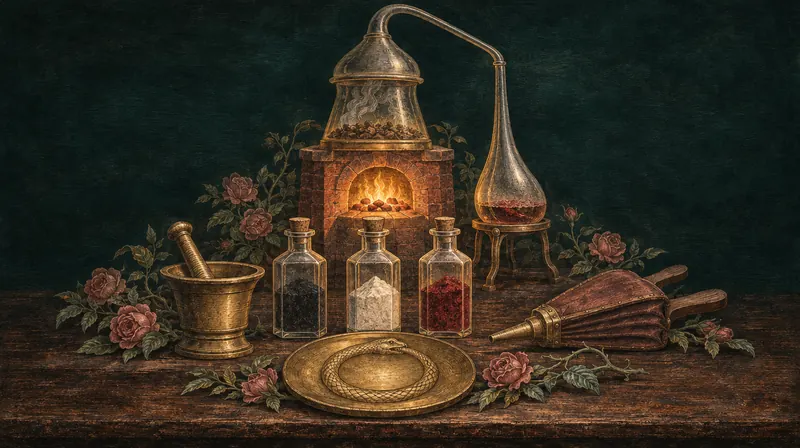
What was the philosopher’s stone in alchemy, and what did it stand for?
What it is
The philosopher's stone is what the Great Work was for. The texts describe a heavy red powder or wax, a small amount of which, thrown onto molten lead or mercury, was said to turn it to gold. The same substance, taken as medicine, was said to cure illness and lengthen life, which is where the elixir of life comes from. In the inner reading the stone is the self made whole, plain to look at and missed by everyone.
The teaching
As the Latin tradition of the stone teaches it.
What the stone is
The philosopher's stone is the end of the Great Work: a substance made by the art that perfects whatever it touches. The books describe it as heavy and red, a powder or a wax, and give it two works. Cast in a small amount onto a base metal in fusion, it turns the metal to gold, and this is projection. Taken as medicine, they say, it restores the body and lengthens life, and this is the elixir. A white stone, made at the whitening, turns metals only to silver; the red stone, made at the reddening, turns them to gold.
For all its names, the books insist that the work is single: one is the stone, says the Rosarium, one the medicine, one the vessel, one the method and one the disposition. Whoever multiplies materials and vessels, they warn, has not yet understood what is being made.
A stone that is no stone
The books speak of it in riddles because, they say, it cannot be named plainly. It is a stone that is no stone, precious and without price, known to everyone and recognised by no one. Its matter is common: the poor have more of it than the rich, children play with it in the street, it is thrown out on the dung heap, and the wise pick it up where others step over it.
The first matter
The first matter of the stone has a hundred names, and the books use them to hide it: the water, the sea, the chaos, the dragon, the serpent, lead, the virgin's milk. What they agree on is its nature. It is matter before form, and the stone is drawn out of it by dissolving it, rotting it, washing it and joining it again. The work does not make the stone from nothing; it frees what was already in the despised thing.
Sun and Moon
The stone is born of a marriage. Its father is the Sun and its mother the Moon, its sulphur and its mercury, the red king and the white queen. They are joined, die together and rise as one, which is why the books also call the stone the rebis, the double thing, and draw it as a crowned figure with two heads, a man's and a woman's, on a single body.
The Rosarium's pictures
The Rosarium philosophorum tells the making of the stone in a series of woodcuts, and the first ten are a story in themselves. A fountain pours out the mercurial water. The king and the queen meet, standing on the Sun and the Moon, and offer each other flowers. They put off their clothes. They step into the bath. They are joined in the water.
Then they lie dead as one body in a tomb. The soul rises out of the body. Dew falls from heaven and washes the corpse. The soul comes back down into it. And the one body rises alive, with two heads and wings, standing on the Moon: the new birth.
Every reader of the art learns the sequence by heart, because it holds the whole teaching: meeting, stripping, dissolving, union, death, the soul's departure, cleansing, its return, and a life that is single where there were two.
Fixing and multiplying
Once born, the stone is fixed, so that it no longer flies from the fire, and then multiplied, by taking it through the work again to increase its strength. Only then is it ready for projection. The books mock the puffers, who blew their bellows for riches and ruined themselves, and say that the stone comes only to the patient, the honest and the humble, and never to greed.
The stone the builders refused
Christian alchemists set the stone beside Christ. They read in it the verse of the Psalms, “The stone which the builders refused is become the head stone of the corner,” and saw in the work's death in the tomb, its rising, and its power to perfect what is base, a likeness of the passion and the resurrection. For them the work was a way of contemplating the mysteries of faith in matter.
Dorn's three unions
Gerhard Dorn gives the stone its inner form. The work of union, he teaches, has three degrees. In the first, the soul and the spirit are joined to each other and drawn back from the pull of the body; this he calls the mental union. In the second, that union is joined again to the body, so that what has been understood is lived in the flesh. In the third, the whole person is joined to the one world, the ground of all things before they were divided.
The stone in a life
Jung read the stone as the Self: the wholeness of a person, plain to look at, made out of what was despised in them and stronger for having been through the black. The books' last warning holds in this reading too. The stone is not bought, borrowed or hurried. It is made by long work in a closed vessel at a gentle heat, and the one who makes it is changed by the making.
How it is practised
The texts say the prima materia, the first matter of the stone, is found in what is thrown away, common and despised. As a mirror that is the working instruction: a reader looks at what they have written off in their own life, a failure, a plain talent or a hard year, and asks what it could be the raw matter of. The answer is kept in writing and tested against the next months, not taken on trust.
Where it comes from
The idea of a transmuting agent goes back to Greek alchemy, and the Arabic word al-iksir gives the English elixir. Medieval Latin authors called it lapis philosophorum. Stories of success gathered around a few names. Nicolas Flamel was a real Paris scribe who died in 1418, but writings on the art were put under his name only after his death, and the full tale that he made the stone was printed in 1612. In 1669 Hennig Brand, boiling down urine in search of the stone, discovered phosphorus instead.
What is known, and what is not
No philosopher's stone has ever been shown to exist, and the accounts of transmutation that survive do not stand up as reports. Gold can be made from other elements in a particle accelerator, as Glenn Seaborg's group did with bismuth in 1980, in amounts too small to see and at a cost far above its worth. That is nuclear physics, and it owes nothing to the recipes.
Its words
- Philosopher's Stone
- The substance alchemists said would turn base metal to gold and heal the body. No one is known to have made it.
- Prima Materia
- The first matter: the raw, unformed stuff the work begins from, which the texts call by hundreds of names and never plainly identify.
- Magnum Opus
- The Great Work: the alchemists' name for the whole labour of making the stone, and in the inner reading for the work of a lifetime.
- Elixir of Life
- The draught hoped to cure illness and hold off age, often the stone itself taken as a drink. Mineral elixirs poisoned people who drank them.
Ask the Oracle further
Where does the story that Nicolas Flamel made the philosopher's stone come from?What in my life might be the despised thing the alchemists said the stone is made from?
Before you practise
Alchemy is read here as a picture of inner change. Never follow an old recipe: they used mercury, lead, antimony and acids, and nothing here is meant to be mixed, heated or swallowed.
Its other branches
Two alchemiesThe four stagesSalt, sulphur, mercurySeven metals, seven planetsWho the alchemists wereThe whole artSearch the tree

