
Salt, sulphur, mercury
Paracelsus’s three principles: body, soul and spirit.
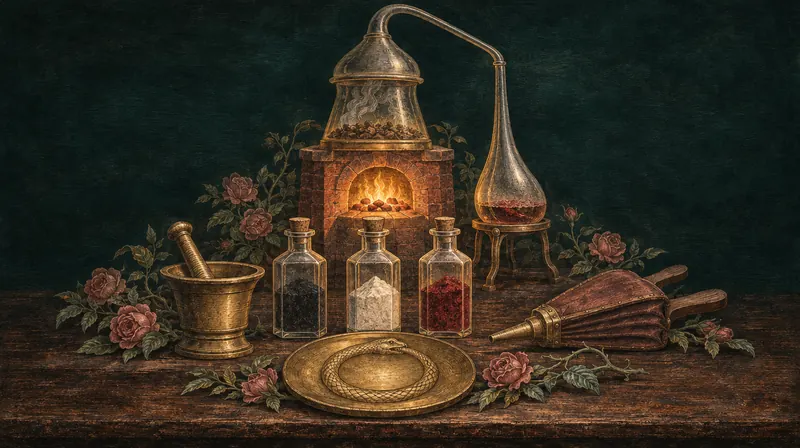
What did Paracelsus mean by salt, sulphur and mercury in alchemy?
What it is
Paracelsus taught that everything is made of three principles. Sulphur is what burns, the oily and fiery part. Mercury is what rises as smoke or vapour, the volatile part. Salt is what is left as ash, the fixed and solid part. He did not mean the kitchen substances but three ways matter behaves, and he matched them to soul, spirit and body in a person. Spagyrics, the plant alchemy that follows him, still sorts a herb into the three.
The teaching
As the school of Paracelsus teaches it.
Two principles before him
Paracelsus builds on two older teachings. The first is Aristotle's four elements, fire, air, water and earth, each a pair of the four qualities. The second is the teaching of the Arabic books under the name of Jabir, that the metals are made in the earth from two principles, a sulphur and a mercury. The sulphur is hot, dry and fiery, the part of a metal that burns; the mercury is cold, moist and fluid, the part that melts and flows. Joined in different measures and with different purity they make the different metals, and in perfect measure and purity they make gold.
The sulphur and the mercury meant here are not the yellow stone and the quicksilver of the shops. They are principles: the burning and the flowing that are found in every metal.
Salt, the third
Paracelsus adds a third. Every body, he teaches, is made of three: sulphur, mercury and salt. His proof is a piece of wood on the fire. What burns is sulphur; what rises as smoke is mercury; what is left as ash is salt. Sulphur gives a body its power to burn and its oiliness; mercury its volatility, the part that flies off as vapour; salt its fixity and firmness, the part that stays. The three are found in metals, in plants, in animals and in the human body.
Each principle has its sign, and the three signs are a small lesson of their own: sulphur is a triangle set on a cross, mercury a crescent over a circle over a cross, and salt a circle divided by a line.
Body, soul and spirit
The three match the three parts of a person. Salt is the body, what is solid, fixed and stays in place. Sulphur is the soul, the warmth that desires and binds. Mercury is the spirit, the moving and volatile part that goes between. So the three are a picture of the human being as well as an account of matter, and the same pattern is to be found in a flame, in a plant and in a person.
All three are needed, and in the picture of the burning wood it is easy to see why: without the salt nothing remains, without the sulphur nothing kindles, and without the mercury nothing rises. Health, for the Paracelsians, is the right measure of the three, and sickness is one of them out of order.
Alchemy for medicine
Paracelsus turns the art toward medicine. Many have said, he writes, that alchemy is for making gold and silver; for him that is not its aim, but to learn what virtue and power lie hidden in things for healing. He looks for illness in the three principles, not in the four humours of the older physicians, and he prepares remedies by the art from minerals as well as plants.
Many of those remedies were poisons, and none of them is to be copied. His own saying holds the warning: all things are poison and nothing is without poison; only the dose makes a thing not a poison.
Nature the alchemist
Nature herself, Paracelsus teaches, is an alchemist. In the stomach of every living thing works an inner alchemist, which he calls the archeus, sorting what is eaten into what nourishes and what must be cast out, the good from the poison, as the worker in the laboratory separates the pure from the impure. The art outside imitates the art inside.
Nature brings nothing to its perfection by herself; a person must perfect it, and that perfecting is alchemy. The baker is an alchemist when he bakes bread from grain, the vintner when he makes wine from grapes, the weaver when he makes cloth from wool. Whoever takes what nature gives and carries it to its end is doing the work.
Fixed and volatile
The three also explain how bodies change. What is fixed can be made to fly, and what flies can be fixed: the volatile part caught and held, the solid part opened and dissolved, the burning part drawn out or tempered. Every operation of the art moves the balance of the three, and the art's maxim, make the fixed volatile and the volatile fixed, is a rule about them.
Read as a mirror, the same rule asks two things of a life: where something has hardened that needs to move again, and where something keeps escaping that needs to be given form.
Five principles
The chymists after Paracelsus kept the three and added two passive principles, water, which they called phlegm, and earth, making five. Nicolas Lemery teaches them so in his course of chymistry: spirit, which is the mercury; oil, which is the sulphur; salt; phlegm; and earth. These were the parts a distiller expected to see come apart, the volatile ones rising into the receiver and the salt and the dead earth left behind in the vessel, and for a long time they were the alphabet of the chymical workshop.
How it is practised
Read as a mirror, the three are a simple check on a life. Sulphur is what a person wants and what warms them. Mercury is how they think, speak and move between things. Salt is the body, the habits and what stays put. A reader asks which of the three is starved and which runs the others: all drive and no ground, or all habit and no fire.
Where it comes from
Arabic alchemy had explained the metals by two principles, sulphur and mercury, an idea found in the works under the name Jabir ibn Hayyan. Paracelsus, the Swiss physician born in 1493, added salt in the 1520s and 1530s and applied the three to medicine as well as metals. His followers called them the tria prima. Later books named the philosophers' mercury Azoth, and Jan Baptist van Helmont sought a universal solvent, the alkahest. Robert Boyle attacked both the four elements and the three principles in 1661, and the scheme faded as chemistry found its own elements.
What is known, and what is not
That Paracelsus taught three principles is documented in his own writings. As chemistry the theory is wrong: burning wood does not show three ingredients, and none of his three principles is an element in the modern sense. Its match to body, soul and spirit is a picture he drew, useful as a way to look and not a finding about people. His burning-wood example is his own illustration.
Its words
- Tria Prima
- Paracelsus's three principles, salt, sulphur and mercury, which he matched to body, soul and spirit.
- Azoth
- A cover name, borrowed from Arabic, for the philosophers' mercury that was thought to drive the work, and later for a medicine for every ill.
- Alkahest
- The universal solvent that van Helmont claimed in the seventeenth century. None was ever shown, and critics asked what flask could hold it.
- Spagyrics
- Plant alchemy in the line of Paracelsus: a herb is distilled, its residue burned to ash, and the purified parts are joined again.
Ask the Oracle further
Which of salt, sulphur and mercury in alchemy is weakest in the way I live?How did the two principles of Arabic alchemy become the three of Paracelsus?
Before you practise
Alchemy is read here as a picture of inner change. Never follow an old recipe: they used mercury, lead, antimony and acids, and nothing here is meant to be mixed, heated or swallowed.
Its other branches
Two alchemiesThe four stagesThe philosopher’s stoneSeven metals, seven planetsWho the alchemists wereThe whole artSearch the tree

