
Fulcanelli
A pen name of the 1920s; the author is unknown
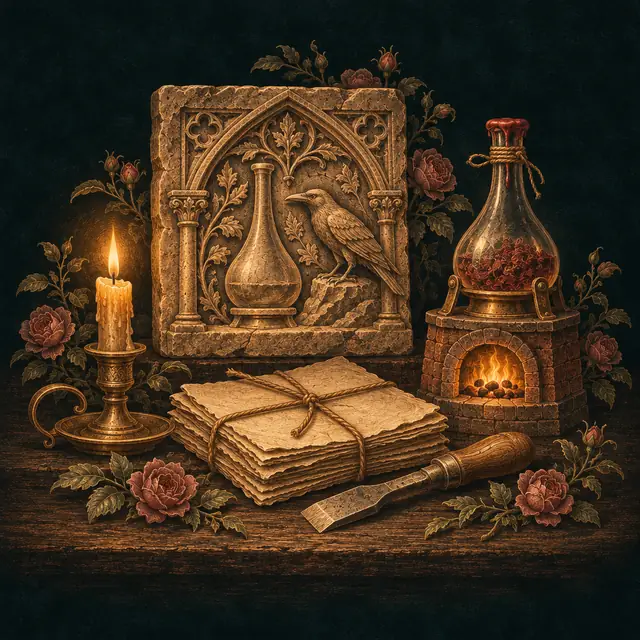
Who was Fulcanelli, and what is truly known of them?
What is known
The name on two French books of alchemy: Le Mystère des cathédrales (Paris, 1926, three hundred copies) and Les Demeures philosophales (1930). Both were illustrated by the painter Julien Champagne and introduced by Eugène Canseliet, then in his twenties, who said he was the author’s only pupil. They argue that the sculpture of the Gothic cathedrals of Paris and Amiens, and of certain old houses, sets out the stages of the alchemical work, to be read through puns in what the books call the language of the birds. A third book was promised and never appeared.
The teaching
Taught from the two books, Le Mystère des cathédrales (1926) and Les Demeures philosophales (1930).
The book of stone
The books teach that the Gothic cathedral is a book in stone. Built for all and open to all, it sets out in its sculpture, for anyone with eyes to read it, the great work of alchemy: the matter, the operations, the colours and the end. Its builders and their learned patrons, in this teaching, knew the hermetic art and wrote it into the porches beside the stories of scripture, in a language that the many pass by and the few can read.
The language of the birds
The key to that language is sound. Words are read by their echoes and their puns rather than their spelling, in what the books call the language of the birds, or the phonetic cabala. Art gothique, Gothic art, is in their reading only a misspelling of argotique: the art of argot, the cant of the initiates. Argot leads in turn to the Argonauts, who sailed in the Argo for the golden fleece, an image of the work itself, and the books hear in cabala the cavalier, the rider who carries the knowledge. The student learns to listen for such echoes in names, inscriptions and carvings.
Alchemy at the door of Notre-Dame
At Notre-Dame of Paris the reading begins at the central porch. On the pillar between its doors sits a woman on a throne, a sceptre in one hand and two books in the other, one open and one closed, the outward science and the hidden; a ladder of nine rungs stands before her, the patience the work demands through its nine operations. She is Alchemy, the books say, set at the very door of the church. In the medallions beside her the work goes on in figures, beginning with the raven, the sign of the black stage with which every true work begins.
The matter and the fire
The matter of the work, the books hold, is common, found everywhere and despised by all, and the secret fire that moves it is no common fire. They speak of two ways: the long or wet way, in glass over a gentle heat for months, and the short or dry way, in a crucible over a strong fire, in days. Neither the matter nor the fire is named plainly; the books point, and the reader must find.
The houses of the philosophers
The second book carries the same reading from the churches to the houses. At Bourges the Lallemant house hides in the coffers of its chapel ceiling a run of emblems of the work, and the house of Jacques Coeur bears carvings read as the merchant's knowledge of it. At the château of Dampierre-sur-Boutonne the ceiling of the gallery is divided into coffers, each with its emblem and motto, which the book reads one by one as stages and maxims of the art. A sundial at Holyrood in Edinburgh and a carved salamander at Lisieux are read the same way: the knowledge, in this teaching, was left in plain sight by those who held it, for those who would one day look.
The cross of Hendaye
To the second edition of the first book was added a chapter on a stone cross at Hendaye, near the Spanish border, whose carved signs it reads as foretelling the end of a cycle of the world and a great renewal by fire, as in the alchemist's reading of the letters on the cross: by fire nature is renewed whole. The work in the vessel and the life of the world, in that chapter, follow one law of death and rebirth.
What the books ask of the worker
Behind the emblems stands a rule for the worker: simplicity, patience, humility, and prayer joined to labour, for the work is the work of nature, which the artist only helps. The stone that crowns it, the books hold, is a medicine of metals and of men, and the one who seeks it for gold alone does not find it.
The stages and the stone are taught on the alchemy art's branches The four stages and The philosopher's stone, and, as there, nothing of the laboratory is to be tried: the old work used mercury, antimony and lead, which are poisons.
Orders and memberships
None can be documented, since the author is not identified. Both books are dedicated to the “Brothers of Heliopolis”, a name that seems to mean the small circle around them: Canseliet, Champagne and the Paris bookseller Pierre Dujols.
The legend
That he made gold, or supplied the powder with which Canseliet said he made it at Sarcelles in 1922; that Canseliet met him again in Spain thirty years on, grown younger; and that in 1937 he warned the chemist Jacques Bergier about atomic energy. Each rests on one man’s word. Who he was is unsettled: Champagne, Dujols, Canseliet himself and the physicist Jules Violle have all been proposed.
What was forged, or is false
Finis Gloriae Mundi, a book printed under his name in 1999. By Canseliet’s account the third work of that title was withdrawn by its author before it could be printed, and the modern book is not accepted as his.
Their works
- Le Mystère des cathédralesBook, 1926
A book arguing that the sculpture of the Gothic cathedrals of Paris and Amiens sets out the stages of the alchemical work. It was printed in three hundred copies, illustrated by Julien Champagne. It is the founding book of the legend of Fulcanelli.
Its author is unknown.
Ask the Oracle about it - Les Demeures philosophalesBook, 1930
A second, longer book reading certain old houses and monuments of France, among them the château of Dampierre, as alchemical emblems. It was again illustrated by Champagne and introduced by Eugène Canseliet. It completes the two books the name is known by.
Its author is unknown.
Ask the Oracle about it - Finis Gloriae MundiBook, printed 1999
A book printed under his name as the third work he had promised. By Canseliet’s account the true third work was withdrawn before it could be printed. The modern book is not accepted as his.
It is not accepted as Fulcanelli’s work.
Ask the Oracle about it
How the house tells a life
This life is told from the record, with what is documented, what is legend and what was forged kept apart. A membership in an order is stated only where documents show it. A person’s chart explains none of their deeds.
The arts it feeds
Lives near it in time
Lives and legends
Dion FortuneManly P. HallIsrael RegardieFranz BardonHelen SchucmanJack ParsonsRobert MonroePierre PlantardZecharia SitchinDoreen ValienteJane RobertsAnton LaVeyThe whole tree

