
Reading as a mirror
Why a spread works on the reader’s own thinking, and where to stop.
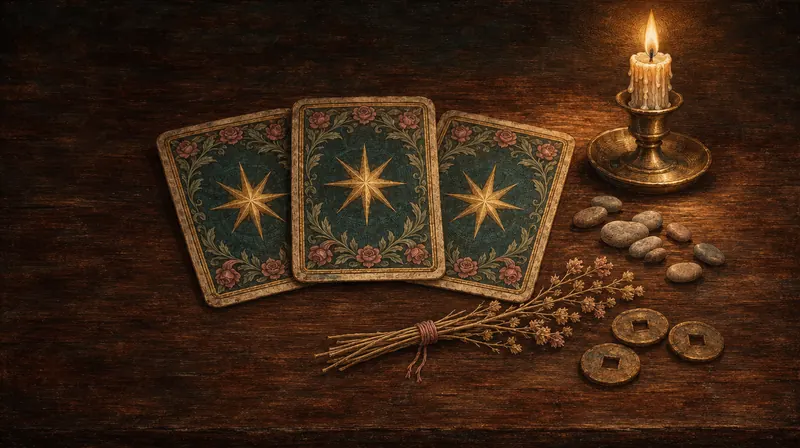
How do I use a tarot reading as a mirror for my own thinking without letting it decide for me?
What it is
To read as a mirror is to treat a draw as a picture of the asker's own mind, and not as news from outside. A card or a line of text arrives by chance. The asker, called the querent in the older books, then does the real work of deciding what the image means for the question. That choosing is revealing. People pick out what fits their hopes or their fears, and seeing which it was tells them something true about where they stand.
The teaching
As the reflective reading of the cards that follows C. G. Jung teaches it.
The image as a mirror
A card falls by chance, but what the reader sees in it does not. The picture is open: a figure walking away, a cup held out, a tower struck. The mind fills it from its own store, and Jung called this projection, the way the unconscious lays its own contents on an outside object and then meets them there as if they belonged to the object. Read in this way, a spread is a picture of the reader's own situation, drawn by the reader's own eye.
So the reflective reader asks of every card not what it predicts but what it shows: what do I see here that I had not yet said to myself? The book's meaning is a starting point, and the reader's own response is the matter of the reading.
The question
The question is written down before anything is drawn, and it is about the reader, open and in the present: what am I not seeing in this choice, what do I need to understand about this quarrel, what am I afraid of here. A question about another person's mind, a yes or no about the future, or a date for an event gives the mirror nothing to show. One question is put once; drawing again until the answer pleases is reading a wish, not a card.
Describe before you interpret
Reflective readers go through a card in three passes. First the plain description, in the present tense, as if to someone who cannot see it: a woman sits blindfolded with two swords crossed over her breast, the sea behind her and a thin moon above. Second, the feeling: what the picture stirs, before any reason is given. Third, the association: what in the reader's own life the scene recalls.
Then the reader speaks as the card, in the first person: I hold two swords so that nothing reaches my heart; I have chosen not to look. What comes out in that voice is often what the reading was for. Only after this is the book opened, and its meaning laid beside what the reader has already found.
Speaking with the figure
Jung's method of active imagination takes this a step further. The reader settles, holds the image in mind until it begins to move of its own accord, and then meets it: asks the figure what it wants, listens, writes down what it says, and answers as one would answer a living person. Jung's followers give the stages as quieting the mind, letting the image come, giving it form in writing or drawing, and then the ethical part, taking what was learned seriously in life.
Jung warned that the method is strong and not for everyone. It is done awake, in short sessions, with the notebook open, and stopped at once if the images grow overwhelming or frightening. Anyone with a history of psychosis, or in acute distress, should leave it alone and speak with a doctor or a therapist instead.
The card you dislike
The card that repels the reader is often the one to stay with. Jung called the shadow those parts of oneself that one will not own, and they are met first as a strong dislike of something outside. A reader who bristles at the King of Pentacles, or turns quickly past the Devil, can ask what in that figure is also theirs: the wish for security, the chain they keep on themselves. The reaction is the information.
Meaningful coincidence
Jung named synchronicity the meaningful coincidence of an inner state and an outer event with no cause linking them, and in his foreword to the Book of Changes he wrote that a cast reflects the quality of the moment in which it is made. On that view a draw is not a message sent: it is a coincidence the reader finds meaningful, and the meaning is the reader's to weigh. Reflective readers hold this lightly. It explains why a card can feel apt without claiming that it knew anything.
The reading journal
Reflective readers keep a journal: the date, the question, the card, the three passes and one sentence of what the reader now thinks. Read back after a month, it shows what no single draw can: the questions that keep returning, the cards met again and again, the fears that came to nothing. The journal, more than any card, is the mirror.
Where the mirror stops
The mirror shows; it does not decide. Matters of health, money, law and whether to stay with someone are not put to the cards, and when they come up in a reading they are taken to a doctor, an adviser, a lawyer or a trusted friend, and to the reader's own judgement. No one is read without their consent, and nothing in a spread is a fact about another person.
A reader who finds they cannot act without drawing first, or who draws again and again for reassurance, has let the mirror become a judge. The practice then is to put the cards away for a while and make the next choice without them.
How it is practised
A reader asks an open question about themselves, such as what am I not seeing about this choice, and not a yes or no about the future. They draw once, write down the first thing the image stirs before reasoning about it, and then ask what they would say to a friend who had drawn it. The same question is not put again that day. Then the card is set aside and the decision is made as it would have to be anyway: with the facts, their own judgement and people they trust.
Where it comes from
The asker's share is old: Croesus heard the oracle of Delphi as he hoped, Rome's priests searched the Sibylline Books for a fitting line, and in Yoruba Ifá the client picks the story that fits. Psychologists have studied why readings feel accurate. In 1948 Bertram Forer handed each of his students what he said was a personal character sketch. All received the same text, and on average they rated it better than four out of five for accuracy. The readiness to take general statements as personal is now called the Barnum effect. Carl Jung, from another side, valued the I Ching as a way of bringing unnoticed thoughts into view and spoke of the tarot pictures in similar terms, and many modern readers use the cards in that spirit and promise no prediction.
What is known, and what is not
The Barnum effect and the pull of a person's own expectations are well replicated findings. They explain why a reading can feel exact without foretelling anything. That a chance image can help someone think is a modest claim, supported mostly by the experience of people who use it. It stops being a mirror the moment it is asked to decide: questions of health, money, law or whether to stay with someone belong with qualified help and the person's own choice.
Its words
- Querent
- The person who asks the question in a reading. The word comes from horary astrology and passed into tarot.
- Tarot
- A deck of seventy-eight cards, made in fifteenth-century Italy for a game and read for divination since the eighteenth century.
- Ifá
- The Yoruba divination of West Africa. A trained priest casts palm nuts or a chain, arrives at one of 256 signs and recites the verses that belong to it.
- Oracle of Delphi
- Apollo's shrine on Mount Parnassus, where for about a thousand years a priestess, the Pythia, spoke the god's replies to cities and private askers.
- Sibylline Books
- Scrolls of Greek verse oracles owned by the Roman state. Priests opened them on the order of the Senate in a crisis and came back with a rite to perform.
Ask the Oracle further
Why does a tarot reading feel so accurate when the cards fall by chance?What kind of question is worth putting to the tarot, and what kind is not?
Before you practise
The Oracle draws no cards and casts nothing; it reads what you bring. Treat any divining art as a mirror for your own thinking, never as the judge of your health, money, legal matters or relationships.
Its other branches
The tarotThe runesThe I ChingBring your own drawPendulum and scryingThe whole artSearch the tree

