
The tarot
Seventy-eight cards: a game of the 1400s that became a book of images.
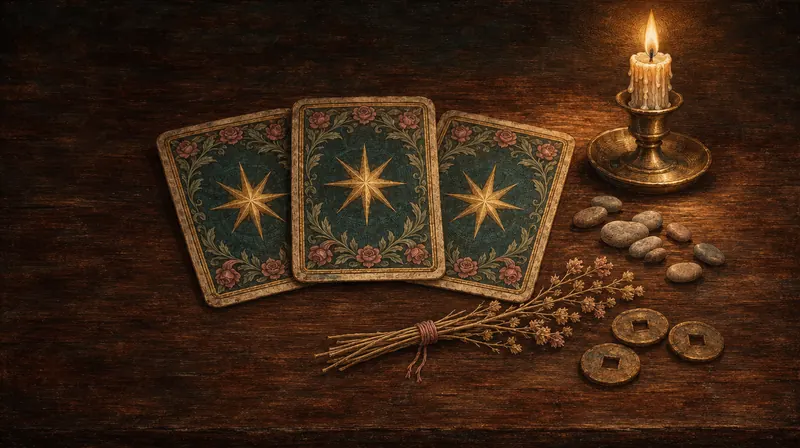
Where does the tarot come from, and how do its major and minor arcana work?
What it is
A tarot deck has seventy-eight cards. Twenty-two are the picture trumps, now called the Major Arcana: the Fool, the Magician, Death, the Tower, the World and the rest. Fifty-six are suit cards: four suits of ten numbered cards and four court cards each, close kin to an ordinary playing deck. A reader lays cards in set positions, called a spread, and reads each picture in the light of its place and of the question that was asked.
The teaching
As A. E. Waite's Pictorial Key to the Tarot teaches it.
The deck and how a card speaks
The tarot has seventy-eight cards. Twenty-two are the trumps, the Major Arcana, numbered from 0 to XXI. Fifty-six are the Minor Arcana: four suits, Wands, Cups, Swords and Pentacles, each running from Ace to Ten with four court cards, Page, Knight, Queen and King. In the Golden Dawn's scheme, which most readers keep, Wands belong to fire, Cups to water, Swords to air and Pentacles to earth.
Every card has an upright meaning and a reversed one, for when it falls upside down. Reversed, a card often turns to the shadow of its meaning, though some turn to good: the Eight of Cups reversed is great joy. Waite holds that bare meanings are not enough alone, for the pictures "are like doors which open into unexpected chambers". Waite numbers Strength VIII and Justice XI, the reverse of the Marseille order.
The trumps from the Fool to the Emperor
0, the Fool. A young man with a rose, a wand and a wallet steps to a cliff's edge, his dog leaping beside him: the spirit in search of experience. Upright: folly, extravagance, frenzy. Reversed: negligence, carelessness, apathy, vanity.
I, the Magician. One hand lifts a wand to heaven, the other points to earth, and the four suit emblems lie on his table as tools: the divine motive in man, the will joined to what is above. Upright: skill, subtlety, self-confidence, will. Reversed: disgrace, disquiet.
II, the High Priestess. She sits between a black pillar and a white, the moon at her feet and a scroll marked TORA half hidden in her mantle: the hidden church, the Shekinah of Kabbalah. Upright: secrets, mystery, the future unrevealed, silence, wisdom. Reversed: passion, conceit, surface knowledge.
III, the Empress. Crowned with twelve stars, corn ripening at her feet: the earthly paradise and the fruitfulness of all things. Upright: fruitfulness, action, initiative, length of days. Reversed: light, truth, the unravelling of tangled matters.
IV, the Emperor. Enthroned on rams' heads with sceptre and orb: the power of this world made real. Upright: stability, power, protection, reason, authority. Reversed: benevolence, compassion, or obstruction and immaturity.
From the Hierophant to the Hermit
V, the Hierophant. Triple crowned between two pillars, he blesses two kneeling ministers, the crossed keys at his feet: the ruling power of outward religion. Upright: marriage, alliance, mercy, the counsellor one turns to. Reversed: concord, over-kindness, weakness.
VI, the Lovers. An angel blesses a man and a woman in the garden, the Tree of Life behind him and the serpent's tree behind her: human love as part of the way. Upright: attraction, love, beauty, trials overcome. Reversed: failure, foolish designs.
VII, the Chariot. A crowned victor with a drawn sword rides behind a black sphinx and a white: triumph in the mind. Upright: succour, providence, triumph, presumption. Reversed: riot, quarrel, litigation, defeat.
VIII, Strength. A woman closes a lion's jaws and leads it by a chain of flowers: the higher nature mastering the passions. Upright: power, energy, courage, magnanimity. Reversed: despotism, abuse of power, weakness, discord.
IX, the Hermit. On a height an old man lifts a lantern with a star in it, and his beacon says, in Waite's words, "where I am, you also may be". Upright: prudence, circumspection, also dissimulation. Reversed: concealment, disguise, fear, unreasoned caution.
From the Wheel of Fortune to Temperance
X, the Wheel of Fortune. A lettered wheel turns with a serpent sinking, a jackal-headed figure rising and a sphinx above, the four living creatures at the corners: the flux of life, with Providence within it. Upright: destiny, fortune, success. Reversed: increase, abundance, superfluity.
XI, Justice. Crowned and seated between pillars with sword and scales: the law that deals with everyone by their works. Upright: equity, rightness, probity, the deserving side winning at law. Reversed: legal complications, bias, excessive severity.
XII, the Hanged Man. He hangs by one foot from a living tree shaped like a T, a halo round his calm face: life in suspension, and not death. Upright: wisdom, discernment, trials, sacrifice, intuition. Reversed: selfishness, the crowd.
XIII, Death. An armoured skeleton rides a white horse under a black banner with a white rose, king, maiden and child falling before him: change, the passage from lower to higher. Upright: end, mortality, destruction. Reversed: inertia, sleep, lethargy.
XIV, Temperance. A winged angel, one foot on land and one in water, pours the essence of life from cup to cup: soul and body tempered into one. Upright: economy, moderation, frugality, management. Reversed: disunion, competing interests.
From the Devil to the Sun
XV, the Devil. The horned goat stands on an altar with a reversed pentagram on his brow, a man and a woman chained below: the chain and fatality of the material life. Upright: violence, vehemence, force, fatality. Reversed: evil fatality, weakness, pettiness, blindness.
XVI, the Tower. Lightning strikes a tower, its crown falls and two figures fall headlong: the ruin of a house built on falsehood. Upright: distress, adversity, ruin, unforeseen catastrophe. Reversed: the same in lesser degree, oppression, imprisonment.
XVII, the Star. A naked woman pours water on land and sea from two ewers under a great star and seven lesser ones: truth unveiled, the waters of life. Upright, Waite gives loss and abandonment, or by another reading hope and bright prospects, which most readers now follow. Reversed: arrogance, impotence.
XVIII, the Moon. Dew falls on a path between two towers; a dog and a wolf bay and a crayfish crawls from the pool: imagination apart from the spirit, the fears of the natural mind. Upright: hidden enemies, danger, deception, error. Reversed: instability, inconstancy, silence.
XIX, the Sun. A naked child rides a white horse before a wall of sunflowers: the light of the spirit, simplicity and innocence. Upright: material happiness, a fortunate marriage, contentment. Reversed: the same in lesser degree.
The Last Judgement and the World
XX, the Last Judgement. An angel sounds a trumpet and the dead rise from their tombs in wonder: a summons from above, answered from within. Upright: change of position, renewal, outcome. Reversed: weakness, timidity, or deliberation, decision, sentence.
XXI, the World. A dancing figure with a wand in each hand floats in an oval wreath, the four living creatures at the corners: the perfection and end of the cosmos. Upright: assured success, recompense, voyage, change of place. Reversed: inertia, fixity, stagnation.
The suit of Wands
Wands are always in leaf, for this is the suit of life, animation and enterprise. The Ace is creation, the start of enterprises; the Two, riches shadowed by sadness, like Alexander among his conquests; the Three, established strength and trade, ships at sea; the Four, country peace, a harvest home, concord; the Five, mimic warfare, the struggle for fortune; the Six, a victor crowned, great news; the Seven, valour holding the high ground against many; the Eight, swiftness, the arrows of love; the Nine, strength in opposition, ready for attack; the Ten, oppression, even by success.
The Page is a faithful messenger with tidings; the Knight, departure, a change of home; the Queen, a loving, honourable woman and success in business; the King, an honest, conscientious man, or news of an unexpected inheritance.
The suit of Cups
Cups are the suit of water, of love and vision. The Ace is the house of the true heart, joy and abundance; the Two, love, friendship and union, the caduceus rising between the lovers; the Three, a matter ending in plenty and merriment; the Four, weariness, a new cup offered and not seen; the Five, loss with something left over, an inheritance below hopes; the Six, memories of childhood; the Seven, images in the glass of imagination, nothing lasting; the Eight, the decline of a matter, or one of slight weight; the Nine, contentment, well-being, victory; the Ten, the repose of the whole heart.
The Page is a studious youth with news; the Knight, an arrival, a proposal, an invitation; the Queen, a devoted woman with loving intelligence and the gift of vision; the King, a man of business, law or the church: equity, art and creative intelligence.
The suit of Swords
Swords, the suit of air, are seldom kindly forces in human affairs. The Ace is triumph, force in excess, in love as in hatred; the Two, a blindfolded woman balancing two swords, equipoise, friendship in arms; the Three, a pierced heart, absence, division, rupture; the Four, a knight's effigy on his tomb, retreat and solitude; the Five, degradation and dishonour; the Six, a ferryman's passage, a journey by water; the Seven, a plan or hope that may fail; the Eight, a woman bound, crisis and censure, but only for a time; the Nine, a woman weeping in the night, utter desolation; the Ten, pain and tears, though not violent death.
The Page is vigilance and overseeing, even spying; the Knight, skill and bravery, wrath and war; the Queen, sorrow, widowhood, absence, mourning; the King, judgement, command and law.
The suit of Pentacles
Each pentacle bears the pentagram, "typifying the correspondence of the four elements in human nature and that by which they may be governed": this is the suit of earth, work and goods. The Ace is perfect contentment, felicity, gold; the Two, a dancer with two pentacles, gaiety, or agitation; the Three, a sculptor at work in a monastery, skilled labour and renown; the Four, a crowned man holding fast to what he has; the Five, two beggars in the snow by a lighted window, material trouble; the Six, a merchant weighing out alms, gifts; the Seven, a man gazing at his crop of coins, money and barter; the Eight, an artist in stone at work, craftsmanship; the Nine, a woman in her vineyard, prudence, safety, accomplishment; the Ten, a family under the arch of their house, inheritance.
The Page is study and scholarship; the Knight, usefulness, responsibility, rectitude; the Queen, greatness of soul, generosity; the King, valour and practical intelligence, success in business.
How it is practised
The Oracle draws no cards. A reader who uses their own deck works in the usual way: one plain question, written down first; a small spread of one to three cards; then a slow look at each picture before any book is opened. What is happening in the scene, and where is that happening in the matter asked about? The printed meanings come second. The reading ends with one sentence in the reader's own words, and the decision stays theirs.
Where it comes from
The cards were made for a game. Trionfi decks, with a fifth suit of picture trumps added to the four ordinary suits, are recorded in northern Italy from the 1440s, and hand-painted sets survive from the court of Milan. The game, tarocchi, is still played in parts of Europe. Nothing ties the cards to fortune telling before the eighteenth century. In 1781 Antoine Court de Gébelin claimed they were an Egyptian book of wisdom, working from cards of the French woodcut pattern now called the Tarot de Marseille, the Paris card reader Etteilla built a method on the claim, and in 1909 A. E. Waite and the artist Pamela Colman Smith published the deck most readers now learn from.
What is known, and what is not
The game origin is documented in Italian records and surviving decks. The Egyptian origin has nothing behind it: Court de Gébelin wrote before hieroglyphs could be read, and nothing Egyptian resembles the cards. No controlled study has found that tarot predicts events. What a spread does show is how the reader sees the question, which is real and useful, and is the reader's own.
Its words
- Tarot
- A deck of seventy-eight cards, made in fifteenth-century Italy for a game and read for divination since the eighteenth century.
- Major Arcana
- The twenty-two picture trumps of the tarot, from the Fool to the World; the name was given by French occultists in the nineteenth century.
- Rider-Waite-Smith Tarot
- The London deck of 1909, planned by A. E. Waite and drawn by Pamela Colman Smith, with a scene on every card; most modern card meanings describe its pictures.
- Tarot de Marseille
- The old French woodcut tarot, whose numbered suit cards show only cups, coins, swords and batons. It was the deck the first occult writers had before them.
- Etteilla
- Jean-Baptiste Alliette of Paris, who died in 1791: the first to print a way of telling fortunes with the tarot, with upright and reversed meanings and set layouts.
Ask the Oracle further
Was the tarot really a card game before anyone told fortunes with it?How do I read a tarot card by its picture before I look up its meaning?
Before you practise
The Oracle draws no cards and casts nothing; it reads what you bring. Treat any divining art as a mirror for your own thinking, never as the judge of your health, money, legal matters or relationships.
Its other branches
The runesThe I ChingReading as a mirrorBring your own drawPendulum and scryingThe whole artSearch the tree

