
Bring your own draw
Tell the Oracle what you drew, and it reads it with you beside your chart.
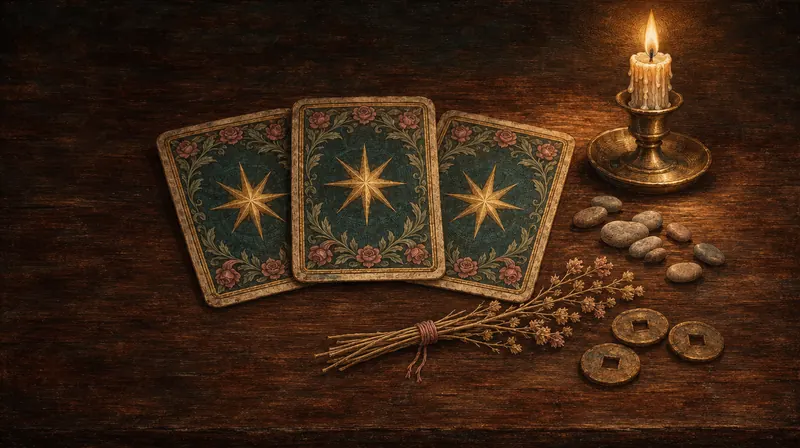
I drew some tarot cards. How do I tell you what I drew so you can read them with me?
What it is
The Oracle holds no deck and casts nothing, so it never draws for anyone. What it can do is read a draw a reader has made themselves. For that it needs four things: the question as it was asked; the name of each tarot card, rune or figure; the position each one fell in; and, for cards, whether any came out upside down. It then reads the draw by the tradition those symbols belong to, and sets it beside the reader's chart and the sky of the day.
The teaching
As the readers' craft of the spread in Waite and the Golden Dawn teaches it.
What a draw is made of
A draw is a question, a set of symbols and their places. All three are written down before reading: the question in the asker's own words; the deck by name, since meanings differ from author to author; the spread and what each place means; then each card in the order it fell, and whether it came up reversed. Nothing is added afterwards.
One card and three
The smallest draw is one card, for the heart of a matter or the tone of a day. The commonest is three, laid from left to right, with their places named before the shuffle: past, present and what is coming; or the situation, what stands in the way and the advice; or what to keep, what to let go and what to try. The places are fixed first and never changed once the cards are seen.
The Significator
For a larger spread Waite first chooses a card to stand for the asker, the Significator, and lays it face up. By his rule a Knight stands for a man of forty or more and a King for a younger man, a Queen for a woman of forty or more and a Page for a younger woman. The suit follows colouring: Wands for very fair people with yellow or auburn hair and blue eyes, Cups for light brown hair and grey or blue eyes, Swords for dark brown hair and hazel or grey eyes, Pentacles for very dark hair and eyes. He lets temperament override this, so that a dark but energetic person may take Swords.
When the question is a matter and not a person, a card of that matter may stand for it, as Justice does for the question whether a lawsuit is needed. Many readers today choose the Significator by temperament alone, or leave it out and let the first card speak for the asker.
The Celtic Cross: the cross
Waite shuffles and cuts the pack three times and turns up the cards one by one. The first covers the Significator, and he says: this covers him. It is the general influence, the atmosphere in which the other currents work. The second is laid across it: this crosses him, the nature of the obstacles, and if it is a good card the opposition is not serious. The third goes above: this crowns him, the asker's aim, and the best that can be reached but is not yet made actual. The fourth goes below: this is beneath him, the foundation, what has already passed into fact and become his own.
The fifth is laid on the side the Significator is looking away from: this is behind him, the influence just past or passing away. The sixth is laid on the side it faces: this is before him, the influence coming into action in the near future. For a card that faces neither way, the reader decides beforehand which way it looks.
The Celtic Cross: the staff
The next four are laid one above another in a line to the right of the cross. The seventh is himself, the asker's position and attitude. The eighth is his house, his surroundings and the people near him. The ninth is his hopes or fears. The tenth is what will come, the outcome of all the rest, and Waite asks the reader to gather the whole spread into that one card.
If the tenth card is unclear, he lays the spread again with the tenth as the new Significator. If it is a court card, the matter falls into the hands of the person it shows, and a fresh spread can be laid with that card at the centre to learn what that person will bring.
Reversals, pairs and neighbours
Waite gives every card a reversed meaning. Many readers today read a reversed card as its meaning blocked, turned inward or delayed, and some do not reverse at all; the rule is chosen before the draw and kept to. Waite also reads cards of one rank that fall together: four Kings, great honour; three Queens, deception; four Aces, favourable chance; three Aces, small success.
The Golden Dawn read each card by its neighbours, which it called its dignity. Cards of the same suit on either side strengthen it greatly. Wands and Cups weaken each other, as fire and water do, and so do Swords and Pentacles, as air and earth; the other pairs of suits are friendly.
Runes and the Book of Changes
For runes, write the names in the order drawn, the place each was given, and whether any came out upside down. For a cast on the cloth, note only those that fell face up.
For the Book of Changes, write the six numbers in the order cast, from the bottom line up. Sevens and nines are firm lines, eights and sixes yielding, and nines and sixes change. A cast of 7, 8, 9, 7, 6, 8 gives 55, Abundance, thunder over fire, with changing lines in the third and fifth places; turned, they give 17, Following, the lake over thunder. Name both figures and the changing lines, and the reading can begin.
How it is practised
A reader writes it out plainly, for instance: I asked what I am avoiding at work; three cards, for past, present and next step; the Six of Cups, the Tower reversed, the Page of Swords; the Rider-Waite deck. For runes, the names and the order they were drawn in. For the I Ching, the figure and which lines were changing. The Oracle reads what is given and adds no card that was not drawn.
Where it comes from
Reading by position is as old as card reading itself: the Paris reader Etteilla published layouts in the 1780s and gave each card an upright and a reversed meaning. The best known spread, the ten-card Celtic Cross, was printed by A. E. Waite in the book that went with his deck of 1909, where he called it an ancient Celtic method. No earlier printed source for it is known. Sets of meanings have differed from author to author ever since, which is why it helps to name the deck, and to say so when it is not a tarot at all, as with the thirty-six cards of the Lenormand.
What is known, and what is not
A reading of this kind is interpretation, and the house says so. The same card is read differently by different authors, and no one meaning is the correct one. What can be checked is the tradition: what Waite, the rune poems or the Chinese text say of a symbol. The link to a birth chart is a comparison of two sets of symbols, offered as another angle on the question and not as proof of either.
Its words
- Tarot
- A deck of seventy-eight cards, made in fifteenth-century Italy for a game and read for divination since the eighteenth century.
- Runes
- The letters of the old Germanic alphabets, cut in wood, metal and stone, and used for casting lots by modern readers.
- I Ching
- China's Book of Changes: sixty-four six-line figures, each with a judgment and line sayings, consulted by a chance cast.
- Lenormand
- A pack of thirty-six cards with one everyday picture each, read in pairs and rows. It took its images from a German game and its name from a Paris card reader.
Ask the Oracle further
I pulled three runes this morning. Can you read them beside my chart?Does it matter which tarot deck I used, or whether a card came out reversed?
Before you practise
The Oracle draws no cards and casts nothing; it reads what you bring. Treat any divining art as a mirror for your own thinking, never as the judge of your health, money, legal matters or relationships.
Its other branches
The tarotThe runesThe I ChingReading as a mirrorPendulum and scryingThe whole artSearch the tree

