Magic, religion, and symbols
Pentacle
Direct answer
Pentagram names a five-pointed star. Pentacle has a broader and historically less consistent use: many grimoire pentacles are complex circular designs, but not all contain a pentagram, and not every circled pentagram should be assigned one religion or moral meaning.
A pentacle is a talismanic diagram or object, especially in ceremonial-magic texts, and its design can include divine names, geometric figures, letters, crosses, or seals. In modern tarot and Pagan contexts it often appears as a pentagram within a disk.
$0 today, then $12/month after 7 days. Cancel anytime.
Quick facts
| Term | Useful distinction |
|---|---|
| Pentagram | A five-pointed star drawn with five lines or represented as that star shape. |
| Pentacle | A consecrated or talismanic figure/object in older magic; often a disk with a pentagram in modern usage. |
| Tarot Pentacles | A suit associated in many modern decks with coins, material resources, labor, and the element earth. |
| Orientation | Upright or inverted meanings depend on period and community; neither is universally good or evil. |
What does your own chart say about you?
Choose love, work or purpose. Your reading is written from your chart. Your reading uses your own birth details.
Walk through Alex’s whole example first
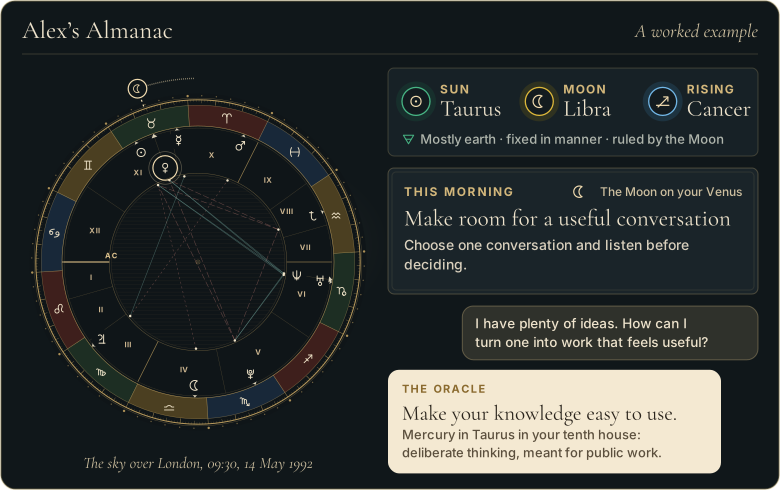
 The Road of AgesSee the turning points of your whole life, from your birth date
See your road's shape
The Road of AgesSee the turning points of your whole life, from your birth date
See your road's shape
Prefer to explore first?
 The Road of AgesThe turning points of your whole life, from your own chart
Walk my road
The Road of AgesThe turning points of your whole life, from your own chart
Walk my road
Free, by email
Your daily Almanac letter
One short letter at 7 each morning: the day’s theme read for your own chart, and one thing to do with it.
Why the word does not mean only “five”
Modern readers often derive pentacle directly from penta-, five, and define it as a pentagram in a circle. Historical usage is messier. Medieval French and English forms referred to a magical or protective figure, and literary use such as the pentangle in Sir Gawain adds further overlap. Early modern grimoires label varied circular talismans as pentacles even when their geometry is not fivefold. Etymological debates continue, so the object’s actual design and source caption are more reliable than assuming the name guarantees five points.
Pentacles in Solomonic and ceremonial texts
The Key of Solomon and related traditions present planetary pentacles containing names, verses, characters, geometric divisions, and seals. Their functions and appearances differ by manuscript, and popular printed plates may be editorial reconstructions from several witnesses. The circles can organize text and mark a bounded sacred figure, but one universal decoding scheme does not explain every design. Historical attribution to Solomon supplies authority within the tradition; it does not show that the biblical king authored the surviving early modern forms.
Tarot, Wicca, Paganism, and public misunderstanding
In the Rider-Waite-Smith tarot, the suit commonly called Pentacles uses disks bearing five-pointed stars and emphasizes material life, work, body, skill, and resources. Modern Wiccan and Pagan communities may use an upright pentacle for elemental balance, earth, protection, or religious identity. Satanic and occult groups have used particular inverted or goat-associated forms, but an inverted star has had other meanings in art and esotericism. Context, accompanying imagery, and self-identification matter; a necklace alone does not establish dangerous belief or conduct.
How to identify a pentacle accurately
Describe what is visible before interpreting: number of points, line continuity, enclosing circles, letters, language, planetary signs, orientation, material, and provenance. Then consult a facsimile or community source specific to that form. Avoid copying unknown inscriptions onto the body or ingesting substances associated with a talisman. This reference does not provide consecration or operational instructions. Symbols have real cultural and personal importance, but no pentacle guarantees protection, wealth, love, or healing; physical safety and health require practical measures.
Sources and editorial method
Research and editorial references used for this page include:
- Twilit Grotto: The Key of Solomon - Comparative transcription showing historically varied Solomonic pentacles in textual context.
- The Metropolitan Museum of Art: Tarot history - Museum overview distinguishing early card history from later occult suit interpretation.
These references support the factual, historical, textual, or interpretive claims on this page. Interpretive traditions are identified as such, and factual claims are kept separate from symbolic claims.
Related reading
Read symbols with context
A definition tells you what it is; your own birth chart tells you what it means for you. The Oracle casts your real chart and answers for your love, your work, and your year ahead, in conversation. It opens with the 7-day Seeker trial.
Speak with the OracleYour year, written once from your chart alone: the Cosmic Codex reads the whole of it, month by month. Open the Cosmic Codex
More in Spells & Occult Terms
- Rootwork
- Spiritism
- Witch Bottle
- Binding Magic
- Control Spell
- Evocation
- Heptameron
- Magical Correspondences
From the reference page to your own chart
Every word here
is in your own chart.
- A personal reading about love, work or purpose, written from your chart
- A practical next step to consider
- It opens with 7 days free, with the AI Oracle and daily guidance
$0 today, then $12/month after 7 days. Cancel anytime.
Common questions
Is a pentacle always a pentagram inside a circle?
No. That is the dominant modern visual definition, but historical grimoire pentacles include many circular talismanic diagrams without five-pointed stars.
Is the pentacle a Satanic symbol?
Not inherently. It appears in ceremonial magic, tarot, Wicca, Pagan religions, literature, and art. Particular groups and configurations must be identified in context.
What is the tarot suit of Pentacles about?
In many modern decks it concerns material resources, work, craft, the body, stability, and exchange. Earlier tarot began as card play, and suit names vary.
Free, by email
The Almanac, in your inbox at 7
One short letter at 7 each morning: the day’s theme read for your own chart, and one thing to do with it.
