
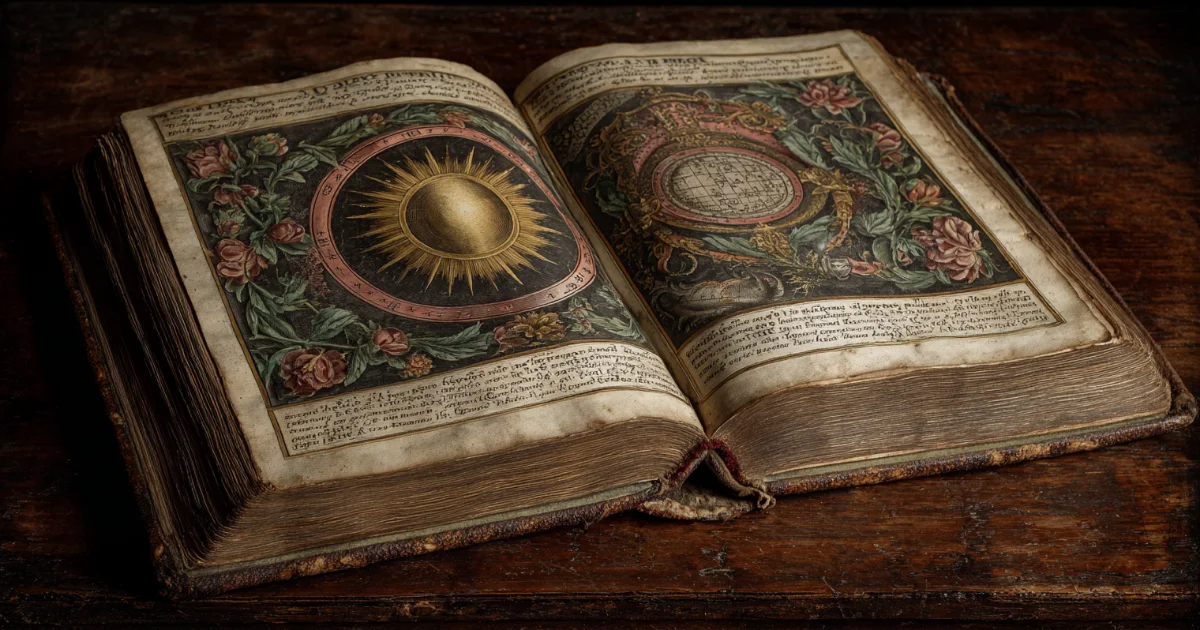
Grimoires and planetary time
Heptameron
Direct answer
The work combines a general ritual framework with day-specific names, directions, seasons, and planetary correspondences. It is best understood through its sixteenth-century print context and manuscript relatives, not as a securely authored medieval book or a timeless handbook unchanged across editions.
The Heptameron is a short early modern grimoire organized around the seven days of the week and their planetary associations. It circulated under the name of medieval physician and philosopher Pietro d’Abano, although that authorship is not accepted at face value.
$0 today, then $12/month after 7 days. Cancel anytime.
Quick facts
| Feature | Historical context |
|---|---|
| Title | Refers to seven days, matching the work’s organization by weekday. |
| Attributed author | Pietro d’Abano, a medieval scholar; the attribution is doubtful or pseudonymous. |
| Early print setting | Often printed with or appended to works associated with Heinrich Cornelius Agrippa. |
| Central structure | Planetary days and hours, with changing angels, winds, directions, and seasonal details. |
What does your own chart say about you?
Choose love, work or purpose. Your reading is written from your chart. Your reading uses your own birth details.
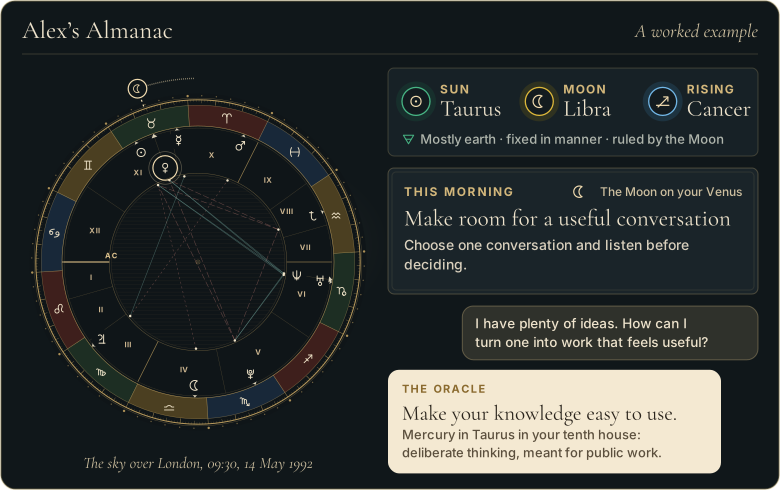
Walk through Alex’s whole example first
 The Road of AgesSee the turning points of your whole life, from your birth date
See your road's shape
The Road of AgesSee the turning points of your whole life, from your birth date
See your road's shape
Prefer to explore first?
 The Road of AgesThe turning points of your whole life, from your own chart
Walk my road
The Road of AgesThe turning points of your whole life, from your own chart
Walk my road
Free, by email
Your daily Almanac letter
One short letter at 7 each morning: the day’s theme read for your own chart, and one thing to do with it.
What kind of book the Heptameron is
The Heptameron is a compact ritual-magic text whose name means a work of seven days. It assigns distinct celestial and spiritual correspondences to Sunday through Saturday, following the traditional sequence of planetary rulers: Sun, Moon, Mars, Mercury, Jupiter, Venus, and Saturn. A preliminary portion describes general preparations and diagrammatic space, while the daily sections vary names and conditions. This entry discusses that literary architecture only; it does not reproduce conjurations, seals, or a sequence for practice.
Why the attribution to Pietro d’Abano is disputed
Pietro d’Abano died in the early fourteenth century and became surrounded by legends of forbidden learning. Attaching his name to a magical work could lend authority and danger to a later text. Scholars therefore distinguish attribution printed on a title page from demonstrated authorship. The Heptameron’s known publication history, language, dependence on wider ritual traditions, and relationship to Renaissance collections make simple acceptance of Pietro as author unsafe. “Attributed to” is the accurate formulation unless new documentary evidence establishes more.
The planetary week as its organizing principle
The seven-day scheme joins ordinary calendar time to the seven classical planets visible without a telescope. Each day carries a ruler, while unequal planetary hours repeat a traditional sequence from sunrise to sunrise. The text overlays this temporal grid with angels, winds, aerial spirits, colors, scents, and seasonal variants. These lists are not perfectly stable across witnesses: spelling shifts, tables can be miscopied, and editors normalize differently. To compare two versions, examine the Latin or source transcription, publication date, and table structure rather than only an English name list.
Influence, editions, and responsible reading
The work became influential partly because it appeared alongside material connected with Agrippa and offered a concise bridge between learned planetary correspondences and ritual procedure. Elements recur in later Solomonic and ceremonial literature, but shared words do not prove direct copying in every case. Modern occult editions frequently combine the Heptameron with later explanatory systems. Historical reading should identify what belongs to the early print text, what an editor supplied, and what a modern practitioner added. Readers can study calendars, textual variants, and religious language without carrying out the rites; sensational claims about guaranteed manifestations are not historical evidence.
Sources and editorial method
Research and editorial references used for this page include:
- Twilit Grotto: Heptameron transcription - A comparative transcription and translation with edition notes useful for textual study.
- Encyclopaedia Britannica: Pietro d’Abano - Biographical context for the medieval scholar to whom the later work was attributed.
These references support the factual, historical, textual, or interpretive claims on this page. Interpretive traditions are identified as such, and factual claims are kept separate from symbolic claims.
Related reading
See it in your own chart
A definition tells you what it is; your own birth chart tells you what it means for you. The Oracle casts your real chart and answers for your love, your work, and your year ahead, in conversation. It opens with the 7-day Seeker trial.
Speak with the OracleYour year, written once from your chart alone: the Cosmic Codex reads the whole of it, month by month. Open the Cosmic Codex
More in Spells & Occult Terms
From the reference page to your own chart
Every word here
is in your own chart.
- A personal reading about love, work or purpose, written from your chart
- A practical next step to consider
- It opens with 7 days free, with the AI Oracle and daily guidance
$0 today, then $12/month after 7 days. Cancel anytime.
Common questions
Did Pietro d’Abano write the Heptameron?
The work circulated under his name, but modern scholarship treats that attribution as doubtful. His posthumous reputation made him a plausible authority for a pseudonymous text.
Why is it called the Heptameron?
Its central organization follows the seven weekdays and their planetary rulers. The title derives from the idea of a seven-part or seven-day work.
Is the Heptameron the same as Agrippa’s Fourth Book?
No. They were often transmitted or printed together and influence overlapping traditions, but they are distinguishable texts with separate structures and attribution problems.
Free, by email
The Almanac, in your inbox at 7
One short letter at 7 each morning: the day’s theme read for your own chart, and one thing to do with it.
