
Ceremonial magic history
Planetary Seals
Direct answer
A planetary seal should be identified by planet, manuscript or printed source, date, and neighboring table. Do not confuse it with the ordinary glyph for a planet, a planetary magic square, an intelligence or spirit sigil, or a modern logo derived from several traditions.
Planetary seals are diagrammatic signs associated with the seven classical planets in particular strands of ceremonial, astrological, and talismanic magic. Their lines and forms are tradition-specific rather than universal astronomical symbols.
$0 today, then $12/month after 7 days. Cancel anytime.
Quick facts
| Item | Distinction |
|---|---|
| Planet glyph | A compact astronomical or astrological sign such as ♄ for Saturn. |
| Magic square | A numbered grid associated with a planet in some Renaissance occult systems. |
| Planetary seal | A diagram associated with the planet and often printed beside its square. |
| Derived sigil | A traced figure generated from names or numbers on a grid under a particular method. |
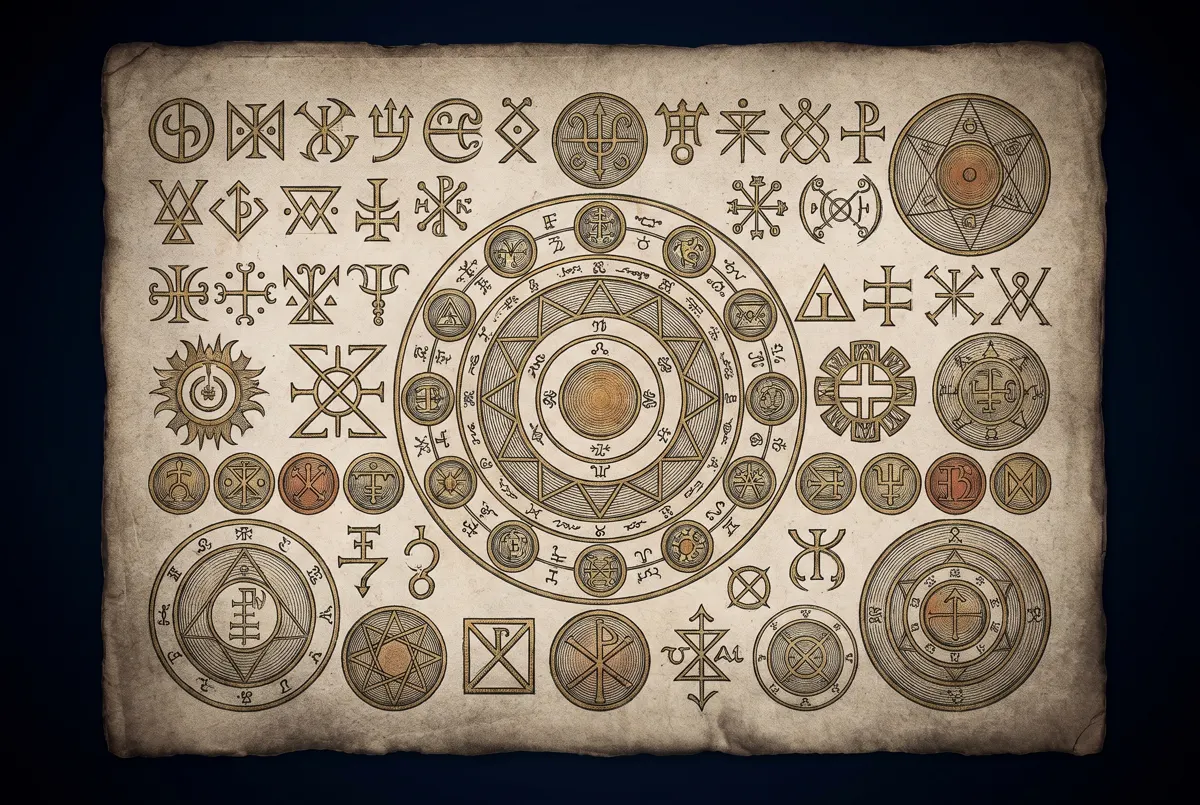
Planetary Seals are planet-linked magical symbols, not ordinary astrology glyphs.
A conceptual orientation, not an exact historical reproduction of every mark or seal.
What does your own chart say about you?
Choose love, work or purpose. Your reading is written from your chart. Your reading uses your own birth details.
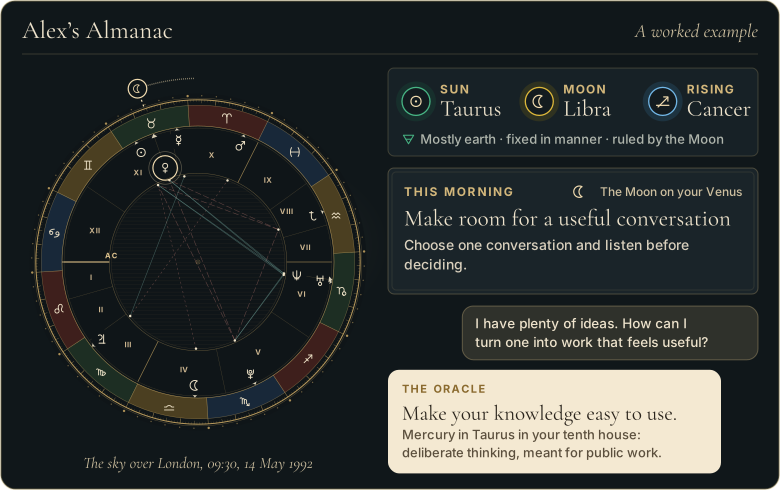
Walk through Alex’s whole example first
 The Road of AgesSee the turning points of your whole life, from your birth date
See your road's shape
The Road of AgesSee the turning points of your whole life, from your birth date
See your road's shape
Prefer to explore first?
 The Road of AgesThe turning points of your whole life, from your own chart
Walk my road
The Road of AgesThe turning points of your whole life, from your own chart
Walk my road
Free, by email
Your daily Almanac letter
One short letter at 7 each morning: the day’s theme read for your own chart, and one thing to do with it.
Where planetary seals appear
Planetary diagrams occur in medieval and early modern texts that join astrology, natural philosophy, angelology, talismanic image theory, number squares, and ritual magic. Widely reproduced sets are associated with works transmitted under names such as Agrippa and Solomon, but exact pages, attributions, and dates matter. A modern chart may silently redraw a damaged woodcut, standardize line crossings, or combine a planet’s seal with named intelligences and spirits. The result can look canonical even when no single historical witness contains that arrangement.
Relationship to planetary magic squares
In influential Renaissance presentations, each classical planet corresponds to a magic square of a particular order, from Saturn’s three-by-three grid through the Moon’s nine-by-nine grid. Seals and name-sigils appear with these numerical structures, and later authors sometimes explain lines as traversing selected cells. Not every seal is generated by one transparent modern algorithm, however. The diagram, square, numerical totals, divine names, and secondary sigils should be cataloged separately before inferring how an editor believed they were related.
How to authenticate a claimed historical seal
Ask for a shelfmark or bibliographic citation, then inspect a facsimile rather than a cropped repost. Compare line endings, enclosed spaces, dots, orientation, captions, and the page’s planet heading. Determine whether the source is a manuscript, first print, later translation, or contemporary reconstruction. Similar-looking figures can represent different planets or named entities after a copying error. “Ancient” is not a date, and attribution to Solomon does not establish biblical authorship. A responsible caption states uncertainty instead of repairing it invisibly.
Historical reference without ritual instruction
Planetary seals can be studied as visual culture, mathematical reception, print history, and evidence of how people imagined celestial influence. This entry does not explain manufacture, consecration, timing, invocation, or activation. Claims that wearing a downloaded figure guarantees wealth, compels love, cures disease, or protects from physical danger are unsupported. Images sold as harmless may also be used to pressure a buyer into further paid rites. Treat a seal as a historically situated symbol; use evidence-based medicine, consent, financial safeguards, and ordinary security for consequential needs.
Sources and editorial method
Research and editorial references used for this page include:
- Wellcome Collection: Magical manuscript catalog record - A digitized manuscript context for historical magical diagrams and textual transmission.
- Twilit Grotto: Key of Solomon transcription - Comparative historical transcription useful for checking Solomonic pentacles and edition variants.
These references support the factual, historical, textual, or interpretive claims on this page. Interpretive traditions are identified as such, and factual claims are kept separate from symbolic claims.
Related reading
Do not activate planetary marks
A definition tells you what it is; your own birth chart tells you what it means for you. The Oracle casts your real chart and answers for your love, your work, and your year ahead, in conversation. It opens with the 7-day Seeker trial.
Speak with the OracleYour year, written once from your chart alone: the Cosmic Codex reads the whole of it, month by month. Open the Cosmic Codex
More in Sigils, Seals & Symbols
- Seal of Solomon
- Staurogram
- Vesica Piscis
- Archangel Sigils
- Circle
- Dragon Symbol
- Hexagram
- Maltese Cross
From the reference page to your own chart
Every word here
is in your own chart.
- A personal reading about love, work or purpose, written from your chart
- A practical next step to consider
- It opens with 7 days free, with the AI Oracle and daily guidance
$0 today, then $12/month after 7 days. Cancel anytime.
Common questions
Is a planetary seal the same as a planet symbol?
No. The ordinary glyph labels a celestial body; a seal is a more elaborate diagram belonging to a particular magical textual tradition.
Are all online planetary-seal charts historically accurate?
No. Many are redrawn, mislabeled, mirrored, or combined from different editions. Verify the design against a cited facsimile.
Do planetary seals have scientifically proven effects?
No reliable scientific evidence shows that the diagrams cause promised material or health outcomes. Their importance is historical, religious, artistic, or personally symbolic.
Free, by email
The Almanac, in your inbox at 7
One short letter at 7 each morning: the day’s theme read for your own chart, and one thing to do with it.
