Early Christian manuscripts
Staurogram
Direct answer
The sign is not simply a later decorative crucifix dropped into an ancient page. In the earliest relevant papyri it works as part of a scribal abbreviation, while its visual form supplies evidence (debated in degree) for early Christian attention to the crucified figure.
The staurogram is a ligature combining the Greek letters tau and rho. Early Christian scribes used it within abbreviated forms of Greek words for cross and crucify, and its shape may also have evoked a figure on a cross.
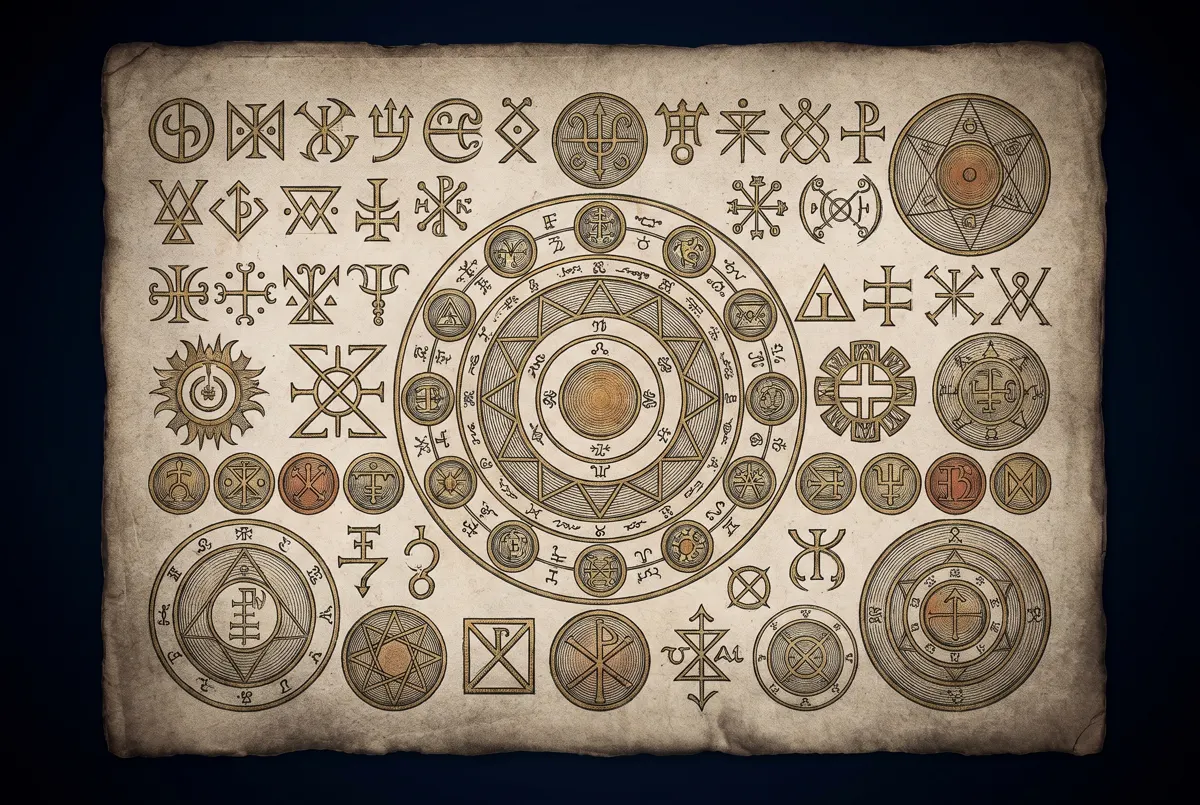
Staurogram means an early Christian monogram-like symbol combining tau and rho forms.
A conceptual orientation, not an exact historical reproduction of every mark or seal.Quick facts
| Feature | Explanation |
|---|---|
| Letters | Greek tau (Τ) and rho (Ρ) combined into one ligature. |
| Name | From Greek stauros, “cross,” joined with the idea of a written sign or monogram. |
| Scribal function | Used in contracted forms of words relating to cross or crucifixion. |
| Visual proposal | The rho’s loop can resemble a head above outstretched arms formed by tau. |
The Instruments
Ten readings, worked out from your own birth chart
An instrument is a reading this house works out for you. Give your birth date, time and place once, and each one reads today’s real sky against the chart you were born under. Eight are personal; two are calendars anyone can open. A free account opens one instrument a day. The plans open every instrument, every day.
- Natal Chart Every planet, house and aspect in your chart
- Active Transits Where the planets are now, read against your chart
- Daily Counsel What to pursue today, and what to leave alone
- Personal Timing Your best days to decide, weeks ahead
- Fellowship Your chart and another, read side by side
- Theme of the Day The one thing today is asking of you
- Sacred Numbers Your life path, your cycles, your name in numbers
- Aeolian Harmonics Classical music chosen to match your chart
- Mercury Retrograde Every Mercury retrograde this year, with its dates Open to all
- Void-of-Course Moon When the Moon is between signs, hour by hour Open to all



How tau and rho make the sign
A scribe superimposes or joins rho, whose upper loop projects from a vertical stem, with tau, whose horizontal stroke crosses that stem. The resulting tau-rho can be read alphabetically as two letters and visually as a compact cross-like figure. Manuscript hands vary, so the balance of loop, crossbar, and stem changes from example to example. A Unicode character can represent the general sign, but a printed glyph should not replace inspection of the original papyrus or a high-quality image.
Its use as a special abbreviation
In early Christian biblical manuscripts, the staurogram appears within contracted spellings of Greek terms related to crucifixion, often with an overline marking abbreviation. This places it near the broader scribal practice called nomina sacra, in which important sacred words receive distinctive contractions. The tau-rho is not identical to every nomen sacrum, however, and it should not be confused with the chi-rho monogram formed from the first letters of Christos. Reading the surrounding Greek is essential to identify its grammatical role.
Was it an early image of the crucified Jesus?
Several scholars argue that the loop of rho suggests a head and the tau a cross with outstretched arms, making the sign a visual reference to Jesus on the cross earlier than surviving full-scale crucifixion art. The proposal is influential because form and word occur together. Caution remains appropriate: ligatures can acquire visual resonance without functioning as independent pictures, and dating manuscripts or reconstructing scribal intention involves uncertainty. The strongest formulation is that the abbreviation may carry pictographic force, not that every tau-rho proves a complete early iconography.
Staurogram, chi-rho, and later cross forms
The chi-rho combines Χ and Ρ and became a prominent Christogram, especially in imperial and ecclesiastical art. The staurogram combines Τ and Ρ and is tied specifically to cross-word abbreviations in its important early examples. The ankh, anchor, Latin cross, and monogrammatic cross may look related at a glance but have different letter structures and histories. Identify strokes before assigning a name, then use date, language, and object type. Similarity alone cannot establish that one symbol secretly derives from another.
Sources and editorial method
Research and editorial references used for this page include:
- University of Edinburgh: The Staurogram in Early Christian Manuscripts - Academic research record on the sign’s manuscript use and possible pictorial force.
- Unicode Consortium: Ancient Symbols chart - Official encoded form and standardized naming for the Greek symbol repertoire.
These references support the factual, historical, textual, or interpretive claims on this page. Interpretive traditions are identified as such, and factual claims are kept separate from symbolic claims.
Related reading
Read the symbol with context
Staurogram in a book is one thing; Staurogram in your own birth chart is your life. The Oracle casts your real chart and tells you what it means for your love, your work, and your year ahead, in conversation, free.
Speak with the OracleYour year, written once from your chart alone: the Cosmic Codex reads the whole of it, month by month. Open the Cosmic Codex
More in Sigils, Seals & Symbols
- Vesica Piscis
- Apotropaic Symbol
- Circle
- Dragon Symbol
- Hamsa
- Maltese Cross
- Planetary Seals
- Scarab Symbol
Common questions
Is the staurogram the same as the chi-rho?
No. The staurogram joins tau and rho; the chi-rho joins chi and rho. Both are Christian monogrammatic signs, but their letter content and early uses differ.
How old is the staurogram?
Important Christian examples occur in papyri generally dated to the late second or third centuries, although dates and interpretations of individual manuscripts can be debated.
Is it a crucifix?
It is certainly a tau-rho ligature used in cross-related words. Many scholars see a pictorial allusion to a person on a cross, but it is not a detailed freestanding crucifix image.