
Sacred geometry and art
Vesica Piscis
Direct answer
Draw two circles with the same radius, placing their centers exactly one radius apart. Their overlapping lens is the vesica piscis. The geometry is precise; symbolic meanings involving creation, birth, Christ, fish, gateways, or union depend on the culture and object being interpreted.
The vesica piscis is the lens-shaped intersection of two equal circles when the center of each circle lies on the circumference of the other. Its simple construction produces notable equilateral-triangle and square-root-of-three relationships.
$0 today, then $12/month after 7 days. Cancel anytime.
Quick facts
| Property | Value or explanation |
|---|---|
| Center separation | One radius, so each center lies on the other circle. |
| Lens height | The common chord has length √3 times the radius. |
| Lens width | One radius along the line joining the centers. |
| Aspect ratio | Height to width is √3 to 1 in the standard orientation. |
Vesica Piscis means the shared lens shape created by two overlapping circles.
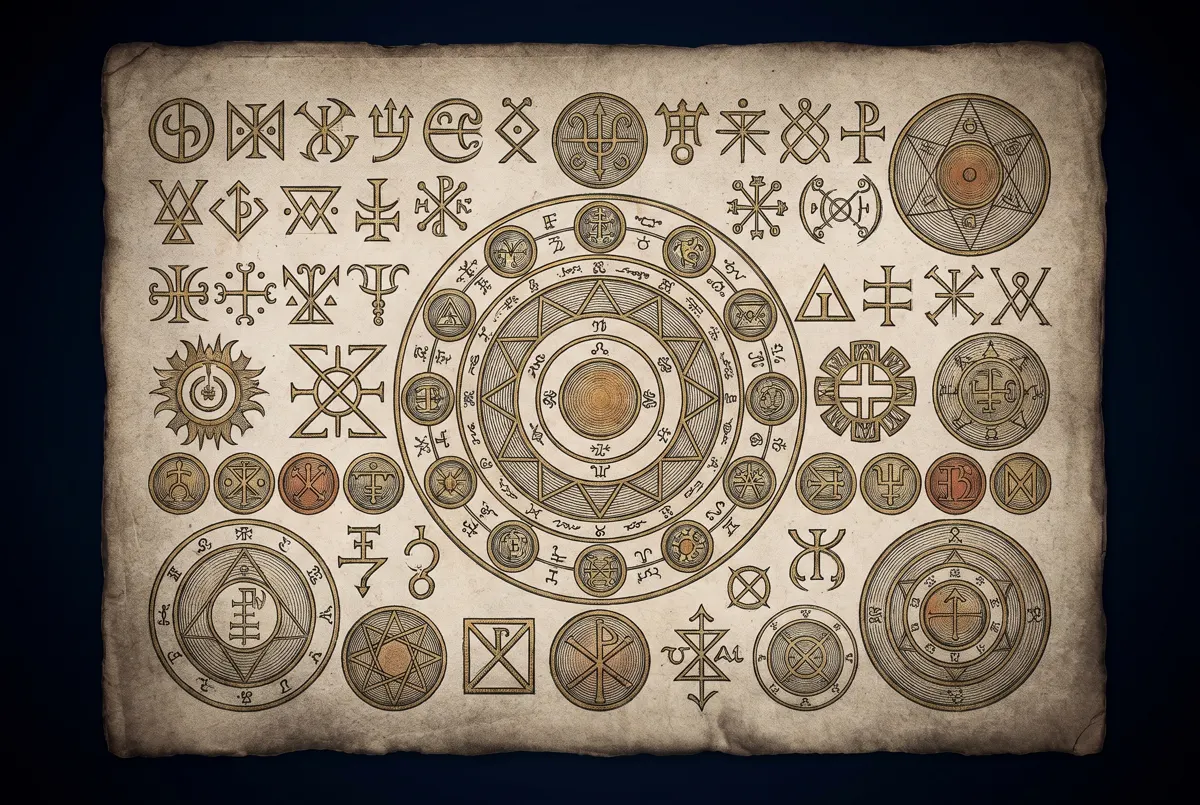
A conceptual orientation, not an exact historical reproduction of every mark or seal.
What does your own chart say about you?
Choose love, work or purpose. Your reading is written from your chart. Your reading uses your own birth details.
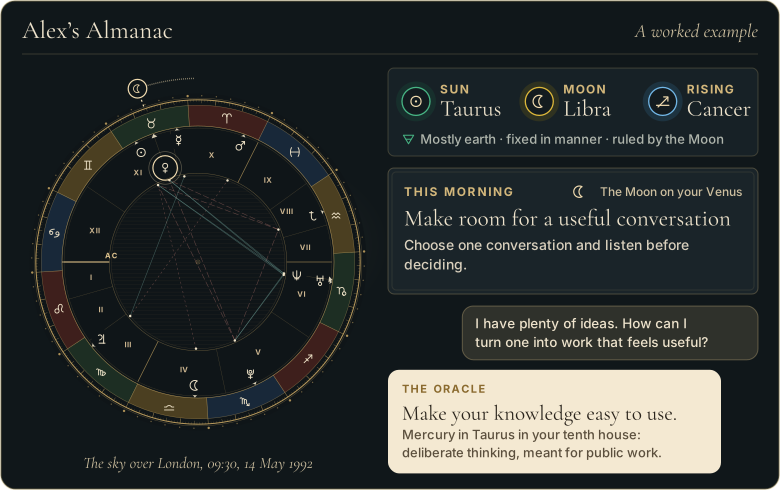
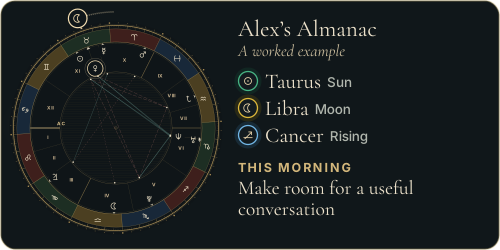
Walk through Alex’s whole example first
 The Road of AgesSee the turning points of your whole life, from your birth date
See your road's shape
The Road of AgesSee the turning points of your whole life, from your birth date
See your road's shape
Prefer to explore first?
 The Road of AgesThe turning points of your whole life, from your own chart
Walk my road
The Road of AgesThe turning points of your whole life, from your own chart
Walk my road
Free, by email
Your daily Almanac letter
One short letter at 7 each morning: the day’s theme read for your own chart, and one thing to do with it.
How the vesica piscis is constructed
Choose two points A and B separated by a distance r. Draw a circle of radius r centered on A and another of the same radius centered on B. The arcs meet at two points, forming a symmetrical lens. Because A, B, and either intersection are each separated by r, they make an equilateral triangle. The line through the intersection points is the perpendicular bisector of AB.
Applying the Pythagorean theorem to half that triangle gives a half-chord of √3r/2, so the full common chord is √3r. The lens extends only r along the line between the farthest points of overlap, producing the familiar √3:1 proportion when its long axis is vertical. These relationships are consequences of equal circles and center spacing, not dependent on any religious interpretation.
Vesica piscis, mandorla, and fish shape
The Latin phrase is conventionally translated as “bladder of a fish,” a reference to the pointed oval’s resemblance to a fish bladder. In art history, a similar almond-shaped aureole surrounding a sacred figure is often called a mandorla, Italian for almond. The terms overlap in shape but are not interchangeable in every context: vesica piscis emphasizes the geometric intersection, while mandorla describes an iconographic frame or field of radiance.
A fish outline can also be made from two intersecting arcs, which encourages association with the Christian ichthys. Shape resemblance alone does not prove a direct line of transmission. When examining an artifact, use its date, region, material, adjacent figures, inscription, and documented religious setting. Calling every pointed oval a vesica piscis can erase the object’s own artistic vocabulary.
Use in art, diagrams, and design
Medieval and Byzantine Christian art frequently places Christ or the Virgin within an almond-shaped mandorla to mark glory, transcendence, or a threshold between earthly and heavenly realms. Intersecting-circle geometry also appears in decorative construction, compass work, Gothic tracery, diagrams, and modern logos. It is easy to generate with an unmarked straightedge and compass, which helps explain its practical appeal to designers.
The figure can serve as the first step in building an equilateral triangle, hexagon, or larger network of equal circles. Modern sacred-geometry writers often read the overlap as union, generation, polarity, or a womb-like opening. Those associations can be meaningful, but they should be identified as interpretations. A geometric construction recurring in several traditions does not by itself demonstrate a single hidden doctrine shared by all of them.
How to evaluate symbolic and historical claims
First check whether the diagram actually meets the definition: equal radii and centers separated by one radius. Two arbitrary overlapping circles make a lens but not necessarily the canonical vesica proportion. Next distinguish a measured design from a visual approximation. Photographs with perspective distortion, damaged masonry, and selective line overlays can make an intended ratio difficult to establish.
Then ask for dated evidence connecting the maker to the proposed meaning. Claims that the vesica encodes every cathedral, goddess tradition, cosmic secret, or biological form often move from resemblance to certainty without documentation. Strong interpretation keeps three levels apart: provable geometry, documented use in a particular culture, and a present-day symbolic response. Appreciating the figure does not require collapsing those levels.
A lecture on this, free to read

Sources and editorial method
Research and editorial references used for this page include:
- Wolfram MathWorld: Vesica Piscis - Geometric definition and formulas for the standard two-circle intersection.
- The Metropolitan Museum of Art: Mandorla collection records - Museum objects and catalog descriptions showing mandorla use in historical art.
These references support the factual, historical, textual, or interpretive claims on this page. Interpretive traditions are identified as such, and factual claims are kept separate from symbolic claims.
Related reading
Read sacred geometry with restraint
A definition tells you what it is; your own birth chart tells you what it means for you. The Oracle casts your real chart and answers for your love, your work, and your year ahead, in conversation. It opens with the 7-day Seeker trial.
Speak with the OracleYour year, written once from your chart alone: the Cosmic Codex reads the whole of it, month by month. Open the Cosmic Codex
More in Sigils, Seals & Symbols
- Archangel Sigils
- Circle
- Dragon Symbol
- Hexagram
- Maltese Cross
- Planetary Seals
- Seal of Solomon
- Staurogram
From the reference page to your own chart
Every word here
is in your own chart.
- A personal reading about love, work or purpose, written from your chart
- A practical next step to consider
- It opens with 7 days free, with the AI Oracle and daily guidance
$0 today, then $12/month after 7 days. Cancel anytime.
Common questions
Is every pointed oval a vesica piscis?
No. The strict figure comes from two equal circles whose centers are one radius apart. A mandorla or decorative lens may resemble it without following that construction.
Why does √3 appear in the geometry?
The two centers and either arc intersection form an equilateral triangle. Its altitude is √3/2 of the radius, and doubling that altitude gives the common chord √3r.
Is the vesica piscis exclusively Christian?
No. Intersecting circles are a general geometric construction. Christian art gives the related mandorla important uses, but meanings must be established object by object.
Free, by email
The Almanac, in your inbox at 7
One short letter at 7 each morning: the day’s theme read for your own chart, and one thing to do with it.
