
The ankh and the cross
Egypt’s sign for life, the Coptic cross that kept its loop, and the chi-rho of Constantine.
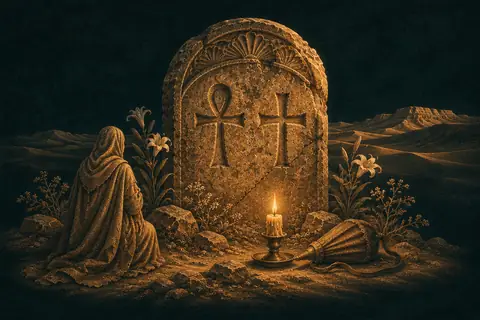
What did the ankh mean in Egypt, and how is it tied to the chi-rho and the cross?
What it is
The ankh is a cross with a loop for its upper arm. In Egyptian writing it is the sign for the word life, and in temple reliefs the gods hold it to the nose of the king, giving him breath, often with the djed, the pillar that writes stability. What object it first pictured is not known; a sandal strap, a knot and a mirror have all been proposed. When Egypt became Christian its church kept the shape as a cross with a handle, and Coptic Christians use it still. A different early Christian sign is the chi-rho, made of the first two letters of the word Christ in Greek, which the emperor Constantine set on the standards of his army.
The teaching
As the lore of the sign in Egypt's temples and the early Church teaches it.
The sign for life
The ankh is a T with a loop above it, and in Egyptian writing it spells the word ankh, life. The same sounds made the words for a mirror and for a bouquet of flowers, so the sign wrote those too, and mirrors and mirror cases were made in its shape. Placed after the name of a king, the words ankh, wedja, seneb wished him life, soundness and health, and the gods are said to give the king all life and dominion.
Life, in Egyptian teaching, is a force that flows through the world from the gods and is renewed each dawn as it was at the first creation. The ankh is that force made visible, and to hold it is to have the power to give it: so the gods hold it, and the king receives it from them.
How the gods give it
In the temple pictures a god holds the ankh by its loop and gives it: the god sets it to the nose of the king, offering him the breath of life. Where water is poured over the king to purify him, the stream is drawn as a chain of ankhs, for water is life too, and fans, the bringers of air, may be carried by ankh signs given arms.
As an amulet it was worn by the living and laid with the dead, most often in blue or green faience, the colours of life and of growing things.
Ankh, djed and was
The ankh is often set in a row with two other signs. The djed is a pillar with four bars across its top, the backbone of Osiris, and means stability. The was is a sceptre with a forked foot and a head like an animal's, and means dominion and power. Set together over the sign for all, they say all life, stability and dominion, the gifts the gods give the king. Beside them often stands the tyet, the knot of Isis. On one of the oldest pieces, a stone dish of the First Dynasty, the ankh is held in the two raised arms of the ka, the life force of a person: life embraced by the power that keeps it.
The cross with a handle
When Egypt became Christian the sign was kept as the crux ansata, the cross with a handle, its loop drawn round where the Egyptian one was shaped like a drop. Coptic Christians wove it into cloth, cut it on gravestones and drew it in their books. The old sign of life became the cross that gives life, and its meaning moved with it: the life to come.
The chi-rho
The chi-rho joins the first two letters of Christ in Greek, chi, written like an X, and rho, written like a P, one laid over the other: the name of Christ made a sign. Set inside a wreath of victory it means Christ's triumph over death. Flanked by alpha and omega, the first and last letters of the Greek alphabet, it gives the words of Revelation: I am Alpha and Omega, the beginning and the ending, saith the Lord.
Eusebius tells that Constantine saw a cross of light above the sun with the words by this, conquer, in Greek en touto nika, which the Latin West remembers as in hoc signo vinces. Set on a pole above a banner, the monogram made the labarum, the standard under which his army marched.
The staurogram
The staurogram lays the Greek tau, T, over the rho, P, and was used in the oldest gospel books to shorten the words for the cross and for crucifying. Seen whole, it can be read as a picture of the crucified: the T for the cross, the loop of the rho for his head. In shape it stands between the ankh and the cross with a handle, and early Christians used it beside the chi-rho as a sign of Christ.
The tau and the other forms
The tau cross, a plain T, takes its meaning from Ezekiel's vision, in which a mark is set upon the foreheads of the men that sigh and that cry for the abominations done in the city, so that they are spared; in Hebrew the mark is the letter tav. Saint Francis signed his letters with it. The Latin cross has a long foot and the Greek cross four equal arms, and the iota chi, an I laid over an X, joins the first letters of Jesus Christ.
How it is practised
Go and look at how the sign is held. In a museum's Egyptian rooms, find three reliefs with an ankh and note who holds it and toward whom: it is given, never brandished. Then find a Coptic stone or cloth with the looped cross and compare the shapes. For the chi-rho, look at a coin of Constantine's sons or an early Christian sarcophagus and see how the two Greek letters are laid over each other. Keep a page of small sketches with a date and a place under each, and add two later forms: the Cross of Saint Peter, a plain cross turned head down, and the fleur-de-lis, the lily of the French kings. The forms of the cross are easiest to learn with a pencil in the hand.
Where it comes from
The ankh is written from the earliest dynasties, about 3000 BCE, and is carried by gods and kings for three thousand years after. Church historians of the fifth century tell that when the temple of Serapis at Alexandria was pulled down in 391 CE, cross-shaped signs were found cut in its stones, and Christians and pagans both claimed them. Coptic textiles and gravestones of the following centuries show the looped cross. The chi-rho is tied to the year 312, when Constantine fought at the Milvian Bridge; Lactantius and Eusebius, writing within a generation, give differing accounts of the sign he saw or dreamed.
What is known, and what is not
The meaning of the ankh as life is certain from Egyptian writing; its origin as an object is not, and Egyptologists disagree. The story of the crosses in the temple of Serapis comes from Christian writers and cannot be checked against the stones. That Constantine used the chi-rho is documented on his coins and standards from the years after 312; what he saw before the battle rests on two accounts that do not match. The modern wearing of the ankh as jewellery dates from the 1960s.
Its words
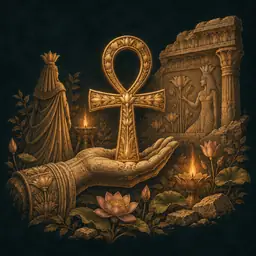 Ankh
- The looped cross that writes the word life in Egyptian, held by gods to the nose of the king and kept by the Coptic church.
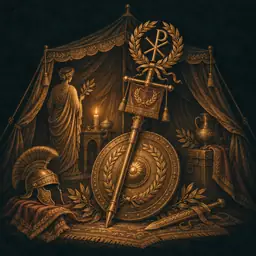 Chi-rho
- A monogram of the first two Greek letters of the word Christ, set on the standards of Constantine’s army from 312 CE.
- Djed
- An Egyptian pillar with four bars near its top that writes the word for stability, later called the backbone of Osiris and worn as an amulet by the dead.
- Cross of Saint Peter
- A plain cross turned upside down, after the tradition that Peter was crucified head downward; only in recent times also a sign against the Church.
- Fleur-de-lis
- A lily of three petals tied by a band: the badge of the kings of France, a sign of the Virgin Mary, and under French slave law a brand.
Ask the Oracle further
What object was the ankh first a picture of?What did Constantine see before the battle, and is the chi-rho older than him?
Before you practise
A symbol has the meanings people have given it over time, and the Oracle tells them in order, with whose they were. Seeing a symbol proves no secret membership and no hidden hand. No sign protects, attracts or harms by being worn or drawn.
Its other branches
The pentagramThe all-seeing eyeThe ouroborosThe caduceus and the rodThe six-pointed starThe swastika, in two partsBaphometThe whole artSearch the tree

