
The six-pointed star
Star of David, Seal of Solomon and the Hindu shatkona: one figure with three histories.
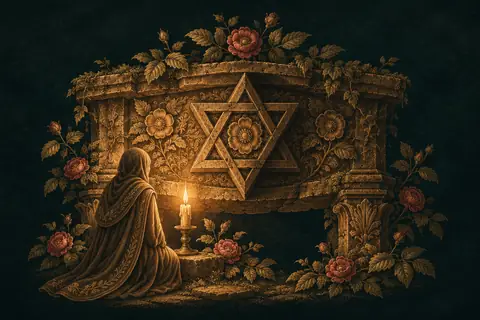
Where does the hexagram come from, as the Star of David and as the Seal of Solomon?
What it is
The hexagram is a six-pointed star made of two triangles, one pointing up and one down. As a pattern it is found in many lands with no shared meaning. Three houses have made it their own. In Hindu and Buddhist diagrams it is the shatkona, the union of two principles. In Jewish and Islamic legend a star of five or six points is the Seal of Solomon, the signet with which the king was said to command demons. And since the seventeenth century it has grown into the Star of David, in Hebrew the Shield of David, the common emblem of the Jewish people. One figure, then, with three histories.
The teaching
As the lore of each faith and school that drew the star teaches it.
Two triangles
The hexagram is two equal triangles, one pointing up and one pointing down, laid across each other so that their six points are evenly spaced round a circle and a hexagon is left at the centre. With compasses it is drawn by stepping the radius six times round a circle and joining every other point. Unlike the pentagram it cannot be drawn in one line: it is always two figures made one, and every reading of it is a reading of that union.
The Shield of David
In Hebrew it is Magen David, the Shield of David, and the name is a name of God: in the blessing said after the reading from the Prophets, God is praised as the Shield of David, and the Psalms call the Lord a shield to all who trust in him. Jewish law gives the star no fixed doctrine. It is the emblem of the Jewish people, on synagogues and gravestones, prayer books and wedding canopies, and on the flag of Israel, and it is owed the respect due to a people's emblem.
The Seal of Solomon
Legend gives King Solomon a ring by which he ruled the demons. In the Testament of Solomon the king prays for help against a demon that torments a young workman, and the archangel Michael brings him a ring with a seal cut in its stone; with it Solomon binds demon after demon, learns each one's name and power, and sets them to work on the Temple.
The Talmud tells that Solomon's ring was engraved with the Divine Name, and that with it he caught Ashmedai, the king of demons, who later tricked him out of it and flung him far from his kingdom. Muslim tellers say the ring held the greatest Name of God and gave Solomon command of the jinn and the speech of animals; a jinn stole it and sat forty days on the throne, until the ring fell into the sea, a fish swallowed it, and Solomon found it again in a fish. Later tellers add that the ring was made of brass and iron, and that Solomon sealed his commands to the good spirits with the one and to the evil with the other. The seal on the ring is drawn as a star of five points or of six.
The shatkona
In Hindu diagrams the six-pointed figure is the shatkona. The upward triangle is Shiva, pure consciousness, the male, fire rising; the downward triangle is Shakti, nature and power, the female, the yoni. Interlaced, they are the union from which all that exists comes forth. Their son is Skanda, also called Kumara and Murugan, who has six faces, and six is his number; the shatkona is his sign.
In the tantric books of the body the same figure stands in the heart: the heart lotus, Anahata, has twelve petals, and within it a six-pointed star the colour of smoke marks the region of air. In a yantra the shatkona is drawn with a point, the bindu, at its centre, the deity in its unmanifest form.
The hexagram of the magicians
The alchemists drew fire as a triangle pointing up and water as a triangle pointing down; air is the fire triangle crossed by a bar, and earth the water triangle crossed by a bar. Laid together, the two triangles of the hexagram hold all four elements, and they picture the union of opposites, the rising and the descending, what is above and what is below. Readers of the Emerald Tablet saw in it the tablet's first teaching, that which is below is like that which is above.
The Golden Dawn set the seven planets on the figure, one at each point and the sun at the heart, and its magicians traced hexagrams to call on and to banish the planetary forces, as they traced pentagrams for the elements. In the lesser ritual of the pentagram the magician stands in the column of the six-rayed star.
One figure, three readings
The setting gives the reading. On a synagogue, a gravestone or the flag of Israel the figure is the Star of David. In a yantra with a point at its heart it is the shatkona of Shiva and Shakti. On a ring, an amulet or the page of an old book of ritual it is the Seal of Solomon, or the magician's figure of the elements and the planets. The same two triangles, each time, are three different things.
How it is practised
Read the figure by its setting. On a synagogue, a gravestone or the flag of Israel it is the Star of David, and it is owed the respect due to a people's emblem. In a yantra drawn with a point at its centre it is the shatkona. On a ring or an amulet in an old book of ritual it is the Seal of Solomon. Look up the carved frieze at Capernaum, where the star sits among other ornaments, to see it before it carried any of these meanings. Note also where it is absent: no such star is described in the Hebrew Bible.
Where it comes from
A Hebrew seal of the seventh century BCE and the carved stones of the synagogue at Capernaum show the figure as ornament. Medieval Jewish and Muslim amulets call both stars the Seal of Solomon. A Karaite book of the twelfth century names a Shield of David without giving its shape; the name is surely tied to the six-pointed star in the fourteenth. Gershom Scholem showed that it was the badge of the community of Prague from that century, spread from there in the seventeenth and eighteenth, and became general in the nineteenth, when Jews sought a sign to stand beside the cross. The Zionist congress of 1897 put it on its flag. From 1939 the Nazi state forced Jews to wear it as a yellow badge, and in 1948 it was set on the flag of Israel.
What is known, and what is not
The late rise of the Star of David is well documented, chiefly in Scholem's essay of 1949, and is accepted by historians; it takes nothing from the emblem's standing today. The legend of Solomon's ring is told in the Testament of Solomon, a work of the early centuries CE, and by later Arabic writers; no ring exists. The claim that the six-pointed star is in origin a sign of sorcery, sometimes used to smear the Jewish emblem, is false: the figure was an ornament in synagogues, churches and mosques alike.
Its words
 Hexagram
- A six-pointed star made of two interlaced triangles, found as an ornament in many lands and given different meanings in each.
 Star of David
- The six-pointed star as the emblem of the Jewish people, in Hebrew the Shield of David; common as such only since the seventeenth century.
 Seal of Solomon
- The signet with which legend says King Solomon commanded demons; the name is given to five-pointed and six-pointed stars alike.
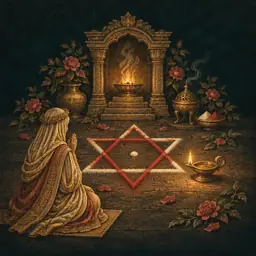 Shatkona
- The six-pointed figure of Hindu sacred diagrams: an upward triangle for Shiva and a downward one for Shakti, interlaced.
Ask the Oracle further
When did the hexagram become the Star of David?What is the Seal of Solomon, and did it have five points or six?
Before you practise
A symbol has the meanings people have given it over time, and the Oracle tells them in order, with whose they were. Seeing a symbol proves no secret membership and no hidden hand. No sign protects, attracts or harms by being worn or drawn.
Its other branches
The pentagramThe all-seeing eyeThe ouroborosThe caduceus and the rodThe ankh and the crossThe swastika, in two partsBaphometThe whole artSearch the tree

