
The swastika, in two parts
An old sign of good fortune across Asia, and from 1920 the badge of a murderous party.
What is the history of the swastika, in Asia and in twentieth-century Europe?
What it is
The swastika is a cross with its four arms bent at right angles. Its history has two parts that must be kept apart. For thousands of years, and to this day, it is a sign of good fortune and well-being in Hindu, Buddhist and Jain use, drawn on doorsteps, account books, temples and wedding invitations across Asia. The word itself is Sanskrit and means roughly that which brings well-being. From 1920 it was also the badge of the Nazi party of Germany, and from 1933 to 1945 of a state that murdered six million Jews and millions of others. In the West, outside the homes and temples of those faiths, it has not been possible to show it innocently since.
The teaching
As the Hindu, Buddhist and Jain lore of the sign teaches it.
The name and the shape
The swastika is a cross whose four arms are bent at right angles, all the same way. Its name is Sanskrit: svasti, well-being, from su, good, and asti, it is; the swastika is the mark of it is well, the sign that brings well-being. In Hindu use the arms most often turn to the right, clockwise, and the form turned the other way is sometimes called the sauvastika. Greek ornament knew it as the gammadion, four gammas joined at the foot, and English heraldry as the fylfot.
In Hindu homes and temples
In Hindu use the swastika is a blessing on beginnings. It is drawn at the threshold and on the door, on the first page of a new account book at Diwali, on wedding invitations and on the ground in coloured powder, and it is marked at the start of rites, often with Ganesha, the lord of beginnings who removes obstacles. Turning to the right, it follows the course of the sun across the sky of India, rising in the east, passing south at noon and setting in the west, and so it stands for the sun, for prosperity and for good fortune.
The left-turning form is used less. It is tied to the night, and in tantric traditions to the goddess Kali. Teachers read the four arms in many ways: as the four directions, the four Vedas, the four aims of life and the four stages of life.
In Jain teaching
For Jains the swastika is the sign of Suparshvanatha, the seventh of the twenty-four ford-makers, and every Jain temple and holy book carries it; rites often begin and end with it, drawn in grains of rice around the altar. Its four arms are the four states in which a soul can be born as it turns in the round of rebirth by its karma: heavenly beings, human beings, beings of hell, and animals and plants.
Above it in the Jain emblem stand three dots, the three jewels of right faith, right knowledge and right conduct, which make the straight path out of that round; and above them a crescent with a dot, the siddhashila, the place beyond the three worlds where freed souls dwell for ever. Read upward, the emblem is the whole teaching: the round of births, the path, and release.
In Buddhist use
In Buddhism the swastika marks the Buddha's footprints, and it is set on the chest, the palms and the soles of his images, where it is read as the seal of his heart and as the turning of his teaching. In China it became a written character, wan, ten thousand, meaning all things and boundless good fortune, and in Japan, as the manji, it marks Buddhist temples on maps and appears in the crests of old families. In Tibet the Bon religion keeps the left-turning form, the yungdrung, the sign of what is everlasting.
The badge of 1920, and the claim it carried
The second part of the sign's history is a theft. In 1920 the Nazi party of Germany made a black swastika in a white disc on red its badge, and its leader explained the colours: red for the party's social idea, white for its nationalism, and the hooked cross for the struggle for the victory of the Aryan man, a struggle he declared to be against the Jews. Under that badge the Nazi state murdered six million Jews and millions of others.
The claim behind the badge was that a white Aryan race of masters had made all civilisation, with the swastika as its ancient mark, and that other peoples, above all the Jews, were its enemies. It came from nineteenth-century writers who took Aryan, a name that ancient peoples of Iran and India gave themselves and that scholars used for a family of languages, and made it the name of a race, and who read the sign dug up at Troy as that race's badge.
Every part of it is false. A family of languages is not a bloodline, and there is no Aryan race. The swastika was drawn by peoples of every kind, from Ukraine to the Indus to the Americas, long before any such race was imagined, and its living home is in the faiths of Asia, which never knew the doctrine. The doctrine itself ended in genocide.
How it is practised
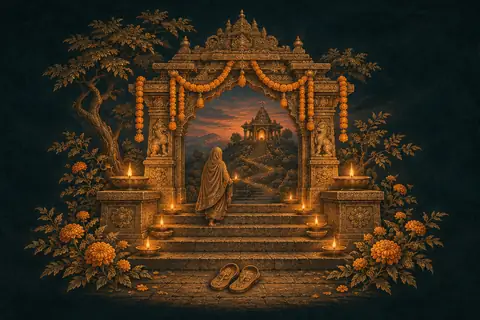
The practice is to hold both parts in mind and to let neither erase the other. Met on a temple, a shop or a doorstep in India, Nepal or Japan, or in a Hindu, Buddhist or Jain home anywhere, the sign is a blessing, and those who use it are owed the plain understanding that it is theirs and far older than its theft. Met anywhere else in Europe or America on a thing made since the 1930s, it is read as the badge of the Nazi party and of its crimes. The house does not show the sign on this page; the picture here is a temple doorway.
Where it comes from
Hooked crosses are found on a carved ivory from Mezine in Ukraine, many thousands of years old, on pottery of the ancient Near East, on seals of the Indus cities, and on Greek, Roman, Celtic and Native American work. When Heinrich Schliemann dug the sign up at Troy in the 1870s, German nationalist writers declared it the mark of an Aryan race. Before the 1930s it was also a common luck charm in Europe and America, used by breweries, scout troops and air forces. The Nazi party adopted it in 1920 and made it a German flag in 1933 and the only one in 1935. Germany has banned its public display since the war, except in teaching, research and art.
What is known, and what is not
Both histories are fully documented. The Asian use is continuous and living. The racial theory that carried the sign into German politics, that of an Aryan master people, is false, and what was done under it is the most fully recorded crime of the twentieth century. The idea that the direction of the arms separates a good sign from an evil one does not hold: both directions occur in Asian use. Whether the swastika can ever be shown again in the West is argued in good faith by Hindu, Buddhist and Jewish writers.
Its words
 Swastika
- A cross with bent arms: for millennia and still a sign of good fortune in Asia, and from 1920 the badge of the Nazi party.
Ask the Oracle further
What does the swastika mean in Hindu, Buddhist and Jain use today?How did the swastika pass from a luck charm to a party badge in 1920?
Before you practise
A symbol has the meanings people have given it over time, and the Oracle tells them in order, with whose they were. Seeing a symbol proves no secret membership and no hidden hand. No sign protects, attracts or harms by being worn or drawn.
Its other branches
The pentagramThe all-seeing eyeThe ouroborosThe caduceus and the rodThe ankh and the crossThe six-pointed starBaphometThe whole artSearch the tree

