
The all-seeing eye
A church sign of Providence that reached a seal in 1782 and a banknote in 1935.
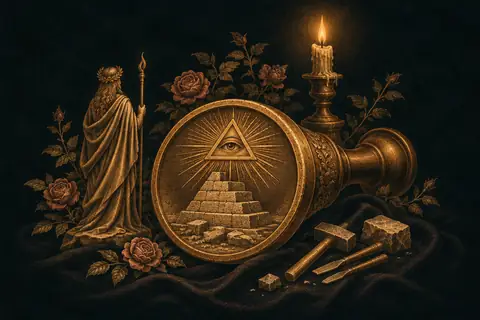
What is the all-seeing eye, and how did the Eye of Providence come onto the dollar bill?
What it is
The eye that sees everything is drawn in several forms that are often confused. The oldest famous one is the Eye of Horus, the falcon god's eye of Egyptian myth, torn out and made whole again, and worn as an amulet of wholeness; it is not the Eye of Ra, the sun god's power sent out as a goddess. The hamsa, a hand that often has an eye in its palm, is carried across North Africa and the Middle East by Jews and Muslims alike against the envious glance. The Eye of Providence, an eye in a triangle surrounded by rays, is a Christian picture of God's watchful care. It is this last one that sits above the pyramid on the Great Seal of the United States and on the dollar bill, and that many people now call the all-seeing eye.
The teaching
As the lore of the eye in Egypt, the Church and the lodge teaches it.
The Eye of Horus
In Egyptian teaching the sky god Horus has the sun for his right eye and the moon for his left. In his long fight with Set for the throne of Osiris, Set tore out the left eye and broke it, and Thoth, the god of wisdom, or in other tellings Hathor, made it whole again. The healing was called the filling of the eye, and it was seen each month as the moon waxed from nothing to full. So the eye that is drawn is the wedjat, the sound one: the eye that was hurt and made whole.
It is drawn as a human eye and brow with the markings of a falcon's cheek beneath: one line falling straight down and one curling into a spiral. As an amulet of faience, glass, gold or stone it was worn by the living and laid with the dead, and pairs of eyes were painted on the left side of coffins, where the body was turned to face, so that the dead could look out.
Horus gave his restored eye to his dead father Osiris, who ate it and lived again, and this became the pattern of every offering: in the temples any gift laid before a god could be called the Eye of Horus.
The hamsa and the envious eye
The hamsa, Arabic khamsa, five, is an open hand with its fingers together, often drawn the same on both sides so that each edge has a thumb, and often with an eye in the palm. It answers an old belief of the Mediterranean and the Middle East, that an envious look can harm, and that a sign which looks back turns the look aside. It is hung by doors, worn at the neck and painted on walls, often in blue, with the eye bead, the nazar, beside it.
Each faith that uses it names it in its own way. Muslims call it the Hand of Fatima, the Prophet's daughter, and in Shia devotion its five fingers are read as the five of the Prophet's household: Muhammad, Ali, Fatima, Hasan and Husayn. Jews call it the Hand of Miriam, the sister of Moses, and read it with the strong hand by which God brought Israel out of Egypt. Levantine Christians call it the Hand of Mary.
The Eye of Providence
The Christian eye is God's: an open eye in a triangle, the triangle for the Trinity of Father, Son and Holy Spirit, surrounded by rays of glory and often by clouds. It pictures Providence, God's watchful care over the world and every soul in it, as the Psalm has it: Behold, the eye of the LORD is upon them that fear him, upon them that hope in his mercy. It stands over altars, in the vaults of churches and on the first pages of devout books.
The eye of the lodge, and the square and compasses
Freemasonry set the eye among the emblems explained to a Master Mason, as a reminder that the Supreme Being, whom sun, moon and stars obey, sees into the inmost recesses of the heart and will reward each according to their merits. It is a lesson in conduct addressed to the mason himself.
The lodge's chief emblem is the square and compasses, the builder's two tools laid one across the other. The old lectures give their lesson plainly: the square, to square our actions; the compasses, to circumscribe and keep us within bounds with all mankind. In many lodges the points of the compasses lie under the square in the first degree, one shows above it in the second and both in the third, as the member rises; in English-speaking countries a letter G often stands between them, for God or for Geometry.
The reverse of the Great Seal
The reverse of the Great Seal of the United States is read part by part. An unfinished pyramid of thirteen courses stands for the thirteen states, with the year 1776 in Roman numerals on its base. Above it, at the zenith, is the eye in a triangle within a glory. Over all runs ANNUIT COEPTIS, he has favoured our undertakings, and beneath, NOVUS ORDO SECLORUM, a new order of the ages, both adapted from Virgil.
Charles Thomson, who finished the design, explained it to Congress himself in 1782: "The pyramid signifies Strength and Duration: The Eye over it & the Motto allude to the many signal interpositions of providence in favour of the American cause. The date underneath is that of the Declaration of Independence and the words under it signify the beginning of the new American Æra, which commences from that date."
Telling the eyes apart
The marks tell them apart. A falcon's cheek line under the eye is Egyptian, the wedjat. An eye in an open hand is the hamsa. An eye in a triangle with rays is Providence: in a church it is God's care, over a pyramid it is the Great Seal, and set among the builder's tools it is the lodge's reminder. Each was made to remind its own people of a care that watches over them.
How it is practised
To read an eye, start with its frame. An eye with a falcon's cheek marking is Egyptian. An eye in the palm of a hand is the hamsa. An eye in a triangle with rays is the Eye of Providence, and before 1797 it is a sign of Providence, in churches and on state seals, and no official emblem of the lodges. Look for it where it was first at home: over altars, on the opening pages of devout books, on old coins and medals. Then look at the Great Seal itself and read the two Latin mottoes on its reverse with a dictionary; neither speaks of ruling the world. The exercise is to tell the three eyes apart at a glance.
Where it comes from
The Eye of Providence appears in European church art from the sixteenth and seventeenth centuries, the triangle standing for the Trinity. In 1776 the artist Pierre Eugène du Simitière proposed it for the American seal, and the design adopted in 1782 was finished by Charles Thomson and William Barton, neither of them known to have been a Freemason. Some lodges already used an eye as an ornament, but it had no official place among their emblems, beside the square and compasses, until a handbook of 1797 set it there. The same eye heads a famous print of the French Declaration of the Rights of Man, made in 1789. It reached the one-dollar bill in 1935.
What is known, and what is not
The committees, sketches and dates of the Great Seal are preserved and published by the State Department, and they show no lodge at work in the design. That the eye on the dollar marks a hidden ruling group is a claim without documents: the eye was a common sign of Providence when the seal was made. For the Eye of Horus, the old teaching that its parts wrote the fractions of a grain measure is now doubted by Egyptologists. Amulets against the evil eye are a living custom, and nothing shows that they turn anything away.
Its words
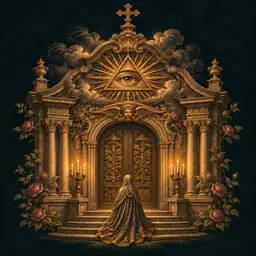 Eye of Providence
- An eye in a triangle surrounded by rays: a Christian picture of God’s watchful care, set on the Great Seal of the United States in 1782.
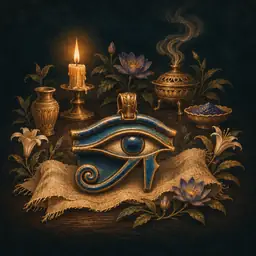 Eye of Horus
- The Egyptian eye with a falcon’s cheek markings, torn out and made whole in the myth, and worn as an amulet of wholeness.
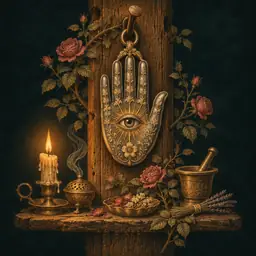 Hamsa
- A hand-shaped amulet, often with an eye in its palm, carried by Jews and Muslims across North Africa and the Middle East.
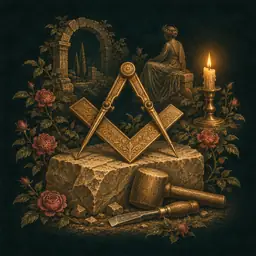 Square and Compasses
- Two stonemason’s tools laid one over the other, the emblem of Freemasonry since the eighteenth century.
- Eye of Ra
- The power of the Egyptian sun god sent out as a goddess, fierce or gentle, and drawn as a sun disc, a rearing cobra or an eye.
Ask the Oracle further
Is the Eye of Providence on the Great Seal a lodge sign or a church sign?How do I tell the Eye of Horus, the hamsa and the Eye of Providence apart?
Before you practise
A symbol has the meanings people have given it over time, and the Oracle tells them in order, with whose they were. Seeing a symbol proves no secret membership and no hidden hand. No sign protects, attracts or harms by being worn or drawn.
Its other branches
The pentagramThe ouroborosThe caduceus and the rodThe ankh and the crossThe six-pointed starThe swastika, in two partsBaphometThe whole artSearch the tree

