
The pentagram
A Greek sign of health, a Christian sign of five wounds, and only since the 1850s a star to fear.
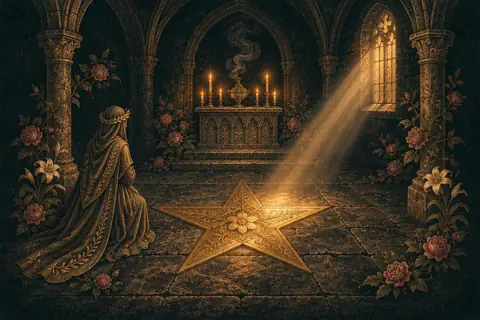
Where does the pentagram come from, and when did people begin to fear it?
What it is
A pentagram is a five-pointed star drawn with five straight strokes in one unbroken line. It is among the oldest figures people have drawn, and almost every age has given it a different meaning. For Greek followers of Pythagoras it was a sign of health. For medieval Christians it could stand for the five wounds of Christ. Ritual magicians of the Renaissance used it as a guard, and modern witches set it in a ring as the pentacle, a sign of the four elements and the spirit, often beside the triple moon of their Goddess. The reading most people now know, a point-down star as a mark of evil, is the youngest of them all.
The teaching
As the line of its readers from Gawain's poet to the Golden Dawn teaches it.
The figure and its one line
The pentagram is drawn with five straight strokes in one unbroken line that ends where it began, which is why the medieval English called it the endless knot. Each point is an angle of thirty-six degrees. At its heart the lines enclose a smaller pentagon, in which a smaller star can be drawn, and so on without end, and every line is cut by the others in the golden ratio. A ring drawn round it makes what is now called the pentacle.
For the followers of Pythagoras the figure was a sign of health, which they used among themselves as a token and a greeting: to draw it for another was to wish them well.
Gawain's five fives
In Sir Gawain and the Green Knight the star is painted in pure gold on the red of the hero's shield, and the poet stops the story to teach what it means. It is a sign that Solomon set long ago as a token of truth, and the English call it the endless knot, because each line passes over and under the others and none has a beginning or an end.
Its five points stand for five fives in Gawain. He is faultless in his five senses; he never fails in his five fingers; all his trust is in the five wounds that Christ took on the cross; his strength comes from the five joys that Mary had of her child; and his fifth five are the virtues of a knight: generosity, fellowship, purity, courtesy and compassion. Each is linked in another, as the lines of the knot are, with no end at any corner, and none of them ever fails.
The five wounds and the little world
Medieval Christians could read the five points as the five wounds of Christ, in the hands, the feet and the side. The Renaissance magicians read them as a man: Agrippa drew a human figure inside the star with its head at the top point and its hands and feet at the others, to show the body as a little world, built by the same measures and numbers as the great one.
Lévi's rule of the points
Éliphas Lévi made the pentagram the sign of the microcosm, the human being who by mind and will rules the four elements. With one point up it is the spirit set above the elements, the head above the limbs, and then, in his words, it represents the Saviour. With two points up it represents Satan, the goat of the Sabbath: the two upper points are its horns, the side points its ears and the lowest its beard. Turned so, he taught, it becomes a sign of infernal evocation, matter ruling spirit.
For Lévi the star on the brow of his Baphomet, one point upward, is therefore a sign of light. To trace the star, he taught, is to make a sign of command, the will set over the forces of the elements.
The pentagrams of the elements
The Golden Dawn gave each point an element: spirit at the top, water at the upper right, fire at the lower right, earth at the lower left and air at the upper left. A pentagram is traced toward an element's point to call on it, and away from that point to banish it. The pentagram of earth, the one most used, is traced to invoke from the top point down to the lower left, and to banish from the lower left up to the top, then on round the star and back to the start.
The lesser ritual of the pentagram
The order gave its new members one rite to practise daily. Facing east, the magician makes the Qabalistic Cross, touching brow, breast and shoulders with the Hebrew words Ateh, Malkuth, ve-Geburah, ve-Gedulah, le-Olam, Amen: thine is the kingdom, and the power, and the glory, for ever. Then in each quarter a banishing pentagram of earth is traced in the air and a name of God is spoken into it: YHVH in the east, Adonai in the south, Eheieh in the west, AGLA in the north.
Standing with arms outstretched, the magician then names the four archangels: before me Raphael, behind me Gabriel, on my right hand Michael, on my left hand Auriel, for about me flames the pentagram, and in the column stands the six-rayed star. The cross is made again to close. The order taught it as a banishing, a clearing of the place and the mind before other work, and as a daily discipline of concentration.
The pentacle
In the old books of ritual a pentacle is any figure drawn on metal or parchment and carried as a talisman, whether or not it has five points. In modern witchcraft the word means the star within a circle, and the pentacle is one of the altar tools: a flat disc of wood, metal or wax engraved with the star, on which things are set to be blessed. Its five points are read as earth, air, fire, water and spirit, and the ring as the whole that holds them.
Waite gave the star to every coin in his suit of Pentacles, for the four elements in human nature and that by which they may be governed.
How it is practised
The practice here is to look, and to date what is seen. A pentagram on a medieval church, a town seal or a national flag (Morocco added one in 1915) is not the same sign as one on a record sleeve of the 1980s. Ask three things of any example: when was it made, who made it, and what did five-pointed stars mean to those people then. Then notice which way it points, and remember that the direction meant nothing in particular before Lévi. Nothing is worn or drawn for effect. The gain is that an old figure stops being frightening.
Where it comes from
Five-pointed stars are scratched on Mesopotamian tablets from about 3000 BCE. The satirist Lucian, in the second century CE, says the Pythagoreans greeted one another with the figure and called it Health. The poem Sir Gawain and the Green Knight, of the late fourteenth century, puts it on its hero's shield as an endless knot of five virtues (the Buddhist endless knot is another figure, a woven band). Agrippa drew a man inside it in 1533. Only in the 1850s did Éliphas Lévi teach that one point up is good and two points up are a goat's horns. Stanislas de Guaita drew the goat's head into the star in 1897, and the Church of Satan took that drawing as its badge in the late 1960s.
What is known, and what is not
The early uses are documented in tablets, coins and texts, and the Christian reading in the Gawain poem. That the inverted star was a sign of evil before the nineteenth century has no support: historians trace the idea to Lévi. The pentacle is recognised as a religious emblem, and the United States added it to the signs allowed on military headstones in 2007. No study shows that the figure does anything to the person who wears or draws it.
Its words
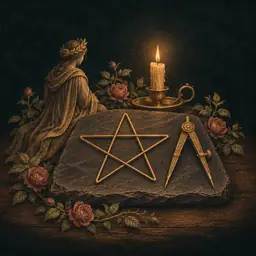 Pentagram
- A five-pointed star drawn with five strokes in one unbroken line: a sign of health to the Pythagoreans, and of many other things since.
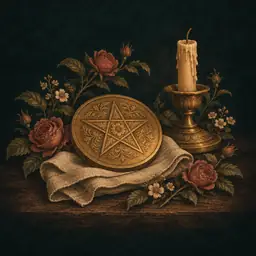 Pentacle
- Today a pentagram inside a circle; in the old books of ritual, any drawn figure carried as a talisman, five-pointed or not.
- Triple Moon
- A full moon between a waxing and a waning crescent, the sign of the Maiden, Mother and Crone in modern Paganism; it dates from the twentieth century.
- Endless Knot
- One band woven through itself into a closed figure, among the Eight Auspicious Symbols of Tibetan Buddhism and read as the way all things depend on one another.
Ask the Oracle further
Did the pentagram mean anything evil before the nineteenth century?What is the difference between a pentagram and a pentacle?
Before you practise
A symbol has the meanings people have given it over time, and the Oracle tells them in order, with whose they were. Seeing a symbol proves no secret membership and no hidden hand. No sign protects, attracts or harms by being worn or drawn.
Its other branches
The all-seeing eyeThe ouroborosThe caduceus and the rodThe ankh and the crossThe six-pointed starThe swastika, in two partsBaphometThe whole artSearch the tree

